Friday, September 14, 2012

August 21, 2012

August 21, 2012

Sydney is built along and around the shore of a massive harbor. As a result the city operates many ferries and water taxis throughout the day. This morning we bought a day pass and took a ferry from our hotel on Darling Harbour around the downtown peninsula, under the Harbour Bridge to Circular Quay, the main hub by the Opera House. We then boarded the Manly ferry that took us to a far eastern suburb on the outer headlands. There we walked across a narrow isthmus to Manly Beach on the Pacific Ocean. It is a picturesque semi-circular beach with a great boardwalk. I bet it is jam packed in the summer with people surfing and playing beach volleyball. Even today it is popular with walkers, joggers, surfers, and winter tourists. It is also lined with distinctive Australian Norfolk Island pines. They are very nice but up close don’t seem to have ordinary pine needles. After strolling and doing some people watching, we decided this is the spot to live if we become Sydneysiders.
We walked to the southern end of the beach and up onto the rocky headlands lining the ocean. The seaside vegetation is very strange; pine trees with flowers, and trees growing corncobs. I continue to be amazed by the unique flora and fauna of Australia. We hiked along the cliff top till we reached Sydney Harbor National Park. On the way back we spotted some Water Dragons (large swimming lizards) sunning themselves on the rocks. We had a fish and chips lunch and took the ferry back to downtown.

We walked up to the Sydney Observatory on a steep hill overlooking downtown. It is an historic old building that was used not for astronomy but to set time to aid navigation. It houses lots of vintage astronomical and navigation instruments and a section on Captain Cook’s initial Pacific voyage on HMS Endeavor. His assignment was to go to Tahiti and make a scientific study of the transit of Venus across the sun. Once done he sailed west intent on finding the mythical continent of Terra Australis Incognita (unknown southern land). Fortunately for our trip he discovered it in 1770.
We then hooked up with a Sydney walking tour at 2:30. It was quite nice and informative. We should have done it the first day. Sydney was the epicenter of Australia’s early history. Having recently lost America, England needed another place to send convicts from their overcrowded prisons. They chose this recently discovered “empty” continent. Eventually gold was discovered here and Brits began begging to be sent here. After spending most of the day walking we cut out of the three-hour tour halfway and go back to our hotel to rest. For dinner we had Hunan Chinese, something we haven’t had since our early days in Chicago. After dinner we took the ferry back over to Circular Quay. This time to see the city night lights. Beautiful!

August 20, 2012

August 20, 2012
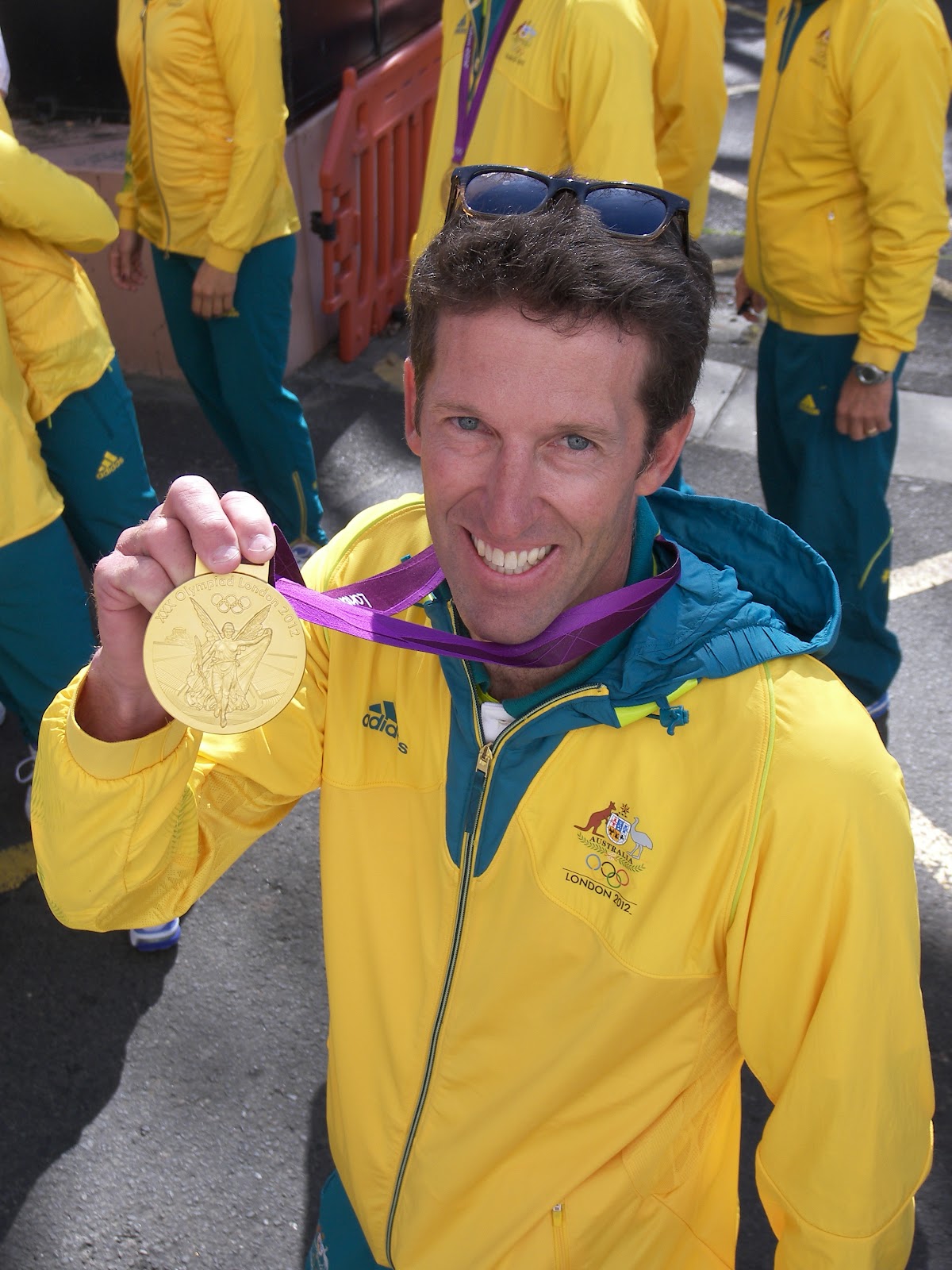
It is a brisk cool morning in Sydney. After spending so much time in Australia’s tropical north, we forgot that it is winter here. We walked toward the historic “Rocks” area of downtown Sydney. On the way we see the streets being prepared for a parade. I tell Aimee it was nice of them to throw a parade for us. She bursts my bubble telling me it is to honor the returning Olympians from London. We take a few pictures of Sydney’s icon, the Opera House, and then watch the parade. It is relaxed and fun. The Olympians stop for photographs, autographs and chats on the way. One lets me touch his gold medal. That is probably the closest I will ever get to one.

Afterwards we stop at the nearby Visitor Center to pick up a map and then walk to Sydney’s other icon, the Harbor Bridge. We walk across the pedestrian portion taking pictures of the harbor. It is easily one of the most beautiful in the world.

Passing a sidewalk café, we spot two Rainbow Lorikeets sitting on a table.  They are brilliant multicolored birds.  We saw one in a zoo lobby outside Cairns and were astounded by their colors.  Who knew they fly around wild here.  One of the Lorikeets repeatedly bent down into a cup of water for a drink.  She must have done this before because she was smart enough to then pull out a sugar packet, and rip it open to satisfy her sweet tooth (or beak).

After a full day of walking we head back to our hotel and have dinner at a pizza joint around the corner on Darling Harbour’s King Street Wharf. It is happy hour and the beers are “cheap”. So far every Australian brew we have tasted has been excellent.

Thursday, September 13, 2012

August 19, 2012

August 19, 2012
This morning we drove back downtown Darwin stopping at the Museum of the Northern Territory. It is part Aborigine art museum, part Australian natural history, and part recollection of the 1974 Typhoon that destroyed most of the city’s houses. Darwin has been a tough place to live. I am not sure how anybody survived the bombings, typhoons, crocodiles and the humidity. The museum was a nice place to spend a couple hours. Unfortunately the only thing they would allow me to photograph was Sweetheart, a huge stuffed crocodile.

Afterwards we turned in the campervan and taxied to the airport. Our driver gave us some of the lowdown on the Aborigines. They make up a third of the Northern Territory population and are delightful people. Unfortunately most don’t work, instead living off welfare and land royalties. No wonder they have so much problems with alcohol and drugs.

I got a window seat for our flight to Sydney. I needn’t have bothered. The Australian interior is flat and boring. We get in late and take a shuttle to our hotel downtown just off the northern end of Darling Harbor. Aimee is glad to be back in civilization again.

August 18, 2012

August 18, 2012

We got up early this morning to finish our tour of Litchfield National Park. Our first stop was the Cascades, a series of small waterfalls in the jungle. Nice but nothing really special. Our next stop is Tolmer Falls. It is a tall waterfall in a narrow canyon with a large plunge pool. Beautiful except the morning sun is in the wrong direction for a good photo; plus no swimming is allowed because it is a sacred spot for the Aborigines. Our third stop is Florence Falls. Like Wangi, it is a twin falls, only smaller and more secluded. I think the plunge pools in Northern Australia are nice because they are deepened during the heavy monsoon downpours. I never expected to have any desire to swim in them; but I can see why Australians rave about their swimming holes. They are very cool. I can’t leave Litchfield without swimming once more. Florence is deep and cold so I don’t venture very far from shore. I wish I had something to help me float.
We did the Litchfield waterfall circuit pretty quick this morning because we luckily have a ranger talk we can join at 10:30am. This one is only offered twice a week. It is at the Magnetic Termite Mound stop. The interpretative ranger gives us the lowdown on termites. Australia clearly has a termite infestation because their mounds are everywhere. Termites have a unique ability to digest complex carbohydrates. We don’t like the ones that eat wood because that might bring our house down. Apparently most of the trees here in the outback are hollow because of wood termites. Now I know why didgeridoos are so common. It is the termites!

Most termites in Australia are actually grass eaters. Since Australia has few grazing animals the termites fill that ecological niche. They build termite mounds to store their food between growing seasons and for protection against fire and flood. Most of the ones we have seen are Cathedral mounds, essentially circular shaped. The mounds in the flood plain in front of us are flat, making it look like a cemetery. Mysteriously they are also all aligned north to south. Scientists are not sure why; they first thought it had to do with the earth’s magnetism but now believe it may be for temperature regulation.

From Litchfield we drove the rest of the way along the Stuart Highway back to the coastal town of Darwin. We parked downtown by the Visitor Center. We didn’t find anything that interested us much so we walked the waterfront stopping at shops and placards along the way. We ended up learning a little history. Australia had its own Day of Infamy. With our Navy in shambles after Pearl Harbor, Japan went on to capture many Southeast Asian ports like Singapore and Manila. In February of 1942, the Japanese bombed Darwin devastating the city. The US lost a destroyer in the raid too. Darwin went on to be a strategic air base for the allies and was bombed repeatedly during WWII.

We also learn that the Stuart Highway we drove through central Australia was the path of the initial telegraph line across the continent linking Adelaide on the south with Darwin on the north. When completed it allowed direct telegraph communication with London in 1872?! I thought this was a misprint but when I later researched the topic, I learned the British were the pioneers in laying submarine telegraph wire across every ocean. They used it to monopolize global trade within their far-flung world empire.

We spent the night at a campground in Darwin and had another delicious meal on the Barbie. This time I grilled chicken shish kabobs. We strolled the campground after dinner. I am amazed at the collection of RVs here. There are no two alike for some reason and many have been modified to survive 4WD roads.

Wednesday, September 12, 2012

August 17, 2012

August 17, 2012
Nitmiluk National Park’s English name is Katherine Gorge. Much of the interior is very hard, flat sandstone a hundred million years old. In this park the Katherine River has carved its way through the rock in a zigzag fashion following fractures in the land.

We want to canoe up the river through the gorge. But since Aimee is still recovering, we opt for the two-hour cruise instead. Since this is the dry season and the water is low, the boat has to stop along the way at a series of exposed rapids. There we walk a few hundred yards to a second boat and cruise the next gorge. Compared to the canyons of the western US, Katherine is not deep but it is pretty. We see little wildlife except for two freshwater crocodiles, the harmless little cousins of the saltie. It is possible to stairstep your way to five more gorges; since the second is supposed to be the most scenic we don’t continue on. Back on dry land we do a short hike to a canyon overlook and then run through the small Visitor Center museum.


Soon after lunch we hit the Stuart Highway north. An hour south of Darwin, we exit and drive to Litchfield National Park. We have gotten several strong recommendations for it, so we make room in the schedule. It is supposed to be a mini Kakadu. Since it is late we immediately head to Wangi Falls at the end of the park road to find a campsite. The campground is full so we pull into what looks like the picnic area parking lot and hope we don’t get kicked out.

We walk several hundred yards to Wangi falls for a quick look. It is a beautiful twin waterfall in an idyllic setting with a massive plunge pool at the bottom. It is so perfect it looks manmade. We take a short walk (that turned into a long one) around the isolated rainforest that hugs the falls. Aimee gets to see the Flying Foxes hanging in the trees. Afterwards I run back to the camper to get my bathing trunks so I can take a swim before dark. Since there are other swimmers, the chances of a Saltwater croc living here are virtually nil. Salties never pass up an easy meal. The water is nice and refreshing and I make it all the way to the falls. That probably was unwise for me since I am not much of a swimmer. I sink and this water is pretty deep.

Back at the camper we finish our transformation into Australians by cooking a steak on the Barbie. Every campground and motel so far has had communal gas BBQs for guests to use. BBQ is an Australian passion.

August 16, 2012

August 16, 2012

From our campground in Kakadu National Park we drove a few miles to Cooinda and bought tickets for the morning Yellow Water Billabong cruise. Billabongs are Australian lakes that expand and contract with the seasons. In the dry season the animals are forced to concentrate in the shrinking billabong. That makes animal sightings more likely. This area is analogous to our Everglades. It is a beautiful sea of floating grass crisscrossed by water channels. Our large pontoon boat can easily navigate the shallow canals.  I want to see Saltwater Crocodiles.  That is not a problem for they are everywhere.  We see lots of smaller females and one large male.  “Salties” are the meaner, big cousins of our alligators.  Signs are posted at most bodies of water warning against going too close.  Salties like to hunt prey that lingers too long at the water’s edge.  They pounce, drag you in, and drown you with a death roll.


Aimee is in heaven; this cruise is a bird lover’s paradise. We have never seen the variety of interesting and colorful birds anywhere else. Our favorites are the Sea Eagle (a Bald Eagle look-alike), the Jesus Bird (walks on water), the Whistling Kite, the Jabiru Stork, and Azure Kingfisher. We also saw plenty of Ibises, Cormorants, Darters, Egrets, and Magpie Geese. Aimee now thinks it truly is Kakadoooo. Plus our Aborigine captain and guide was outstanding. He could steer the boat, spot wildlife in the thicket, and provide a running commentary without losing a beat.

After the cruise we stop at the nearby cultural center to learn about the Aborigine of northern Australia. We thought it was much better done than the more famous one in Uluru. Nonetheless, we found the gift store to be most educational. The sales clerk was a wealth of info. I thought her best comment was about the derivation of the name, didgeridoo. That is not what Aborigines call their musical instrument but what the English thought it sounded like. If you say didgeridoo several times in low baritone, it mimics the musical sound. We ended up buying three boomerangs painted with Aboriginal art from her.

From Cooinda we drove south through the park. The outback was endless and monotonous. Nothing but flat dry grass prairie peppered with skinny trees. We reluctantly passed the turnout to JimJim Falls. It is supposed to be spectacular but like many spots in Australia, it requires a 4WD vehicle and an extra day to visit.

We eventually hit the Stuart Highway that leads south to Alice Springs. We took it partway to the town of Katherine. There we exited and drove to Nitmiluk National Park. Right past the entrance we saw a grass field full of Wallabies, a miniature version of the kangaroo. We spent the night in the park campground where we ran into several of these little creatures begging for food. Because their front arms are so short, they almost look handicapped when they walk around on all fours.


After dinner I struck up a conversation with our neighbor. He turned out to a fascinating semi-famous character. Although named Jon Muir, he is not to be confused with the famous American naturalist John Muir. This Muir has done some amazing treks, like walking solo across Australia, and skiing to the North and South Poles. He even has some books and DVD about his treks. Jon gave me a rundown about eating “bush tucker” on his cross continent journey. Tucker is Australian for food and bush tucker is what the aborigines used to eat.  http://www.youtube.com/watch?v=vG9zhniND-8

We are finding that lots of Australians are adventurous. I guess it comes with the territory. Which brings me to a fifth reason for not going to Australia. Much of it is not easily reached. There aren’t a lot of roads in Australia and many aren’t paved. We have run into many Australians traveling these rough 4WD roads. They bush camp along the way carrying two wheels, two tires, extra water and gas, and a fully stocked tool chest.

Tuesday, September 11, 2012

August 15, 2012

August 15, 2012
Since we got in late last night we start slow this morning. Our first stop is the grocery store. Since the campervan has a tiny fridge and a limited kitchen, and we are only in it a few days, we have to make some careful choices.

Leaving Darwin we head east along the Arnhem Highway. After several hours we reach Ubirr in the northeastern corner of Kakadu National Park, another Australian World Heritage Site. The drive was pretty boring through a flat expanse of trees. This is the winter dry season. If this was summer, it would likely be raining and the road flooded.
Ubirr is on the edge of the escarpment where the higher interior of Australia drops to the coastal floodplain. The cliff face is hundreds of millions of years old and it looks it. Kakadu garnered international exposure when the movie “Crocodile Dundee” was filmed here. Kakadu is also famous for its Aborigine art. The cliff walls are filled with it, mostly depicting animals found in the region. For a Stone Age culture the paintings are extraordinarily detailed. They make American Indians look like grade school finger painters. This art culture continues to this day with their wonderful blend of modern and impressionism. Even though much of it is simply comprised of dots and circles, it is unique and highly sought after. If it wasn’t so expensive I would love to buy a few pieces.
We next stop at the Visitor center in Jabiru. It has nice displays on the plant and animal life unique to the area. While filling up with gas, we notice a flock of noisy white birds in the surrounding trees. On closer inspection they turn out to be white cockatoos feasting on something in these trees. It is interesting watching them use their beak as a third leg as they climb the trees. Here I thought cockatoos were only found in some impenetrable Amazon jungle.

Our next stop is Nourlangie to view more rock art. This time we have the opportunity to hear an interesting ranger talk. I would appreciate this park much better if we had the luxury of doing it on my time. Instead we are speeding through it. Aimee is not as engaged with this famous park. She is calling it “Kakadon’t”.

We stop for the night in one of the primitive park campgrounds. The southern sky is beautiful and I can hear cockatoos squawking as Aimee cooks dinner.

August 14. 2012

August 14. 2012

Last night our tour bus dropped us off at our hotel in “the Alice” around 8pm. Shockingly there is a locked gate and no night clerk. Uhoh! This could have been a major disaster except for a stroke of luck. Within seconds, another customer showed up. They had the foresight to call ahead for the gate code and late arrival instructions. Whew!

We have another lazy morning planned.  We spend it on the Internet catching up with email and posting pictures.  I would have liked to have seen Alice Springs.  Instead our taxi driver gives us his ten-minute rundown on the town.  Alice is an old telegraph station that has grown to 25,000 people.  We just missed the Henley on Todd, a drunken “boat” race down the bone-dry Todd River.  Just south of town is a secret US intelligence base.  I can only imagine what it costs to feed and house 2000 Americans in the middle of the Australian outback.

At the airport we learn that our flight is delayed three hours and we will be getting in to Darwin long after the rental company closes.  I called them and found for a stiff fee they will stay open late for us.  When we finally arrive, we get our luggage, and wait in a long slow taxi line. It is almost 7pm by the time we pick up our rental campervan.  It is also a manual transmission.  Since it is dark, we go straight to the closest campground a mile away.  Of course the gate is closed and locked.  Again!  We look around and fortunately see an after-hours phone. The clerk gives us the last spot they have and tells the next sorry camper to get lost.  I am not sure whether to curse our bad luck or bless our good fortune.

This campervan rental is an experiment for us.  It seems the right thing to rent when we go to New Zealand in the future.  Aimee doesn’t like it.  Compared to our motorhome this thing is a closet.  We spend the first hour unpacking and trying to find a spot for all our belongings.  Fortunately we had a late lunch at the Alice airport so we aren’t too hungry.

Before we retire for the night, the loudest airplanes I have ever heard start taking off from the nearby airport.  Apparently Darwin is the air force’s home for night training.  Of course the US has another couple thousand troops in Darwin too.  Where don’t we have soldiers?

August 13, 2012

August 13, 2012
I am getting worried about Aimee. Her sore throat is back and her cough sounds terrible. I had expected her to be on the mend by now. There is no doctor for hundreds of miles so I am it. I give her a strict regiment of saltwater gargles and rest. She is not a good patient.
The weather in the Red Centre of Australia is very similar to our home in Tucson albeit in February. Afternoons are sunny and warm while the nights are freezing cold. At home we don’t normally go out till after 10am so we forget how cold it can get. We ventured out last night to use the facilities. We were greeted with a glorious sky. We can confirm that the southern sky has 50% more bright stars than our northern half. I recognize a couple constellations. Orion is the most notable but I am shocked to see it upside down. An Australian points out the Southern Cross for us.  It is featured prominently on their flag.

We have an easy day planned. We fill the rental car with gas ($8/gallon) and drop it off at the resort. Surprisingly there turns out to be a Visitor Center here; and it is both nice and free. We spend an hour learning about the history, geology and biological life of Ayers Rock. A dirt road to Uluru was only scraped fifty years ago. The resort complex is a mere twenty-five years old. Word though has gotten out and now tourists come in droves.

We had lunch in the resort’s “town center”, while watching a young Aborigine play the didgeridoo. This wind instrument is simply a long hollow tree stump. Like a bagpipe, Aborigines use their lips to produce a baritone series of rumbles in an interesting and distinctive music style. For a sample watch the movie, Crocodile Dundee. We had hoped to see more of these Aborigine demonstrations, but most have been cancelled because of “Cultural conflicts”. That seems to be code for “drunk”. Or "high" maybe. The gas we filled up with was a special blend. Apparently the locals like to sniff ordinary gasoline.

This is a good day to leave Uluru. To avoid huge grass fires, local officials carry out of a practice of prescribed burns. Unfortunately the breeze is in the wrong direction and Ayers Rock is hidden in smoke today. We are so lucky that yesterday was clear.

From Ayers Rock resort we board a bus that drives us 300 miles northeast to Alice Springs, the closest “big city”. I thought this tour was a good way to see the terrain. Unfortunately it added travel complexity I could have done without. There is nothing to see. The Red Centre is a mostly flat, dry grassland interspersed with a few stunted trees. The only paved road going north is the Stuart Highway. Like all highways here it is just two-lane. An outback driver needs to be careful. There are two dangers, sleep-inducing monotony and road trains. Road trains are semis that haul three and four trailers to reduce freight costs in the remote outback. The road rumbles and the wind spirals when they roll past.

Monday, September 10, 2012

August 12, 2012

August 12, 2012

There are two sections to the National Park at Ayers Rock. The second is the Olgas, or now Kata Tjuta. The Olgas is another red mountain that sits about twenty miles away. Aimee is feeling a lot better today so we rise early and drive there. We arrive too late for sunrise, but it doesn’t seem the sunrise parking lot was such a good photography spot anyway.

Instead of a single peak, the Olgas have eroded into a tight grouping of red domes. We start our visit hiking the Valley of the Winds. The path takes us up several of the shoulders between the domes. We don’t finish the circular trail; instead turning around after reaching the second overlook. The hike is nice but both monoliths lose their impact when you have spent any amount of time among the more impressive red rocks of the Colorado plateau. The appeal of these Australian monoliths is their dramatic upsurge out of an otherwise utterly flat terrain.

After lunch, we return to Uluru for the six-mile base walk. Aimee is thinking that is too much exertion so she soaks up the sun and waits. Ayers is pretty much a smooth solid monolith but up close you can see quite a few places that look like Swiss cheese. I also see why the Aborigines thought it was sacred. There are water holes at two spots along the base, a miracle in the desert. Several niches around the base also contain wall art.

My fourth reason for not coming to Australia is the cost. It is a major expense to fly to this continent and then on to the scattered tourist sites. Unfortunately the pain doesn’t stop when you get here. Australia is a rich country and their citizens are well paid. Their minimum wage is double our own so everything here is twice the price in the US. And getting worse as the US Federal government prints money like there is no tomorrow.

If Australia is pricey, Ayers Rock is exorbitant. Everything here is trucked in at great expense. You have to want to see this rock to come here. To avoid the overpriced tours that ferry you twelve miles to Uluru and back, we rented a car. This also gave us some much-desired flexibility.

August 11, 2012

August 11, 2012

Aimee is sick. Her sore throat is worse and now she has a slight fever. She is bummed and it is not good timing. We are on the move again to the airport for the next leg of our trip. We are headed for the opposite of Cairns, the desert center of Australia. Cairns is on a narrow strip of green lining the coast. As we fly inward, we pass another thin strip of farmland and then nothing, just arid brown rolling hills. No rivers either, only dry washes. I do see an occasional road but they are all dirt. No paved ones and certainly no towns. As we fly on the only thing that changes is the color. The ground goes from brown to gray to red.

After three hours we land in the “Red Centre” at Ayers Rock airport. We secure another rental car and drive the five miles to the resort complex. We have a reservation for a cabin in the campground. We normally wouldn’t have stayed here but the alternatives are budget busters. Besides we are familiar with campgrounds and have often talked about staying in the cabins we’ve seen in the US.

After checking in, we head to Uluru-Kata Tjuta National Park. Uluru is the Aborigine name for Ayers Rock, as Denali is to Mt. McKinley. We pay a stiff entrance fee and drive up to the red monolith. It is one giant piece of rock jutting straight out of an otherwise very flat landscape. It is too late for the base walk so I decide to climb to the top. Aimee waits for me at the bottom. In addition to being sick, she is afraid of heights and wouldn’t have come along anyway. The hike up is not long but is atop very steep slickrock. An iron chain follows the ridgeline so people can pull themselves up the incline. I am huffing and puffing by the time I reach the top. The path up is pretty cool but the uninteresting top is anticlimactic. The peak is so big and flat the views are not 360. Not to mention there is virtually nothing in the surrounding terrain to see anyway.

Ayers Rock is another result of Australia wandering the tectonic globe alone. Since it hasn't bumped into another continent in a hundred million years, no new mountains were formed. The old ones had plenty of time to erode away making Australia the flattest continent. Uluru is a very hard mountain core that resisted millions of years of erosion. The return hike down the steep incline is treacherous. If you are not careful, I could see easily tumbling all the way to the bottom. No wonder a bunch of people have died on this trail.

After the climb, we went to the Cultural Center to learn about the Aborigine owners of the park. It was a big disappointment. They are nowhere to be seen. We saw a few in Cairns but have had little conversation with them. The Australian Aborigine experience parallels our own Indian history, just more recent. Aborigines are a very old people having crossed the sea from Asia to Australia some 50,000 years ago.

Since it is getting late, we went to the sunset parking lot to watch Uluru change colors as the sun drops closer and closer to the horizon. This is the same thing we do at home with our mountain view. Afterwards we went to the market to buy groceries for a very late dinner.

Sunday, September 09, 2012

August 10, 2012

August 10, 2012
This morning we rose a little later than usual.  Aimee seems to have acquired a sore throat and needs some extra rest.  From the Ferntree Rainforest Lodge in Cape Tribulation we head across the street to the last boardwalk hike in Daintree National Forest.  I leave Aimee in the car to recuperate.  This hike is similar to the last, a combination of rain and mangrove forests, but with a lot more circular fan palms.  I mostly tiptoe along as quietly as I can, hoping to see a Cassowary.  This is pretty much my last chance.  I hear lots of jungle sounds, birdcalls, and things dropping from the canopy, and to my displeasure several rooster-like Brush Turkeys scraping at the forest floor.  But no Cassowaries.  I heard a crashing sound and saw a large animal in the distance but it looked like a feral pig, albeit a big one.  I think the rainforest is like the desert.  There are lots of animals but most are camouflaged and quiet.  I probably need to be extremely lucky or very patient.

Disappointed we head south to return to Cairns.  Since Aimee is under the weather I drive slow enjoying the drive.  It is still early and there are few cars to push me along.  Fortunately my lucky charm, even sick, did her job.  Less than 15 minutes later, I see something crossing the street ahead and it has a blue head!  A Cassowary!  And he has a chick with him.  The baby is the size of a rooster and looks like a watermelon with legs.  Both strut slowly across the road letting me take photos.  I am now at peace with the rainforest.

Soon we ferry back across the Daintree River.  Yesterday we talked to a couple from Boston who had taken a guided wildlife hike in the interior Tablelands.  They mentioned seeing kangaroos on a golf course.  Since Roos are still on my must-see list we make a detour to the west climbing up the coastal hills through Mowbray National Park.  As we drive the steep road, what do I see ahead, another Cassowary.  When it rains it pours!

Up on the interior Atherton Tablelands the terrain is noticeably drier, and the trees more scattered.  Brahma bulls are grazing in the fields.  Curiously there are also strange boulders scattered around the terrain.  I stop and look at a couple.  They are not very hard, so I don’t understand how these rocks can be here.  After a while I realize these are the giant termite mounds that I have read about.  They are everywhere.  I wonder how the Australians keep their houses from being chewed up.

After an hour we arrive at the hopping town of Mareeba. It is bigger than I expected for the Outback. We have lunch and then head to the golf course. I am not disappointed. There must be a hundred kangaroos sitting under the trees on the course. And they are huge. One of the males is easily five foot tall. These Eastern or Great Greys are the second largest kangaroo; Reds can be a foot taller and weigh 200 lbs. I get up close and take photos for fifteen minutes. They are all keeping an eye on me, making sure I don’t get too close. They are pretty cool. Several have feet hanging out of overstuffed pouches. Every once in a while I see a Joey head popping out. When I accidentally startle a few, they humorously bounce away.

From Mareeba we head downhill back to Cairns and the same hotel as before.


Saturday, September 08, 2012

August 9, 2012

August 9, 2012

From Cairns we drove up the coast passing sugar cane fields in the process of being harvested. After a while the flat coastal land disappeared and we drove along a narrow winding cliff road. This area is famous for being the only spot where two World Heritage Areas come together. The Wet Tropics of Queensland and the Great Barrier Reef. After a half hour the shoreline flattened out again and we turned inland to the Mossman Gorge section of Daintree National Park. There we board a shuttle bus for the final 1.5 miles to the park trailhead.

We spend an hour hiking a boardwalk thru the rainforest. This jungle is right out of the Tarzan movies. There are vines everywhere. Sunlight is a precious commodity in rainforests. The canopy of the tall trees almost completely blocks sunlight. My camera can attest to that. It is very hard to take photos in the rainforest. It is too dark. I should have lugged a tripod along with me on this trip.

Rainforest plants have to fight for their share of sunlight and they have come up with amazing strategies. Some plants, whose seeds are dispersed by birds, germinate in niches and cracks of trees and then grow as vines upward and downward. Some vines grow to tree-size. The strangler fig, my favorite, ends up completely wrapping itself around the tree to the point the host dies, leaving the fig looking like a hollow skeleton. The basket fern grows a large bowl-like structure high up in trees to collect all the rainwater and nutrients it needs. The huge amount of rain that occurs in a rain forest causes trees to develop strategies to remain upright. Most end up growing wings mimicking the flying buttresses of medieval churches.

From Mossman, we continue our journey north to the wide Daintree River. We cross it by ferry to enter the Cape Tribulation section of Daintree National Park. The next thirty miles are mostly narrow winding roads. We stop at the Jindalba and Marrja pullouts to hike hoping to spot a Cassowary. We see lots of the large colored fruits they eat, but no sign of the elusive bird.
The rainforest has amazing diversity. The Wet Tropics Rainforest heritage area here is especially unique because it lies in Australia, which has been isolated from the rest of the world for millions of years. As a result many of the plants here are living fossils, thought to have been extinct but surviving only because of the isolation.

Our final hike is at Cape Tribulation beach. This area earned its nickname from the famed English explorer Captain Cook who had the misfortune of discovering the Great Barrier Reef the hard way. With his ship damaged, he limped ashore here to make necessary repairs. Cook really got around. We have run into his exploits on previous travels to Alaska, Tahiti and Hawaii.

Australia is full of beautiful sand beaches. But nobody gets too close to the water. The world’s deadliest animal, the box jellyfish, swarms these waters in the summer. That is why I wore a stinger suit on my reef dive. If the jellyfish don’t get you, the saltwater crocodiles will have you for lunch. This brings up my third reason not to come to Australia. It is dangerous. Australia has the most dangerous version of every animal in the world whether it is snake, spider, seashell, octopus, fish, or shark.

Since it is late we spend the night at the Ferntree Rainforest Lodge. We have one of many cabins in this resort nestled in the rainforest. We celebrate our arrival here by drinking a bottle of Australian wine on our cabin porch. That evening while dining al fresco in the restaurant, I hear some familiar screeches in the surrounding trees. The flying fox! We watch them one by one take off for their nightly routine. Welcome to the jungle. For dinner I had the fish entree, barramundi. Barramundi is a large fighting fish that is on every local sportsman’s list to catch.

Friday, September 07, 2012

August 8, 2012

August 8, 2012

The big tourist draw in Cairns is its other World Heritage Area, the Great Barrier Reef. Even though it has been many years since our last dive, I can’t come to Australia and not see it up close and personal. Aimee doesn’t feel the same urge, so I make my way downtown alone. While looking around for a good parking site, a local tells me to be careful parking under a tree with flying foxes. Their droppings will strip paint. I am in a hurry so I don’t ask any questions. Close to the harbor, I hear lots of screeching noise in the trees above and see things hanging in the upper reaches. Bats! Monster bats! Oooh, that’s what a Flying Fox is. These scary looking things have a dog’s head with jet-black wings. They look like little Draculas.

At the dock, I get checked in and find my dive boat. While filling out my paperwork, I realize that I left my dive certification card at the hotel. Uh-oh. I hope they still let me dive! They do, but they insist the first dive be an introductory one.

Although Cairns is a Reef gateway, it is still thirty-five miles out to the dive site. We are on a large powered catamaran and it is flying through the water. Unfortunately not fast enough with the rough water we are traveling through. I don’t do well on boats so I took Dramamine an hour ago. Apparently I am the exception. One by one almost the entire boat ends up on the back deck praying that we arrive quickly. At the reef, I don a Lycra stinger suit, a shortie wet suit, my Scuba gear and jump in. The cold water takes my breath away. I thought this was the Tropics! I am not sure if it was the cold or my rusty Scuba skills but I immediately thought I was too old for this. I am glad Aimee is not along or I would be worried about her too. I slowly descend the anchor line and try to breath calmly. It was a boring dive with little to keep my mind occupied.

Back on the boat, I can’t stop shivering so I delay my second dive until after lunch. I sat in the sun huddled up for 30 minutes before feeling better. I overheard the snorkeler’s briefing mention giant clams. Thinking I might miss this once-in-a-life opportunity I jumped back in the water with only snorkel gear to take a look. About thirty feet below I saw two huge specimens. Unfortunately I couldn’t equalize my ear pressure to get close to them.

Warmed up by a big lunch, I donned my scuba gear again and went out for the second dive. It was much more enjoyable. The coral was colorful and full of anemones. And giant clams were everywhere. I thought they only existed in movies! They were large enough to easily swallow a child. I swam with a huge blue fish as big as me called a Maori Wrasse, and I saw a poisonous but beautiful Lionfish lurking within the coral.

August 7, 2012

August 7, 2012
The hillside to the west of Cairns is rainforest and part of the Wet Tropics World Heritage Area. We are going to explore it today. Just north of the city we get tickets for the Skyrail. Skyrail is a series of gondolas that carry us uphill skirting the treetops of the rainforest. It is an anti-climatic journey. After a very short ride we disembark at the first station where a ranger gives a guided-walk through the rainforest. It was very interesting. He pointed out numerous plants and their strategies for growing in this very competitive environment. Necessity is definitely the mother of invention.

The rainforest here gained World Heritage status because it is the only piece left of the immense jungle that used to cover all Australia and Antarctica during the age of the dinosaur. As a result it holds many living relics from that era. One of those is the endangered Southern Cassowary. A giant blue-headed flightless bird. Only the ostrich is bigger. We would love to see one of them walking through the jungle.


The next station on the Skyrail is near an overlook for Barron Falls. Surrounded by jungle we can’t get a good view of the falls. This is the dry season and the flow is minimal anyway. Based on the surrounding rocks it is clear that in the wet season, this waterfall grows to immense proportions.
The last stop on the Skyrail is the touristy mountain town of Kuranda. Main Street is one big line of souvenir stores. Since we are new to Australia, it is still fun wandering around. The big sellers seem to be Aborigine art, analogous to American Indian jewelry at home. I like this Australian version much better. It is very unique. Buying anything though is going to have to wait till the end of our trip. I am not dragging painted boomerangs all over Australia.
Also in Kuranda are several specialty zoos. We pass on them and choose instead to do a short hike in the rainforest. At 2pm we board the Kuranda Scenic Railway back to Cairns. This is an old Victorian-era gold mine train that follows the rim of the Barron Gorge. Unfortunately the rainforest growth is so thick we only get glimpses of the canyon. Overall Aimee and I were not overwhelmed with our travel today. Despite the Skyway/Rail tour being very popular and pricey, it was kind of a snoozer. The highlight was when we got off and took the guided ranger hike.

Thursday, September 06, 2012

August 6, 2012

August 6, 2012

Finally, almost two days later we have landed in Australia. In Brisbane, on the east coast. Unfortunately it is not our final destination. In three hours we will be back on a plane to head north. Which brings me to my second reason to avoid Australia. It is too big, physically the size of the United States but with a fraction of the population, mostly spread out around the coast. I had initially planned on renting a motorhome and driving around the country. Only in my dreams. I would need six months and several sets of tires. Driving times here are mind-boggling. Imagine wanting to visit New York, Miami, Denver, and Seattle with only a single two-lane road connecting them and you get the magnitude of the problem. So by necessity we are flying everywhere.

After going through customs, we recheck our bags, and meet one of my forty-two cousins in the airport lobby. He works for Peabody Coal and recently moved to Brisbane on a job assignment. He and his wife took the morning off and rode the train out. I was hoping to have a beer with him but since it is 7am here we opt for strong coffee instead. He gives us the lowdown on Australia and how fun it is to work here.

Unfortunately the layover goes by much too quickly and we are back in the air following the coast north to Cairns. I chose a window seat so I could get a good look at Australia’s world famous Great Barrier Reef. We fly over much of its 1600-mile length. Although some claim it is the largest single organism, it clearly is made up of thousands of separate islands and reefs. They are a beautiful brilliant teal color.

After a two-hour flight we land in Cairns. It looks a lot like Hawaii, with sugarcane fields and lush green hills. After getting our luggage, we pick up the rental car. Since Australia is part of the British Empire, the steering column is on the right. I tell Aimee to keep repeating “stay left” whenever we approach intersections. After driving around the tiny parking lot a few times, we head for our hotel. Before leaving home I bought a SD card that adds Australia to our GPS. It works perfectly taking us right to our hotel.

Checked in, we head to “downtown” Cairns to walk along the Esplanade, a sidewalk following the ocean. The weather is delightfully warm and sunny with not too much humidity. Cairns isn’t very big, more of an overgrown beach town than a city. Back at the hotel we eat a quick dinner before a very early bedtime.

Wednesday, September 05, 2012

August 5, 2012

August 5, 2012

I am not sure what happened to this day. It vanished. Flying west we crossed the International Date Line and skipped ahead a day.

Flying today is for the birds. Our plane is packed and I can’t sleep in an upright chair. For me it is a miserable fifteen-hour flight and the biggest reason not to go to Australia. Aimee on the other hand doesn’t mind the trip. Our seats are equipped with an ultra modern entertainment system with endless options. She watches six hours of a British TV show. She is going to regret not trying to sleep.

Newer Posts Older Posts