Thursday, July 13, 2017
July 12, 2017
The World Heritage site of Mont Saint-Michel is a rocky island sitting in a bay on the border between Normandy and Brittany. Our hotel is at the end of the public road. We can see Mont Saint-Michel if we lean out our window. It is lit up at night. So around 11 pm, I head out to take a night photo. I really need to walk closer to get a photo but it is over mile away. A little too far to walk at night.
In the morning we take the shuttle across the new bridge to Mont Saint-Michel and hike up to the Abbey at the summit. We opt for the audio-guide tour. While impressive for being built so long ago and in such a remote location, the tour is uninteresting as most rooms are empty. The first monastery here was started over a thousand years ago in the 8th century and was expanded during the Middle Ages. The abbey has undergone much reconstruction since. A shiny gold statue of St. Michael now crowns the abbey church. With its mighty fortifications and remote tidal location, the island was nearly impregnable. Mont Saint-Michel held out for years against the English during the Hundred Years War.
It is overcast and it drizzled rain the whole time we were in the abbey. We stop for a warm lunch of soup and salad and a pint of the local cider hoping the weather clears up. Afterwards we walk the ramparts that protected the land-side of the island. Mont Saint-Michel is mobbed at mid-day, so we decide to walk back to the hotel. On the way the sun starts to break through and we get great weather and nicer photos.
Wednesday, July 12, 2017
July 11, 2017
July 11, 2017
About an hour west of our Amboise, France area inn, we stopped at another Chateau in Villandry. This time we passed on the house tour and opted only for the garden. And what a garden! It is a huge 10-acre Italian-inspired Renaissance splendor. It has everything, over 100,000 plants; vegetables, flowers, fruit trees, and sculpted hedges. It is all planted as a work of art. Aimee is amazed by the trellised apple trees. No surprise, it takes 10 full-time gardeners to keep it looking good. We walk in a long circle around this botanical masterpiece ending at a high point where we get a good view of the entire garden.
From Villandry, we have a long driving day, heading northwest. Our only stop is at a McDonald’s for a quick bite. We are amused to find the order entry is automated.
After more than three hours, we reach Brittany, the traditional homeland of the Bretons, one of the six Celtic nations. We stop in the town of Dinan and park in the old city. We give ourselves a walking tour of this charming medieval city. Dinan sits on a bluff high above the Rance River and is circled by a great wall. The old center has lots of stone and half-timbered houses. After walking the town and ramparts, we follow a steep cobbled lane through a massive gate to the river far below. This is Dinan’s old river port, the source of its wealth. It is now lined with restaurants and personal watercraft.
About twenty minutes east we stopped in the cute town of Dol de Bretagne. Just outside the city limits is the gigantic Menhir de Champ Dolent. This granite monolith is almost 30 feet tall. A menhir is a standing stone from the Neolithic people that populated Western Europe some 5000 years ago. They are all over Europe but especially concentrated here in Brittany. Like Stonehenge nobody knows their purpose or how they were transported or erected. Aimee is amused to find we are not alone. We have to dodge a dozen people to get a photo.
It is another twenty minutes to the border with Normandy and our home tonight in Mont Saint-Michel.
Tuesday, July 11, 2017
July 10, 2017
July 10, 2017
This morning we drove a short distance from Limeray, France to Chateau de Chenonceau. It is probably the most beautiful and most photographed of the Loire Castles. It rained overnight and it is cloudy this morning, so I am having my doubts on getting a good photo. We take our raincoats with us because it invariably rains on our vacations.
After paying the entrance fee, we head to the vista points. We are the first there. We get really lucky and I get some nice photos of the Chateau and its reflection in the Cher River it spans. I am amazed how often my lucky wife comes through for me.
We then start our tour of the interior. Unlike Chambord, it is mostly furnished with period furniture. Almost every room has Belgian tapestries covering the walls. Aimee loves it that there are wonderful arrangements of fresh flowers everywhere. We also learn a lot about the history of the Chateau. It started out just being a normal riverside castle. Eventually one queen, Catherine of Medici, in an affair of royal intrigue, took ownership of the chateau, poured money into it, built the bridge and extended a ballroom gallery over the river.
It rained heavily while we were inside. Afterwards, we toured the grounds dodging raindrops almost perfectly. We visited the wine cellar, carriage house, and flower and vegetable gardens. There was also an exhibit on its war history. During WWI, the ballroom was used as a hospital. During WWII, the Cher River was the border between divided France. The Chateau was used to smuggle Resistance Fighters from one side to the other.
We stop in the nearby town of Amboise for lunch. We then head to the supermarket where we find a spot to do laundry. We have run out of clean clothes.
Monday, July 10, 2017
July 9, 2017
The World Heritage Loire Valley was a playground for French nobles. It is studded with hundreds of magnificent highly decorated Chateaus. We are starting our tour at the biggest, Chambord. This huge hunting lodge was begun by Renaissance-Era French King Francis I in 1519. Francis never spent much time here. Subsequent owners thought the area too filled with mosquitoes so the Chateau remains unfinished. But what was built is amazing. The central keep has a double helix staircase surrounded by four towers. We start at the roof and its profusion of chimneys. There are supposed to be 365 fireplaces in the Chateau.
We then work our way down the three levels. The top floor has an art exhibit in its rooms. The next two floors have a few furnished rooms from the various owners. There are a number of exhibits about the future King Henry V. Born during the Republic Era, he spent most of his life in exile, only visited once, and never became king. Not surprisingly, this is the part that Aimee likes best.
Afterwards, we head to the town of Amboise near our inn. There we stop at Chateau du Clos Luce. This modest mansion was the home of Leonardo Da Vinci during the last three years of his life. King Francis I invited him here to work. Da Vinci came here with the Mona Lisa in tow. We tour the house which includes his study and workshop.
The big draw for this site though is the multitude of mechanical models on display. Da Vinci was a man ahead of his time. His voluminous notebooks contain sketches of inventions that would arise many years into the future. His genius was held back by a lack of materials and power. In the basement are miniature models made by IBM. The garden and grounds contain life-size models.
Sunday, July 09, 2017
July 8, 2017
Last night, we drove outside La Roque Gageac, France stopping at a local farm. It is dinner time but not for us. It is feeding time for the geese that are raised here. Three times a day, geese are force fed a large dose of corn via a long tube inserted down the throat. This process causes the goose liver to enlarge 8x to about two pounds. These fatty livers are used to make the French delicacy of Foie Gras. We tour the farm, watch the feeding and then are served some samples. We have to buy some. I hope the can will pass security at the airport.
It was brutally hot yesterday. Plus the Tour de France is coming into town, bringing crowds, and closing roads. So we pack up, leave La Roque Gageac and head north.
Two hours later we arrive at the ghost village of Oradour-sur-Glane. The town is infamous in France because on June 10, 1944, just after D-Day, the Nazis massacred the 642 inhabitants of the town, including the women and children. It is not known exactly why. The burned out buildings have been left as a memorial. We walk through the somber town. It looks like it has been fire-bombed. Signs on most of the buildings identify the occupation of the owner. Dilapidated cars litter several yards.
From Oradour, we continue our journey north stopping briefly at the Abbey of St. Savin. The abbey church was built in the 11th century pre-Gothic Romanesque period. Its barrel arched nave is completely filled with frescoes. Each panel illustrates a story from the Bible. This World Heritage site is considered to be the Sistine Chapel of the Romanesque Era. It is in outstanding condition for being almost 1000 years old.
Another two hours north we reach the Loire Valley and find our Auberge (French Inn) in the town of Limeray.
Saturday, July 08, 2017
July 7, 2017
July 7, 2017
For breakfast we walked down the street to a Bakery and had Cappuccino and a chocolate croissant. Aimee thinks we need to cut back on our croissant consumption.
From La Roque Gageac, France we then drove upriver a few miles and found the tiny road that scales the cliff, where we found the fortified city of Domme. In an attempt to find the parking lot closest to the viewpoint, we ended up going down narrow lanes to a dead end facing a cliff. Thank goodness it was still early and I could turn around and violate one-way streets. We are having too many of these driving adventures lately. From a central parking lot we walk along the cliff admiring the views of the river valley far below.
We stopped at the Farmers Market back in La Roque Gageac and bought some raspberries for the ride. Our next destination was Lascaux IV. It should have been an easy drive but apparently neither of our GPS units have the latest roads and the French signage is limited, even for major tourist attractions.
Lascaux is the premier Cro-Magnon cave art site. Unfortunately it attracted so many visitors so quickly, the paintings developed mold and deteriorated. The cave was closed permanently in 1963. In 1983, a replica, Lascaux II was built. Unfortunately it was located too close to the original cave and added to the damage. Six months ago, a new replica opened.
At 11:06 our English tour group is called. The tour starts a little like Jurassic Park to make you believe you are entering a real cave. Unfortunately the experience is interrupted as we walk around the undecorated concrete bunker-like walls of the building. The replica cave has been precisely duplicated and is astounding. There are dozens of colorful animal figures decorating every surface. Lascaux deserves its reputation as the Sistine Chapel of Paleolithic Art.
After the cave tour, we enter a workshop area where another set of replicas are available to photograph and study. Instead of an audio guide, we are each given a hi-tech tablet. Sadly, it is very temperamental. We learn a lot but it is a very frustrating experience. The cave was awesome but it could have been so much better.
From Lascaux IV we drove back to the Dordogne stopping at Beynac. We are hungry so we quickly walk to the top of this cliff-side town and stop at Taverne des Ramparts for lunch.
Friday, July 07, 2017
July 6, 2017
July 6, 2017
We had dinner last night at our hotel in La Roque Gageac, France. It was outstanding. Finally we have started to get the French meals we have expected. After dinner we walked the very small town. It is another town on the Cutest Villages of France list. It sits at the foot of the cliff-lined Dordogne River. At one end the locals are having a Petanque (bocce ball) tourney.
This morning we are up early driving to the town of Les Eyzies about thirty minutes away. This town is where Cro-Magnon man remains were first found and has become a center for Prehistoric Man. It is also renown for the abundance of nearby caves with Early Man artwork. Unfortunately, visiting the caves has been severely restricted because of environmental damage. One of the best still open is Grotto of Font-de-Gaume. We are here early to see if we can get the limited “walk-up” slots. We are 14th and 15th in line. Two hours later when the ticket office opens up, we really luck out and get the last two tickets for the first tour and it is in English, a rarity.
Font-de-Gaume has loads of paintings of bison and a few horses. They are well drawn with shades of brown, black, and red. Often the figures have the eyes and horns scratched into the rock. And surprisingly some of the figures are almost 3-D because of the texture of the base rock. Surprisingly very few human figures are represented in any of the Cro-Magnon cave art sites. Our guide for the tour was excellent. He reminded me of a professor. He explained that the cave floor is now lower because of archeological excavation for artifacts.
Afterwards we stayed in town for lunch and visited the Prehistory Welcome Center and the National Museum of Prehistory. Neither was worth the time or money. While they have lots of stone age artifacts, the level of detail is beyond my interest. Plus English was rare. Despite now being part of the polyglot European Union, the French are stubborn about language and go out of their way not to translate or accommodate non-French tourism. Another reason their economy is in the dumps. The best part of the museum for me was right at the end when I saw some sculpted oxen in bas-relief retrieved from a local cave.
Finished with our Prehistoric Man lesson, we drove to the main Dordogne town of Sarlat-la-Caneda. We walked several times around the Medieval Center. The town has many sumptuous old buildings. We stopped at a cafe and got the standard French teeny-tiny coffee so I could rest my legs and Aimee could people-watch. Street entertainers are common in France. Appropriately here was one posing as a Neanderthal Cave Man.
July 5, 2017
We had breakfast at Chateau Ladausse in the Lot River valley of France outdoors on the terrace. The weather is turning nicer as we move north.
This morning we drove up the Lot River valley to Cahors. It is an ancient town sitting on an easily defensible tight turn of the river. Its premier site is Pont Valentre, a medieval fortified bridge in excellent condition. The Middle Ages must have been terrifying. Virtually every town had to build significant defenses to protect themselves from their neighbors.
Our next stop is further upriver at St. Cirq Lapopie, another of the Most Beautiful Villages of France. The vertical town hugs the steep cliff-side of the Lot. We parked at the top and walked down through the narrow lanes. The town is amazingly well preserved. Virtually every building looks medieval. And the river views are just as outstanding.
The downside of visiting a town hugging a cliff-lined river is getting away. Our one lane exit route hugs the river edge and crosses the narrowest bridge I have ever driven. From St Cirq we drive a short distance north to Pech Merle. We signed up for a guided tour of this cave a month ago. We are an hour early and the museum is closed for lunch so Aimee and I have to sit tight.
We normally aren’t into cave tours but the ones in this area are special. They contain amazing art by Cro-Magnon humans that inhabited France 25,000 years ago. I can’t imagine a Stone Age human wandering down a dark narrow cave let alone painting pictures far from the entrance. Two art panels stand out. One displays a black line drawing of horses, oxen, and mammoths. The second is of two horses with colorful spots. What is even more incredible is that the paintings exhibit real talent. These aren’t stick figure drawings; they remind me of the Impressionist art we saw yesterday with Toulouse-Lautrec.
Our next destination is the Dordogne River valley. The journey turns out to be a drive from hell. It was 90 minutes of one lane winding roads. I have two GPS units going simultaneously. I needed both to avoid narrow cliff-huggers. We eventually made it to the Dordogne River and our home for the next three days in La Roque Gageac.
Thursday, July 06, 2017
July 4, 2017
July 4, 2017
Carcassonne, France is lit up at night, so after Aimee went to bed, I snuck out and spent an hour walking the perimeter taking photos.
This morning we left town heading over the mountains to the World Heritage city of Albi. Albi was the center of the storm during the 13th century Cathar Crusade. The French King and the Pope united to add Languedoc to France and eliminate a heretical sect of Cathars. It was a brutal campaign. Afterwards, a bishop ruler was installed in Albi. He built a fortress-like Cathedral here named St Cecile. This Southern Gothic monstrosity is the largest brick church in the world. The interior is highly painted with scenes of the Last Judgement near the altar to remind parishioners of the cost of defying the Church.
Next door he built a similarly styled Bishop’s Palace. He obviously felt the need for protection from the potentially vengeful locals. Today this building is devoted to a favorite son, Henri Toulouse-Lautrec, a famed French Impressionist painter. I remember his work well from my several college art history classes.
Aimee likes the museum too because of Henri’s interesting life story. He was the son of two aristocratic first cousins. The inbreeding left him deformed and short. He studied art, moved to Paris and lived among prostitutes. He gained success in the new business of advertising. In particular he is noted for his posters for the Moulin Rouge can-can Cabaret. Interestingly this out-of-the-way museum contains most of his work because he did not achieve fame till later. Aimee and I are surprised how much of his work was painted on cardboard.
Before leaving, we walked around to the back of the Bishop's Palace. Between the Palace and river is a beautifully manicured garden. Stunning!
From Albi we stuck to the tollway and drove several hours north to Monflanquin in the Lot River Valley. I have some former Nalco colleagues that opened a B&B in a 17th century hill-top chateau. They have spent the last couple years renovating the home and building a clientele. The American wife followed her husband to Paris and attended cooking school while he worked. She made us a delicious fish dinner. It is the 4th of July, but with no fireworks we popped champagne corks instead.
Wednesday, July 05, 2017
July 3, 2017
July 3, 2017
This morning we walked into the walled city of Carcassonne, France and had breakfast at a little outdoor cafe. Nearby is the Basilica of St Nazarius. Its altar is surrounded by beautiful Gothic stained-glass windows with a ribbed vaulted ceiling. The back half of the cathedral remains in its original Romanesque design with arched roof and small thick windows. I guess funds dried up during the late Medieval renovation.
We spent the next several hours touring the fortress' Keep or Lord's Chateau. It was the original castle of the local ruler. It has a small museum of local stonework, including a Roman milepost, several sarcophagi, and Gothic decorations. We then walked the extensive ramparts in both directions. Carcassonne is impressive because of the superb condition of the structure. We hung around to join an English language tour. We are glad we did as the guide was both educational and entertaining.
Because of the city growing up around Carcassonne, I haven’t been able to get a good panoramic photo. I saw one in a postcard, so I was able to infer which direction to head. It took some driving around but we eventually found the right general area. A ten-minute walk through a vineyard took me to the perfect spot.
While out we stopped at a Boulangerie for lunch. These bakeries are the fast food of France. Back at the hotel, we bought a bottle of rose wine and chilled out for the afternoon.
Monday, July 03, 2017
July 2, 2017
Yesterday’s visit to Pont du Gard piqued my engineering interest in aqueducts so this morning we drove to the nearby Barbegal aqueduct. It delivered water to Arles, France from the Les Baux hills. This 200-yard remnant is about 20-feet high and sits hidden in a rural area. It is cool being able to walk it without anyone around. Barbegal is unique in that the aqueduct hits a hillside where two sets of eight water wheels powered a flour mill. It is considered the greatest known concentration of mechanical power from the ancient world.
If we need to be reminded what happened to all the Roman edifices in Provence, all we had to do was watch the road. It is lined with square stones that probably came from the aqueducts. What a terrible fate for such an ancient construction! We even see a length of aqueduct in the middle of a nearby Roundabout.
From Barbegal we drove west on the tollway. Ninety minutes later we exited in Beziers, one of the oldest cities in France. It is located on a bluff above the Orb River. We stopped here to visit another World Heritage Site, the Canal du Midi. This waterway was completed in 1681 and connects the Mediterranean and Atlantic Ocean. The route was first surveyed by Leonardo da Vinci in 1516. After he invented the modern canal Miter Gate in Milan, the French king invited him here to work.
Two unique features of this marvel can be seen in Beziers. Our first stop is at the 1856 Canal Bridge, where the canal passes over the unpredictable Orb River. About a half mile down the canal we see the Fonserannes Locks. This is a staircase of eight oval locks that can raise boats 65 feet. We watch two boats enter the complex and begin the descent. We are shocked by how many tourists are watching with us.
From Beziers we got on the Tollway again continuing west. We stopped in a rest area for lunch. We got a little bit of a scare when we temporarily misplaced our toll ticket. The toll booth is not manned so I am not sure how we would have gotten out. Many things are automated in France because of the strict labor laws. Even the Burger King at the rest area had automated ordering kiosks.
Our next destination is another World Heritage Site, the Medieval City of Carcassonne. It is the largest fortress in Europe. We check into our hotel and rest awhile. We then give ourselves a walking tour of this massive hilltop city. We start with a very long hike around the exterior stopping at the Old Bridge on the far side. When the French conquered the city, they evicted all the citizens to a new town across this bridge.
The French beefed up defenses by adding a second set of walls and towers. We next walk the circuit between the walls. This is where jousting tournaments would have been held. Looking closely at the walls, you can tell the original Roman construction, from the later Languedoc lords, and finally to the Medieval French. The walls, towers, bastions, and high location made enemies think twice about attacking. Carcassonne faded into history in 1659 when the border with Spain moved sixty miles south.
Finally before dinner with the crowds now thinned out, we make a circuit of the interior city. It is a narrow hodgepodge of restaurants and shops with a cathedral and keep on either end.
We were going to eat in a restaurant terrace facing the tall keep but the winds are vicious. These are the Mistral Winds that regularly plague the South of France. For us they are a blessing as they bring cooler temps from the north.
For dinner I had the traditional Languedoc meal of Cassoulet. It turns out to be a crock filled stew of beans with duck and pork sausage. Quite good and filling Medieval chow!
With the tourist crowds now in their hotels we made one last circuit of the intra-wall area. I was hoping to catch Carcassonne lit-up, but the sun sets far past our bedtime this far north.
Sunday, July 02, 2017
July 1, 2017
Arles France’s annual town festival, Les Fetes d’Arles is this weekend. The party started last night with a torchlight parade. After dinner we followed the music to Republic Square where we find a band playing and tons of people in period costume assembling. Soon after our arrival they begin to move. The parade takes a half hour to pass by. There must be a 1000 townspeople participating. Most are dressed in traditional peasant outfits. Many of the men are representing local farming trades. We follow the parade to the Arena, where we watch them file in. For the finale about 100 riders on white Camargue horses enter and fill the arena perimeter.
On our way out of Arles this morning we ran into the Saturday Farmers Market. It took us twenty minutes to find an alternative exit. We drove forty minutes northwest to the premier Roman ruin in Provence, the Pont du Gard. This World Heritage structure is the highest and probably best preserved of Roman Aqueducts. It is huge.
We paid extra for a guided tour through the water canal carried on the upper tier. After a brief explanation in English and French, we were escorted down the old water channel. After 150 years of operation it built up almost a foot of lime scale along the pan. We then hiked to several viewpoints to take photos from various angles.
On the way out we explored the large Museum. It provides a lot of the details of this amazing 2000 year-old technology. This aqueduct channeled water 31 miles from a spring down to the city of Nimes. Amazingly Nimes is only 41 feet below the elevation of the source. The aqueduct was built mostly below the surface following the contours of the topography only crossing valleys like this one when it had to. Building these monumental bridges was costly! The design, layout, and construction of this aqueduct remains an engineering marvel to this day.
During the Middle Ages, the stones of most of the valley spans were disassembled and carted off for churches. Pont du Gard only remains because the stones were too big to easily move.
From Pont du Gard, we drive to Nimes to find the end of the aqueduct. After finally finding parking in an underground lot, we explore Nimes' Roman history. We are parked near the Arena, the best preserved Roman Amphitheater still standing. A short walk away is the best preserved Temple. Another couple blocks we arrive at the Castellum, a small circular tank where the aqueduct ended. From here we can see the holes that held lead pipes that directed water to various public uses. Thermal Baths were the biggest consumers of the waterflow.
Saturday, July 01, 2017
June 30, 2017
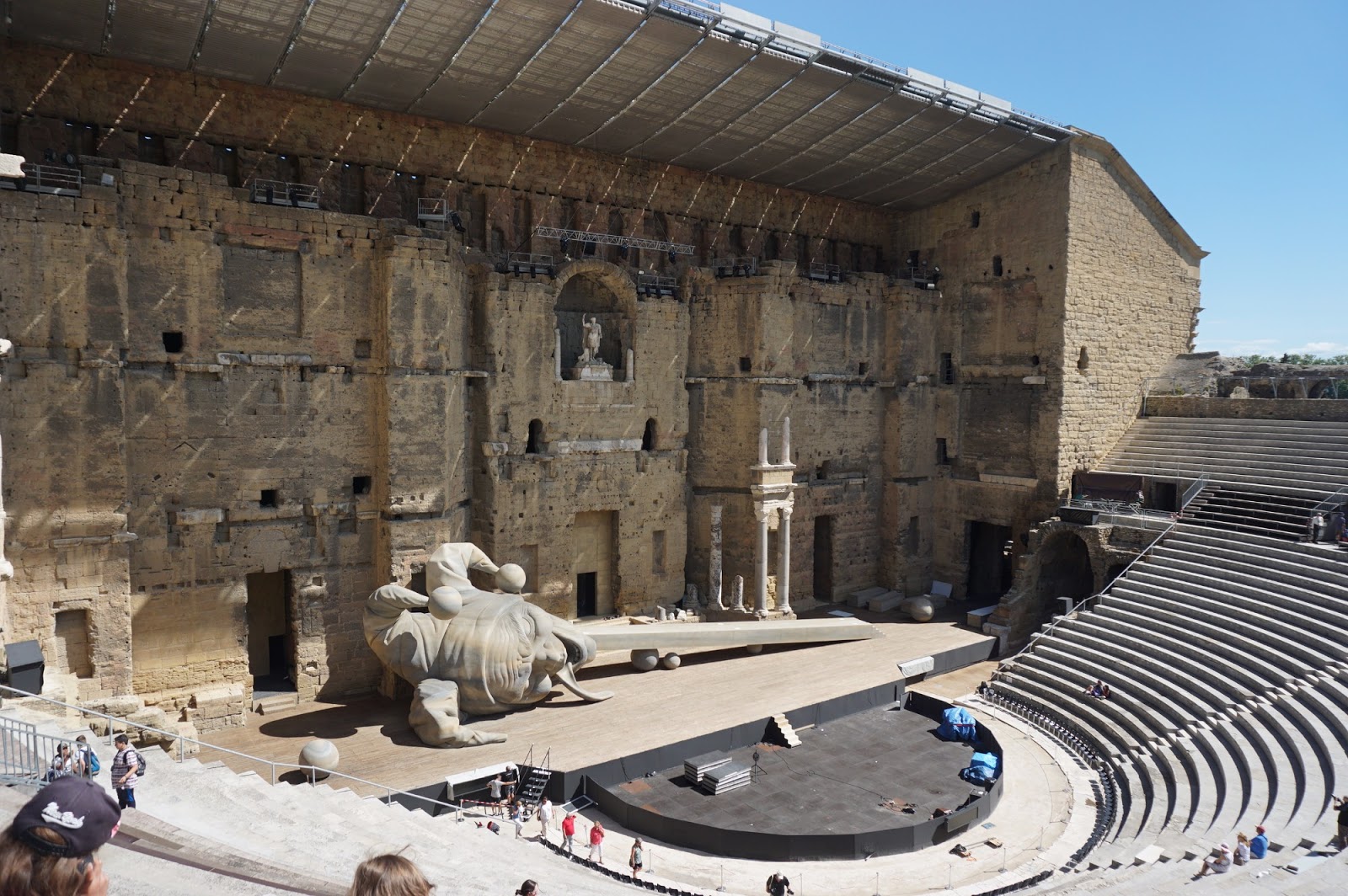
This morning we left Arles, France and drove an hour north to the city of Orange. It was founded by former Roman Legionaries. Apparently retirement abroad was encouraged in order to entrench Romanization of the conquered provinces. And any good Roman city had to have a theater. Orange has the best-preserved theater in the Western World. In particular it has an intact backstage wall which improves acoustics. We take a self-guided audio tour of the complex. We learn a lot about the history of Roman Theaters and the performances. Rome promoted events to keep the citizenry entertained and too busy to protest. We could use something like that in today’s world. In the Christian era, the theaters were closed because they had become too bawdy.
We quickly toured the historical museum across the street. It had little of interest. Afterwards we walked several blocks to the site of a Roman Triumphal Arch.
From Orange we drove down the Rhone River to Avignon. This city is famous for being the home of the pope and Catholic Church in the 1300’s. We park across the Rhone and walk into this walled city. The Papal Palace is very imposing. We take the audio tour where we learn more of the history of the “Babylonian Captivity of the Papacy”. It all started when a Frenchman was elected pope in 1309 and he stuffed the College of Cardinals and moved the Papacy here. Subsequent popes were also French and they built this fortified palace. When it ended officially in 1377, there were dueling popes for a while. The palace interior is empty, mostly undecorated and only mildly interesting.
From the Palace we walk up the nearby Cathedral Garden hilltop where we get great views of the area, including the Pont d’Avignon bridge. This was the only bridge across the Rhone in ancient times. The bridge was washed out periodically by floods and now only a short section remains.
We stop for a snack and then do a short walk through some of the city’s narrow back streets. Avignon seems nicer and more upscale than Arles.
June 29, 2017
June 29, 2017
The main reason we chose to come to France and start in Provence at this time of the year is Lavender. I have seen photos of lush fields of purple as far as the eye can see. I want a picture like that on our wall.
I got recommended directions off the Internet. We start by driving an hour north, passing beautiful Sunflower fields, to the town of Gordes. It is a picture perfect hill town that looks like it should be in Tuscany. Aimee read that it is now an enclave for the uber-wealthy French. We take a detour from the plan and visit nearby Senanque Abbey. I have seen photos of this Medieval Cistercian structure fronted by Lavender. Little did I realize it was down a one-way road at the bottom of a steep valley and mobbed by tourist buses. Sadly the Lavender was mediocre. Going after flower blooms can be a risky proposition. Sometimes Mother Nature doesn’t cooperate. Aimee and I are hoping that we aren’t too early.
We should backtrack to Gordes to follow our itinerary but decide to just input the next destination into the GPS. That was probably a mistake. I am wishing I had bought a real map to check the GPS. It turns out the Luberon Region, which we are touring, is a mountain range extension of the Alps that separate France, Switzerland, and Italy. We end up driving for an hour along narrow hilly winding roads dodging mountain bikers without even a hint of land flat enough for Lavender. The area is however beautiful.
We persevere and eventually come to the town of Sault which overlooks a valley with Lavender fields. We descend down and find several fields worthy of photos. In particular I am looking for extensive fields of lavender that have contours. Since the Lavender fields rotate every year, I am realizing I might have to drive around for weeks to find the perfect spot. There are other obstacles. At our first stop I am overrun with bees. Apparently hives are stored near the fields to produce special Lavender Honey. I have to overcome my urge to swat at them. The lavender fields are also full of sticky mud and manure fertilizer. Worst of all, I found that to get a good photo, I need to spend time pulling weeds that shoot regularly from the rows.
Lavender Photography is getting too much like work; so in the early afternoon, I surrender and turn back towards Arles. My GPS says we have an hour forty minutes, which we now know really means two hours.
Close to Arles, I get a second wind and stop at the Roman ruins of Glanum. We stop and tour this very ancient village built around a sacred spring. It is expensive and underwhelming. The best part is outside the gate, where stands the oldest Triumphal Arch in France and probably the best preserved Roman Mausoleum.