Monday, May 09, 2022

May 8, 2022

May 8, 2022

When the Ottomans captured the city of Constantinople, they moved their capital here immediately. They were so impressed with the Hagia Sofia church, they not only left it intact they went on to build domed mosques everywhere copying the architectural style. They also had to build a grand new palace. We are visiting the Topkapi Palace Museum this morning to see how the Ottoman Sultans lived.

Topkapi is a huge walled compound with four main courtyards and lots of buildings and walls. Access became more restricted the farther you got into the interior. The Harem was the most guarded; of course that is where I want to start. The Harem was essentially the private quarters of the Sultan's family. It has over 400 rooms because the Sultan had lots of concubines, children and servants. Almost everybody in the palace started out as a captured slave, not only the concubines, but also the guards and the government administrators. The slaves were almost always young Christians, who were then raised Muslim.

The business of the Harem was producing a son to inherit the throne. With so many concubines, failing to have an heir was not a problem. Just the opposite; too many contenders. As a result the Harem was a female web of intrigue to get their son to gain the throne. The stakes were very high. For a time, the losing brothers, by law, were all killed immediately. Since they were royal, it was strangulation with a silk scarf. To prevent any mishaps, the Harem was guarded by a group of eunuchs (castrated males) who were usually black Equatorial Africans.

The most interesting rooms of the Harem were the baths, and the highly decorated Imperial Hall. This room was where the Sultan’s family would be entertained while lounging on great pillowed platforms. This is our source of the furniture we call an Ottoman.

Aimee and I did a speed tour through the other courtyards of the Palace. The last courtyard has great views over the Bosphorus and several highly decorated pavilions. We spent most of our time in the Sacred Relic Museum and the Imperial Treasury. Since the Ottoman Emperor was also the Caliph of Islam, he collected the most venerable religious icons of the Muslim world. These include Mohammed’s teeth, hair, bow, and sword, and the staff of Moses. The Treasury is an astounding collection of armor from the Orient. It includes all kinds of swords, helmets, bows, muskets, and armor. Most are highly decorated in a distinctively Middle Eastern style. Probably the most famous piece is the emerald-studded Topkapi dagger.

The last room we visited was the Imperial Council Chamber. This is where the Divan, or advisory group would meet sitting on pillowed benches along the room’s perimeter. Westerners now refer to a Divan as that cushy furniture they sat on.

We last visited the Hagia Irene. This is a very ancient Byzantine Church used by the Ottomans as a storage building. The interior is empty, having been stripped clear centuries ago.

Leaving Topkapi, we make a quick visit to the adjoining Gulhane Park to see the tulips blooming. Tulips (along with coffee) were introduced to Europe by the Ottomans. The tulip name derives from the Persian word for ‘turban’ which it resembles.

We then walked northwest a bit to the Spice Bazaar. One stall owner gave us a long dissertation on the spices and treats he sells. We ended up buying two varieties of pistachios for the rest of the trip. Many of the vendors are also selling Turkish Delight. This is a candy confection of nuts and dates in a starchy gelatin. It is tasty, but we get filled up grazing on the samples available at every stall. We also bought an Evil Eye amulet that is supposed to ward off harm. Aimee thinks it would be a nice Christmas ornament.

Just downhill is the old Orient Express train station, and the Golden Horn. This is a long inlet off the Bosphorus and was the natural harbor of Constantinople. During attacks a great chain would be stretched across the mouth. We crossed the Golden Horn over the Galata Bridge. Fisherman with huge poles line the entire span.

The northern side of the Golden Horn is the New District. We took a funicular train uphill. Opened in 1875 this underground train is the second oldest surviving subway after the London Metro. We then walked along busy pedestrian Istiklal (Independence) Street. It is packed with tourists. We stop for a calamari sandwich lunch washed down with a local beer called Efes.

We continued to Taksim Square where we saw the Republic Monument. It has a cool statue of Atakurk, the George Washington of Turkey. One side has him in uniform driving out the Greeks in 1922 during their war of independence. The other side has him as a western statesman establishing the modern state of Turkey.

We then hopped on the subway and took it back south across the Golden Horn stopping at Suleyman Mosque. This 500-year old mosque was built by Suleyman the Magnificent who reigned over the Golden Age of the Ottoman Empire. He controlled a third of Europe and knocked on the doors of Vienna.

In the courtyard of the Mosque, we see a little boy dressed as a Sultan. He is happy to be the center of attention. Little does he realize he is about to be circumcised.

The interior of the Suleyman Mosque is spacious but not overly decorative. Interestingly the huge low hanging chandelier has ostrich eggs dangling. Apparently they emit some odor that repels spiders from building cobwebs.

From Suleyman we walked back to the hotel passing through Istanbul University. On the way, we see lots of stray cats gathering. This seems to be feeding time by the locals. We also stop and watch a bride and groom taking wedding photos outside Hagia Sofia.

We have dinner at a restaurant around the corner from the hotel. Like our hotel it also has ruins of the Byzantine Palace in the basement. The domed ceiling structure looks like another palace cistern. Turkish restaurants traditionally provide tea at the end of the meal. This time it was apple-flavored. Once I added sugar, I thought I was drinking apple cider.

Sunday, May 08, 2022

May 7, 2022

May 7, 2022

We got up very early this morning because our bodies have not acclimated to Istanbul time zone yet. After breakfast we took a walk uphill to check out the Cistern again. An Internet search said it should be open. As soon as we saw it again, I recognized my mistake. While the modern above-ground structure is similar, the name is wrong. Apparently Istanbul has dozens of cisterns, few of which are open. We wander the neighborhood and soon find the Cistern of Theodosius. We buy tickets for the next show. Built in 430AD, this cistern is a hundred years older than the much larger and famous Basilica Cistern. This one used to be free, but after renovation, it is now only open for light shows.

At 10am we are allowed to proceed down the long stone stairway into this large room dug into the ground. The clay-tile ceiling is supported by 32 marble columns. In ancient times, this cistern (underground water storage tank) was filled by the Valens Aqueduct that delivered water from springs many miles away. This water tank fed the Byzantine Palace.

After a few minutes the light show starts. There is a little bit of a theme to it, but it is mostly different colored lights illuminating the columns and walls. Totally unnecessary. I would have preferred it to be a museum explaining its purpose and history. But that probably wouldn’t draw the average tourist.

After the light show we walked towards the Grand Bazaar. On the way we passed the Burned Column that once supported a great statue of Emperor Constantine. Across a plaza is another domed mosque. Its interior is ordinary. Istanbul has domed mosques everywhere.

We then entered the Grand Bazaar. It is a large shopping mall on steroids. It is also probably the oldest covered market in the world. We spent an hour exploring (getting lost in) this maze of shops and hallways.

On our walk back to the hotel we stopped at Seven Hills Terrace Restaurant. We were going to have a drink but there was a long wait for a seat. Instead we soaked up the outstanding view of the Blue Mosque and the Hagia Sofia.

Back at the hotel, we rested for an hour. At 1pm we met our tour group. It is a Rick Steves excursion. We have watched all his shows and routinely use his books for our personal European adventures. Rick and I are of similar age and we both backpacked Europe in our youth. Who knew I could have made a living out of travel.

Our group of twenty-five travelers did a walking tour of the local area stopping at the Hippodrome and the Grand Bazaar. So far it is a repeat of yesterday. Very late in the day we visited the Hagia Sofia, my main motivation for coming to Turkey. This architectural masterpiece was built by Emperor Justinian in 537AD. For a long time this church was the Vatican of Christianity. When Constantinople fell to the Ottomans in 1453, it was turned into a mosque. After Turkey was secularized 100 years ago, it was converted into a Museum. Just two years ago it was changed back to a mosque for political reasons. On the plus side it is now free to enter, but that comes with a heavy cost. Access is now limited during the five daily calls to prayer. The gates reopened at 6pm and we pushed through the waiting crowd to enter.

Hagia Sofia (Holy Wisdom) is an extraordinary World Heritage site. The dome is massive, supported by four great arches and pillars. It was the largest building of the ancient world and the biggest church for a millennia. Unfortunately Islam doesn't allow human figures in their mosques, so flag-like pennants are now strategically placed to obscure the visibility of the few remaining Christian mosaics. The second floor is also closed to prevent getting closer to that artwork.

On the way out Aimee and I notice two small mosaic panels in the exit hallways still visible. They haven't been covered since they are not visible to active prayers.

We eat dinner with the tour group at a restaurant very close to our hotel. We skip the salad, but eat the minced meat Turkish pizza, and chicken eggplant entree. Aimee and I are hoping for a sound sleep tonight.

Friday, May 06, 2022

May 6, 2022

May 6, 2022

Istanbul sounds so Middle Eastern foreign. I always thought the name had some connection to the Muslim ‘stan’ countries. Actually it is derived from the name the city was known by for over a millennia, Constantinople, city of Constantine. Like New Yorkers refer to Manhattan as ‘the city’ so did those eastern Christian Byzantines refer to their great capital city as ‘ista polis’ or Istanbul.

Constantinople was probably the greatest city in the world during the Middle Ages. It was the capital of two great empires. For 1000 years, this was the center of the Eastern Roman or Byzantine Empire. After its fall in 1453 it became the center of the Ottoman Empire for the next half millennia. Our hotel sits on land that sat just outside the palace of the Byzantine Empire. Or so I thought. We had breakfast on the bottom floor of the hotel. I was pleasantly surprised to discover that we sat right next to some preserved foundation walls of this great palace.

After breakfast we walked uphill a few blocks to the Great Palace Mosaic Museum. This section of the Byzantine palace floor was rediscovered fifty years ago during a construction project. The project was cancelled, and a protective cover was built. The beautiful mosaic floor is quite extensive but incomplete. A wide variety of scenes are depicted, especially of exotic animals.

When the Ottomans conquered the Byzantine capital, the Great Palace had become decrepit. It was torn down and the great Mosque of Sultan Ahmet was built atop it. Known as the Blue Mosque for its interior tile work, it dominates the skyline with its domes and six tall minarets. Unfortunately the interior is undergoing renovation and has limited hours.

Instead we visit the adjoining tomb of Sultan Ahmed. I have to laugh as the beautiful structure is filled with caskets. When you have a harem with many wives, you have to make room for dozens of sons in your burial plot.

Just north of the Blue Mosque is the Hippodrome. This was the 1500-ft chariot race track of the Byzantines. It is now a long rectangular park. The central spine was decorated with monuments stolen from within the Empire. Most notable is an Egyptian obelisk and a bronze Serpent column from the Greek Oracle of Delphi.

Constantinople lacked a reliable water source. That was remedied with an Aqueduct that filled large underground cisterns. The famous and vast Basilica Cistern is closed for renovation (that is a common theme) so we visit the nearby Cistern of Theodosius. Or try to. It is also mysteriously closed.

Assyrian Soldier Frieze from Arslan Tash
So we punt and visit the Istanbul Archaeological Museum instead. It has three buildings. We start in the Museum of the Ancient Orient. It covers the ancient civilizations of the Middle East. It has a wide variety of artifacts from this cradle of civilization including some glazed brick panels from the famed Ishtar Gate of Babylon. Looking at the many statues and reliefs, it seems every man from these civilizations had a braided beard.

Cuneiform was the alphabet of the Middle East. Apparently it derived from an Hieroglyphic-like picture writing but evolved into a simple wedge-shaped alphabet. The museum has loads of sample tablets. Ancient Middle Easterners must have had superb vision, because most of the script is microscopic.

For me the best part was the intersection with our recent Egypt trip. On display is one of the Hittite copies of the Kadesh treaty. That was the world’s first peace treaty negotiated between the local Hittite King and the Egyptian Pharaoh Ramses the Great.

Afterwards we toured the main Museum exhibits. It has an amazing collection of Greco-Roman artifacts. I guess I shouldn't be surprised as the Ottoman Empire was rich enough in its prime to indulge in archeological enterprises.

The centerpieces are a collection of sarcophagi from a royal burial complex in the ancient city of Sidon in present day Lebanon. The necropolis is the Greek equivalent of the Valley of Kings in Luxor. The most stunning is known as the Alexander Sarcophagus. This carved stone casket is in near mint condition with superb high relief depictions of a battle that Alexander the Great participated in. It even has traces of the colorful paint that once decorated it. It tells me that Egypt was not as unique as I thought. Other civilizations had their impressive treasures. Egypt’s were just lucky enough to survive intact because many had been buried and forgotten in an arid desert.

We have to speed through the rest of the museum, because we are jet-lagged and this museum is vast. That is unfortunate because the quality of the artifacts is astounding and extensive. Even the outdoor grounds of the museum are strewn with artifacts exposed to the elements that other museums would love to exhibit, including a giant Medusa head and several sarcophagi of the Christian Byzantine Emperors.

Statue of Tyche (with traces of color)
Western Turkey was a center of Greek and later Roman civilization, so it is not surprising that the exhibits from these eras are astounding. These artifacts are generally missing heads or arms, but not here. Most are amazingly intact. It is a testament to the former power of the Ottoman Empire that this collection exists.

Exhausted, we finally have to run through the upper floors of the museum. And it isn't over. We finish next door in the third building, the Tiled Pavilion. This is a medieval Ottoman structure that has been repurposed as a Museum of Islamic Art.

Our walk back to our hotel is through thick crowds of tourists. And I thought Istanbul tourism had yet to return (or maybe I was just hoping.) The Blue Mosque opens late afternoon once renovation has finished for the day. We join a long line to enter. It was a crowded waste of time. Almost everything but a tiny view of the main dome is behind barricades. We will have to return in the future.

Back at the hotel Aimee and I take a nap and then head out to a nearby rooftop restaurant for an early dinner. The fish entree was just okay, and the Rice Pudding dessert was good, but the beer and the view and the service was outstanding. In one direction was the Blue Mosque, in another the Great Hagia Sofia, and to the south the Sea of Marmara. In the distance we see dozens of ships waiting to go through the narrow Bosphorus Strait that bisects the city of Istanbul.

Thursday, May 05, 2022

May 4-5, 2022

May 4-5, 2022

Our last trip to Egypt was inspired by Agatha Christie’s Death on the Nile. When we got home we rented the earlier film, Murder on the Orient Express. In it Hercule Poroit solves a crime while riding the luxury train that once carried passengers from London and Paris to Istanbul. This movie wasn’t nearly as good. Yet it reminded me of a destination long on my bucket list. Additionally this is the 100th anniversary of the 1922 end of the Ottoman Empire. It is time to explore Istanbul and Asia Minor.

We left Tucson in the morning flying to Dallas where we caught our connection to London. That is where our problems began. It started with a defective business class seat with a broken TV and no overhead lighting. With nothing to do, Aimee noticed our flight segment to Istanbul was totally different than scheduled, getting us in well after midnight. American Airlines never bothered to notify us of the cancellation and rebooking. Furious, it was hard to relax and get any sleep on the long overnight flight. American Airlines made my ‘never fly again’ list.

This would have been the perfect opportunity to hop on the Orient Express train. Unfortunately WWI and the end of the Ottoman Empire led to the demise of this transportation option. Instead we spent the entire day at London Heathrow in a mediocre British Airways Lounge. In the late evening we boarded a completely full flight to Turkey. We met a British couple going to Istanbul to catch a Mediterranean Cruise. They said they retired to Spain where they endured long Covid lockdowns and this is their first opportunity to get away. Aimee and I are both thankful we live in Arizona which took a more practical approach to the pandemic. The data has shown with the highly transmissible virus, the lockdowns were ineffective and provided almost no benefit. China is resisting learning that lesson to the world's detriment.

The Istanbul airport is brand new and huge. Even with visa already in hand and no checked bags, it is a long walk to the exit. We meet our driver who ferries us the hour to our hotel in the historic district of Istanbul. We take the Galata Bridge over the famed Golden Horn. Our route next to the Bosphorus Strait follows the ruins of the great wall that once surrounded Constantinople. This greatest medieval walled city wasn't breached until 1453. It is after 2am before we make it to bed. Finally!

Wednesday, April 20, 2022

April 18, 2022

April 18, 2022

We spent the Easter weekend visiting Aimee's mom in Amarillo. A radio show we heard during the long drive made me chuckle about the origins of this religious holiday. Growing up I never questioned the name Easter or the association with Bunnies and Colored Eggs. It turns out it was originally a pagan Spring fertility festival. Like Christmas with its Santa and decorated trees, nobody wanted to give up their annual parties so religious leaders had to adapt and co-opt rather than the other way around.

On the return journey, I am always looking for something interesting to break up the long drive. This time we made a short detour in the New Mexico mountains, following Billy the Kid Trail, past the Lincoln Historic Site, to Fort Stanton State Historic Site. It sits at a very pleasant 6500ft in the broad Rio Bonito Valley. This is stereotypical cowboy country perfect for any Western film.

I wasn’t expecting much but this Fort now in the middle of nowhere had a very long history. It was established in 1855 to protect settlers from Apache raids. But its lucrative beef and timber supply contracts kicked off the infamous Lincoln County War that gave rise to Billy the Kid.

The fort hosted a star-studded list of army veterans including famed scout Kit Carson and WWI Commander Blackjack Pershing. Lew Wallace, Union general and New Mexico governor wrote part of his novel, Ben-Hur, here.

We walked around the large parade ground checking out some of the exhibits in the perimeter buildings. Little of its early history remains because the fort with its enduring stone structures went on to have second and third careers. In 1899 it became a military hospital and soon became the government’s first Tuberculosis sanitarium. At the time it was thought the cure to the “White Plague" was fresh mountain air. The hospital wards look like a time-warp and are a great glimpse into how much life and technology has changed in the last hundred years.

During WWII, the fort accidentally became a German Internment camp. At the onset of the war, a German luxury cruise ship sailing the Caribbean became the object of confiscation by the British. After offloading the tourists in Cuba, the ship was scuttled, and the crew rescued by the US Navy. The distressed sailors were housed here awaiting repatriation. In the interim, Germany declared war on us, and the crew became prisoners. These industrious Germans spent their time building a home here, including a nice swimming pool.

Wednesday, March 09, 2022

March 4-5, 2022

March 4-5, 2022

We rose early this morning, had breakfast, and left just after 6am for a three-hour drive to Abu Simbel. Since our international flight home is late tonight, we can’t risk another flight cancellation. The road South skirts wide of Lake Nasser. It begins with a very flat sandy desert that eventually gives way to scattered mounds in the desert. They look volcanic to me. There is no vegetation whatsoever until we get to the area around Abu Simbel. This locale is being heavily irrigated. Egypt is complaining of Ethiopia draining Nile water, but it seems Egypt is doing the same thing trying to turn the desert into cropland.

After three hours we turn toward Lake Nasser and arrive in the town of Abu Simbel, where the Second or Great Cataract of the Nile once was before being submerged. We are just twenty miles north of the border with Sudan. Interestingly the Nubian houses here all have multiple domes on the roof. Apparently, this helps keep the homes cooler in the intense desert heat.

3300 years ago, Ramses the Great built a great temple here to warn Nubia of his power. His temple is the original Mount Rushmore. Ramses' builders carved a facade of four enormous, seated statues of himself into the Nile cliffside. They continued excavating a temple into the mountain. The temple walls relate the story of Ramses’ heroism at the Battle of Kadesh, one he nearly lost in Palestine against the Hittites. The battle was concluded with the world's first written peace treaty.

Next door is carved a smaller facade and temple to his wife Nefertari, whose tomb we visited in the Valley of the Queens. Aimee is happy to be able to pick out her Cartouche because it contains the recognizable fiddle-shaped hieroglyph, Nefer, meaning beautiful. I am going to start calling Aimee, Nefertari, ‘beautiful companion’.

If the scale of the temples wasn’t amazing enough, their relocation was an astounding feat of civil engineering. The building of the high dam at Aswan threatened to submerge Abu Simbel beneath the Nile waters. In the greatest work of UNESCO, this temple and a dozen others (including Philae) were systematically sawn apart and reassembled on higher ground. We saw one such relocated temple a few years ago in the Metropolitan Museum in NYC. In the case of Abu Simbel they had to build a concrete mountain to support this rock temple!

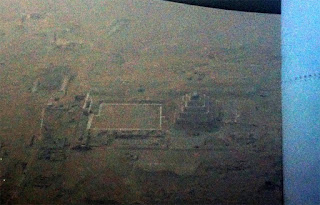
This is a good spot to finish our whirlwind tour of Egypt since it was the Abu Simbel scenes in the movie Death on the Nile that inspired this trip. Now we need to make the long trip back across the length of Egypt. So it is three hours back to Aswan where we catch a ninety-minute flight to Cairo. I was happy to see us pass over the Step Pyramid on our approach. That is where great Egyptian history started and also where we began our tour.

In Cairo we get an evening room at an airport hotel where we can shower. We go out with the group for our last meal of Egyptian food. At 11pm we head to the airport for our night flight to Paris. There we have a long layover that we spend in the Air France lounge. Then it is a super long flight to Los Angeles and our puddle jumper to Tucson. Humorously over the Irish Sea, I see England's version of the new Texas gold. We have Global Entry now that gets quickly through customs; maybe a little too quickly. As we approached, their cameras spotted and recognized our faces in seconds. We barely had to stop. A little too much ‘Big Brother Watching Me’ for my liking!


Jewelry Making in Tomb of Mereruka
This trip to discover ancient Egypt reinforces for me what an amazing and advanced civilization Pharaonic Egypt was. It was vastly ahead of its time. They were so productive to be able to afford leisure time where they could develop a sophisticated culture with a writing system, agriculture, industry, and artistry. This trip only scratched the surface of what ancient Egypt has to offer. Egypt is so much more than the Pyramids.

Sunday, March 06, 2022

March 3, 2022

March 3, 2022

Overnight we continued sailing upstream ending in the town of Aswan. Here hard granite extrusions rise to the surface. Granite quarried here was ferried downstream for Egyptian statues and temples. This granite also caused the first of several cataracts on the Nile. These rocky outcroppings in the river impeded water travel and defined the border between Egypt and the tribes of Nubia to the South. The annual rising of the Nile was mysterious and magical to the Egyptians. They thought the Aswan cataract was the source of the flood.

The British built a low dam on the first cataract a hundred years ago. In the 1960’s President Nasser with Russian help built the high dam that formed Lake Nasser. The high dam produces 2100 MW of power, controls the flooding, and provides year-round irrigation for agriculture.

We drove over the low dam and stopped at the high dam. Looking over the edge we got sand blasted by the strong updraft. We then stopped at the Russia-Egypt Friendship Monument memorializing the dam building partnership.

We finished at the Aswan airport to board our flight to Abu Simbel 150 miles to the south on the shore of Lake Nasser. Our flight was delayed by a dust storm, and eventually cancelled. The wind continued to pick up obscuring visibility. We head back to the ship disappointed. It looks like we are going to miss Abu Simbel. Our back up plan of going to the sacred island of Philae was also cancelled because of the sandstorm.

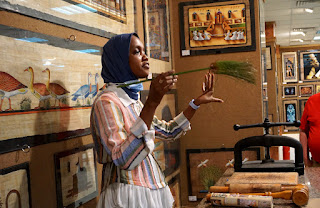
On the way back to the ship we stopped at a papyrus store, where a Nubian girl demonstrated the basics of making paper out of thinly sliced stalks of the papyrus plant. Papyrus gave us the word ‘paper’. Another amazing technology development we owe to Egypt.

After a couple hours resting on the ship, we learn that Philae has reopened. We gather quickly to attend its nightly Sound and Light show. From the Aswan dock we take a little powerboat to this granite island sitting in the water between the two dams. Shortly after disembarking, the show begins. There is some flashing of the lights as we move through the Temple of Isis, but it is mostly a sound show relating the thousands of years of Egyptian history. While I would probably have preferred a day visit, it does provide a way to get in the mood of actual Egyptian religious life.

Saturday, March 05, 2022

March 2, 2022

March 2, 2022

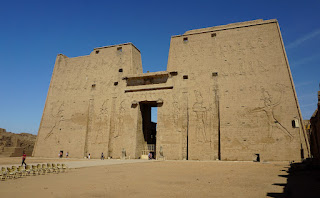
Sometime early this morning our ship continued its journey up the river Nile. Midmorning we arrived (along with dozens of other ships) in the town of Edfu. Once ashore we hired a horse cart to drive us the couple miles to the Temple of Edfu. Alexander the Great conquered Egypt in 332 BC. His general Ptolemy governed Egypt after his death. This began a dynasty of Greek Pharaoh Ptolemys often married to Queen Cleopatras. Caesar married Cleopatra VII. Surprisingly these Greeks adopted Egyptian traditions and religion. They built this temple here in Edfu. Since it is so much newer (only 2200 years old!), it is in very good condition and wasn’t added onto like older ones.

The entire temple complex is surrounded by a mud brick wall. The entrance pylon has two halves symbolizing Upper and Lower Egypt with the sun rising in the center gap. Just inside is a hypostyle courtyard. Past that is the sanctuary surrounded by lots of rooms.

The temple was dedicated to Horus, the falcon god. During the renewal festival his wife Hathor would be transported from her temple at Dendera for the sacred marriage ceremony.

In the Muslim and Ottoman eras, this religion was forgotten, and the desert reclaimed the temples half burying them in sand. Ordinary people occupied the temples leaving a layer of fire soot on the ceiling. They also hacked out the god’s faces as pagan idolatry giving us the term ‘defaced’. The figures near the floor, below the sand, escaped this vandalism.

Throughout the hieroglyphic inscriptions, I can identify lots of the Cartouches with the names, Ptolemy and Cleopatra. These Greek names were part of the key to decipherment. Linguists eventually realized Hieroglyphics mostly represented sounds (vs picture writing). Cleopatra and Ptolemy have several letters in common (especially P, T, O, L) and this proved crucial.

In the back of the temple is a staircase that leads down to the river level. This calibrated staircase was a Nilometer that measured the flood level of the river. This information would be relayed down river to the kings so they could anticipate the coming inundation season.

Back on the ship, we toured the Captain's Bridge before sitting down to lunch. One of the entrees was camel meat. It didn't taste like chicken, but rather a tough cut of beef. We spent the afternoon again on the upper deck watching the Nile riverbank float past.

Late in the day we stopped at Kom Ombo. We got off the ship and walked to the temple. This is another relatively modern temple from the Ptolemaic Period. It is unusual in that it is a double temple with two entrances and two sanctuaries, dedicated to two different gods. And oddly one is Sobek the Crocodile-headed god. Crocodiles surely must have inspired fear in the ancient Egyptians who depended on visiting the Nile River often. I am sure there were more Crocodiles the farther south one went. Crocodiles (and Hippos) were eliminated once the High Dam at Aswan was built. This temple even had an artificial pond on the grounds where the priests raised sacred crocodiles.

Next door we made a quick visit to the Crocodile Museum. Besides having the nicest statues of Sobek, it has a large collection of mummified sacred crocodiles. We then walked back to the ship for dinner.

Friday, March 04, 2022

March 1, 2022

March 1, 2022

This morning we left the ship and drove to nearby Karnak Temple. It is one of the largest religious complexes in the world. It is a sprawling mishmash of pylons and courtyards because each Pharaoh had to show he was a descendant of Amun by modifying and adding on to the site. The first pylon entrance in the West has a line of ram-headed sphinxes. During the Opet Festival the statue of Amun would be transported in his boat out the South pylons down the Avenue of Sphinxes for his sacred marriage in Luxor Temple.

The most famous part of Karnak is the Hypostyle Hall. It contains 134 massive columns. The largest ones are seventy feet tall and ten feet wide, and they are tightly packed in order to support the heavy stone roof. Every surface and every column is carved with figures and hieroglyphics. The huge crowd of tourists took away some of the majesty for me. Tourism is down in Egypt. I can't imagine what it was like pre-pandemic.

The most impressive part of the Hypostyle Hall for me is that workers are removing three thousand years of accumulated dust and soot, revealing that the carved columns were gaily painted. This reminded Aimee that many religious sites (like Amiens Cathedral in France) used to be painted. This temple must have been a colorful site to behold in ancient times.

Once back on the ship, we set sail heading up river. The weather is nice, sunny and getting warmer as we continue our journey south. Aimee and I relax inside a cabana on the ship's open roof deck with cocktails. The tourist vendors are stubbornly persistent in Egypt and they are inventive. They even tie up to our ship to display their wares. If interested, they will toss the items onto deck with payment thrown down.

We watch the scenery of the Nile flow past us. Surprisingly apartment buildings line one bank of the Nile for miles. The habitable part of Egypt is very tiny; maybe a mile of very fertile soil on each bank. Sometimes though the desert mountains come very close to the river bank.

Sugar cane is a major crop of Egypt. Unfortunately burning the fields before harvest is common practice, so the sky is hazy and sometimes downright smoky. It does however make the sunset glow.

When we get to the town of Esna, we encounter one of many Barrage Dams. Like the ones on the Mississippi where I grew up, these are gate dams designed to maintain navigability of the Nile and provide enough head pressure to feed irrigation canals. We watch as our ship passes through the lock. We dock in Esna for the night. I have to laugh as we hear the evening call for prayer of the Muslims. The exhortation is echoing as the call comes from a dozen closely packed, uncoordinated minarets. It must constantly remind the local Christians they are the minority.

At 7:30 pm we had a cocktail hour to introduce the ship's crew. And then it was on to a delicious dinner.
Newer Posts Older Posts