Friday, November 25, 2022

November 25, 2022

November 25, 2022

Blue Penguins are plentiful in New Zealand but cumbersome to view. Since they are the world’s smallest penguin, they are the most vulnerable when they come ashore to their nests. That is probably why they wait until sunset to return. With their dark blue back they can easily hide in the shadows. To make spotting them easier and more comfortable for penguins and tourists, the town of Oamaru, New Zealand has built grandstands and lighting astride one large colony. Unfortunately they charge a princely sum for the convenience. Sunset was 9PM last night.

At 8PM we went to the Blue Penguin Colony on the harbor front. We got the last two premium seats. This ticket price tier allows us to stroll the boardwalk through the colony. Blue Penguins dig holes in the shoreline dirt for nests. To expand the colony, Oamaru has built a couple hundred wooden box nests.

We had to be in our grandstand seats before dusk so not to scare the arriving penguins. Almost on clockwork the first ‘raft’ of a dozen penguins comes ashore at sunset and makes their way up the rocky slope. They wait in a group at the crest to see if the coast is clear. They then quickly waddle past us through a wooden gate into the nesting grounds. They are adorable creatures, about the size of a small rabbit.

For the next hour, these little Blues come ashore in groups. By the time we are ready to leave there are two hundred all over the nesting grounds. They make all kinds of sounds. The chicks sometimes sound like crying babies with a trill added. On the boardwalk out, the penguins are milling about right below our feet. If allowed, I could easily pick them up. Near the exit, two penguins sound like they are getting ready for a fight, but instead a male mounts his female.

On the drive home with our headlights, Aimee spots a couple penguins aside the harbor road. But when I stop and turn around, they pretty much disappeared into the dark. So glad we spent the money to see them under the spotlight.

This morning, we checked out of our Oamaru motel and continued our whirlwind tour of New Zealand. We would have liked to stay another day here. Oamaru is a pretty city, nicknamed the Whitestone City after the many civic buildings that were built out of this local limestone in a distinctly Palladian style (a connection to our recent visit to Vicenza, Italy). Oamaru got rich in the late 19th century servicing the export of frozen meat to England. The economy crashed when the UK joined the EU in 1973 and New Zealand lost its favored status.

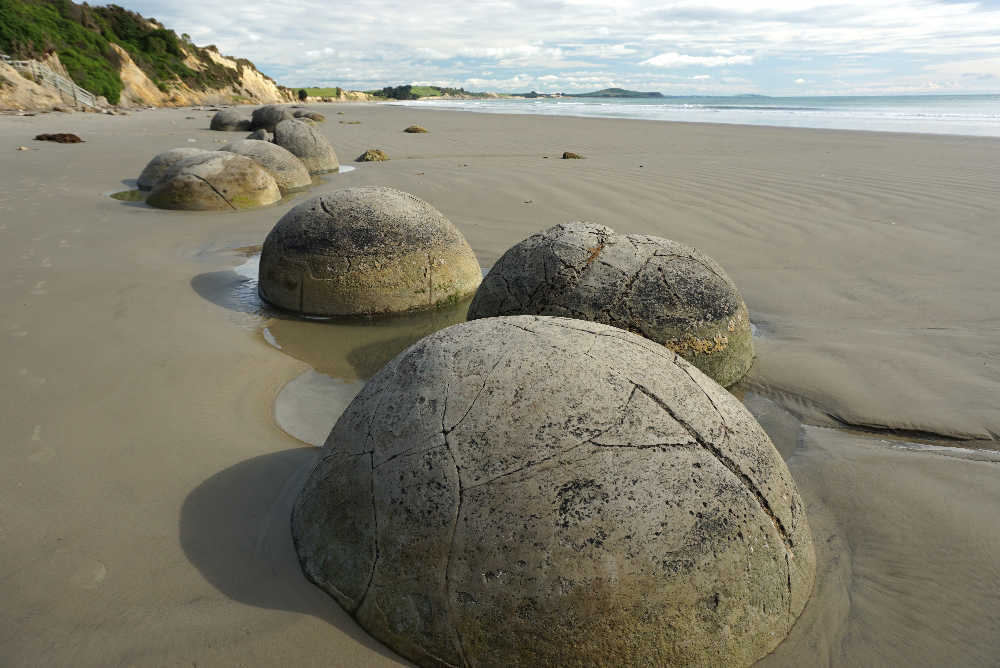
A half hour south, we stopped at Moeraki Boulders Beach. It is low tide and we can see dozens of huge almost perfectly spherical stones lying on the sand. We even see a couple boulders in the process of being weathered out of the cliff face. How these strange geologic concretions formed is not understood. Some stones are perfectly smooth, but others look like cracked dinosaur eggs with a seam of calcite gluing them together. Apparently there used to be many more, but the smallest were hauled off years ago by souvenir hunters.

Continuing south, our next stop is the major city of Dun-edin. Its name is the Gaelic version of Edin-burgh. We have only time for a quick stop in the pretty central square. It is in the shape of an octagon. Because of the Scottish roots here, there is a nice statue of the Scottish poet Robert Burns. We left Dunedin on a four-lane divided highway, the first we have seen. Unfortunately, it didn’t last more than a couple miles and it was back to two-lane country highway.

Cutting west across the southern end of the South Island, we stopped for an Indian lunch in Balclutha. It was surprisingly good, and the owner reminded us of Babu from Seinfeld. Farther on, I smiled when we passed a giant Trout statue in Gore. They call themselves the Brown Trout capital.

Most of the land on the east coast was rolling farmland that could easily be Hobbit land in the Lord of the Rings. The closer we get to the Southern Alps, the farms become perfectly flat like in the Midwest. Most farmers are raising Cattle and Sheep to provide China with their increasing desire for meat. We were shocked to see some farms raising European Red Deer. It is partly for the European Venison market but also to fill the Chinese demand for Antler Velvet used in traditional medicine. When I pulled over to take a photo, the deer scattered but the cows all came close.

At the base of the Southern Alps, we stopped for the night in the town of Te Anau. After checking in, we drove a few miles to the Rainbow Reach Trailhead of the Kepler Track. Named after the great German astronomer, this is another Great Walk. This 37-mile trek opened in 1988 to relieve pressure on the other nearby Fiordland National Park Great Walks. We donned our rain gear even though the weather looks good. We are hoping that will keep the rain away.

The trail starts with a bridge over the rain-swollen Waiau River. It played the River Anduin in the Lord of the Rings movie. The trail goes through Temperate rainforest versus the Tropical rainforest of Abel Tasman. That means more trees, with moss and some small ferns, but no palms or fern trees. We hiked two hours across several swinging bridges almost to Lake Manapouri.

We saw several cool-looking Fantail birds flitting through the forest. Their tail feathers open and close to help them catch flying insects. While trying unsuccessfully to take photos of these fast-moving aerial artists, Aimee spotted two of their nests, both with chicks. 

Back in Te Anau we went straight to dinner at a restaurant recommended by our hotelier.

Thursday, November 24, 2022

November 24, 2022

November 24, 2022

When we awoke this morning at Mt. Cook National Park, we could see a little more mountain outside our window, but it was still drizzling. We checked out of our Hermitage Hotel room, and went to the car to find some snow had fallen on it overnight. The auto temperature was just above freezing.

Before leaving the park we drove down Tasman Valley Road for one last hike. At road's end we hiked the short trail over the terminal moraine to an overlook for Blue Lakes. These three lakes no longer get much glacier melt water so algae is turning them green. We continued on to a view of Tasman Glacier and the large melt lake below it. All four of the glaciers we saw or tried to see recently descend from the same Mt. Cook massif.

Although it is still raining, looking down the valley we can see sunshine. That probably shouldn’t be too surprising as the east is the drier part of New Zealand. The mountains capture the clouds and wring out the moisture. We work our way back down the length of Lake Pukaki. At the southern end of the lake we stop at two public parks for photos. The scenery is gorgeous with the iridescent blue lake water against snow-capped mountains. One spot has a statue of a Himalayan Tahr, which is some kind of rare Nepalese Mountain Goat that was introduced here for hunting.

We stopped in the nearby town of Twizel for an early lunch of Thai food. Twizel started life as a temporary housing camp for workers building the Waitaki Power System. A cascading series of eight hydroelectric dams were built along the Waitaki River as it descends from the mountains to the sea. They provide 20% of New Zealand’s Power. We decided to follow the Waitaki Hydro Heritage Trail south to learn more about this energy generation system.

Along the way we stopped at a Salmon Farm that uses the cold lake water to raise these fish in large pens. A retail store is also attached. We had a good time watching some kids feed them by tossing pellets into the water and watching the fish compete with a duck for the morsels.

The first couple hydroelectric lakes are set amongst steep dry hills that look like the ones we often pass through in New Mexico. At Benmore Dam, we stop and stretch our legs along the Benmore Peninsula Track.

The lower elevation lakes are lined by rolling hills with some exposed limestone bluffs. We stop at Takiroa to see some crude Maori rock paintings in an overhang. The South Island was too cold for the Maori. They came mainly to hunt Moa and search for Greenstone. Nearby we visit Elephant Rocks which are some limestone boulders that have been weathered out of a small valley.

We finished our drive at the ocean town of Oamaru. We checked into our motel and then went down to the harbor front. Our motel clerk said we could probably see Blue penguins there tonight as they return to their shoreline nests from a long day feeding in the ocean. Humorously we saw Penguin Crossing signs. We went to Bushy Beach to see if we could spot Yellow-Eyed penguins. After watching unsuccessfully, a volunteer told us there were only eight of these rare penguins nesting here. We decided it wasn't worth the wait. Instead we celebrate Thanksgiving with an early pizza dinner at a brewpub.

Tuesday, November 22, 2022

November 23, 2022

November 23, 2022

It didn’t rain last night, and we woke to bright sunshine! A first for our New Zealand trip. Instead of leaving town, we decided to take advantage of the weather and hike to the top of the local Mount Iron hill. After checking out of the hotel, we head the short distance to the trailhead, sitting inside a local subdivision. It is a strenuous hike straight uphill to the peak. It was so worth the effort as we have glorious views of Lake Wanaka and the surrounding Southern Alps.

The weather forecast is predicting late afternoon rain, so we get back in the car and race east to our next destination. It probably took us longer than needed because our car GPS sent us on a long detour around Lake Dunstan. Since it is late Spring in New Zealand, Lupin wildflowers line the highway most of the route. 

The terrain on this side of the mountains is much drier with a lot less vegetation. The rain shadow of the mountains is to the east, just the opposite of Hawaii in the northern hemisphere. We stopped at the Lindis Pass lookout for a short hike to stretch our legs. Interestingly there was a burned out jeep in the parking lot. To save time, we stopped at a grocery store along the way for a pre-made chicken, brie, and cranberry jam sandwich. It was actually pretty good.

Just past the town of Twizel, we left the highway and followed the shoreline of glacial Lake Pukaki north. The water is an unreal blue color from the microscopic rock flour suspended in it. At the end of the lake we enter Aoraki-Mount Cook National Park. Unfortunately by the time we arrive, it is starting to rain.

Saddened, we check into the Hermitage Hotel, one of the most famous in New Zealand. Thinking the weather is only going to get worse, we don our rain gear and head out on the Hooker Valley Track. This trail follows the raging Hooker River over several swinging bridges towards Mueller Glacier descending from Mt. Cook, the tallest mountain in New Zealand. Unfortunately with the rain, it is nowhere to be seen. We can see the bottoms of many snow-capped peaks. It must be stunning in the sunshine.

On the hike we see a Paradise Shelduck and several ducklings. The mother has a white head while the father’s is jet black. They are endemic to New Zealand.

Back in Mt Cook Village, we stop at the National Park Visitor Center. The first explorers of New Zealand noted the snow-capped Southern Alps but for some reason never mentioned the lofty Mt Cook peak. That is not a mystery to me. From my experience Mount Cook is always in the rain clouds! The famed mountaineer, Edmund Hillary, was probably the most famous Kiwi. He honed his skills by climbing Mt Cook, before successfully scaling Mt Everest. His statue graces an outdoor courtyard here.

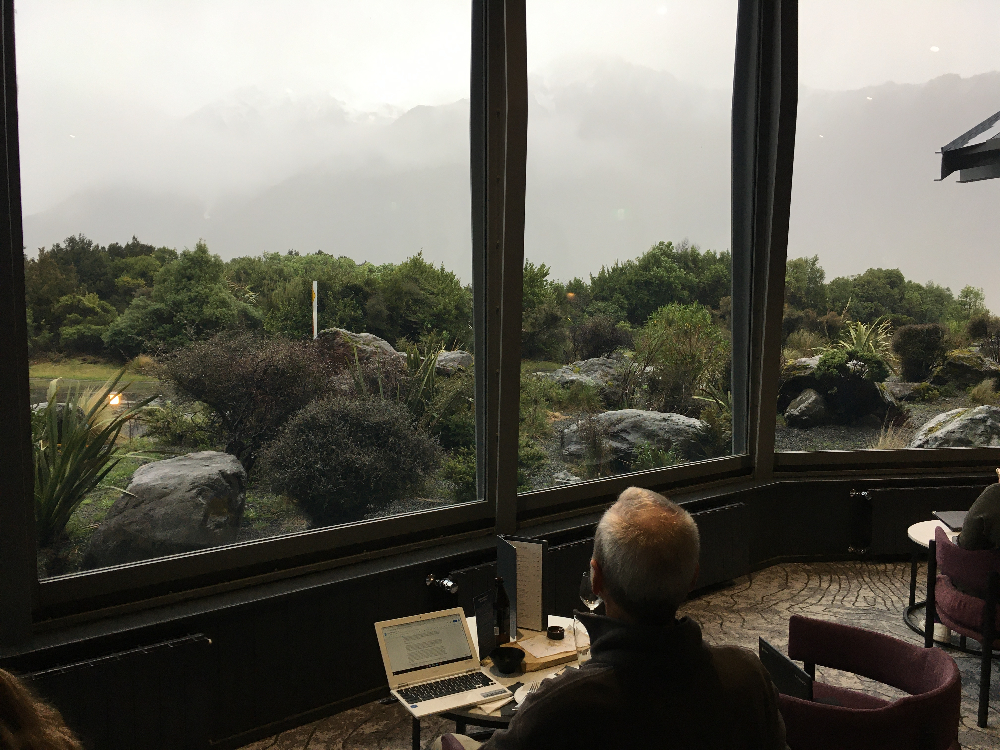
We finish off the last of our Hawke's Bay Chardonnay in the room, before going to the lounge for drinks and a cheese platter. Our seats would have a great view, except for the rain.

November 22, 2022

November 22, 2022

It rained again last night. That is sounding like a broken record on the Wet Coast of New Zealand. When we woke, Aimee looked out to see clearing skies. We hurriedly got dressed and as we stepped out of our room, it began to pour again. Darn. Back in the room, I read the morning paper.

After an hour or two, we left the town of Fox Glacier, continuing south. With twenty feet of annual rainfall, there is no shortage of rivers. To save money, New Zealand has mostly built narrow one lane bridges outside the urban areas. Combined with winding roads travel is slow.

We stopped at two scenic lookouts along the coast to use the bathroom and stretch our legs. We seem to be leapfrogging three tour buses doing the same itinerary. We are also seeing loads of camper vans. At one time that was going to be our plan. I am glad we deferred. RVing in the rain is no fun.

At the town of Haast, we turned inland and followed the large Haast River upstream. The road soon climbs a narrow gorge and we enter Mount Aspiring National Park. One benefit of rain is roaring waterfalls. We stopped at two; a very tall skinny Thunder Creek and a gushing Fantail Falls. We took an hour hike out to see Blue Pools, but with the rain it is not so blue. Unfortunately I am finding my old rain gear is not up to New Zealand standards and I am drenched.

Once over Haast Pass we descend down to Lake Wanaka. This is one of many glacier carved finger lakes on the eastern interior side of the Southern Alps. We follow the cliff road along this lake, before crossing to Lake Hawhea. They are probably a beautiful blue color in clear weather.

We end the day in the town of Wanaka on the southern tip of its namesake lake. We get a break in the rain long enough to haul our luggage into the hotel. After checking in we have a delicious Taco Tuesday very late lunch. We then went shopping for new rain gear. Wanaka seems like a nice town full of helpful friendly locals.

After an hour or so of chilling out, we noticed the sun has popped out. We can’t let this opportunity pass, so we get dressed and have a nice walk along the lakefront. With the snow-capped Southern Alps in the distance, the scenery is beautiful. We chuckle when we see the local attraction. For some reason there is a small tree growing thirty yards into the lake. A small crowd of tourists are bunched on the shore snapping photos.

Sunday, November 20, 2022

November 21, 2022

November 21, 2022

It rained again last night. From Greymouth, New Zealand, we drove south along the west coast. After a half hour we reach the town of Hokitika, which is the unofficial Greenstone capital, a type of jade that the Maori prized. They used this hard stone for tools and jewelry. It was found in rivers eroded from the mountains. Aimee thinks downtown Hokitika is very cute.

After this short break we continue south. The road is now straighter passing through flat pastureland with mighty green hills to our left. Unfortunately the rain is not stopping. We used up all our luck.

Two hours later we entered Westland Tai Poutini National Park and the town of Franz Josef. We stop at the park visitor center and learn that there is only one tiny cafe open for lunch in town. There we have hot chocolate and a toasted cheese sandwich.

It is still raining. We have no choice so we drive to the Franz Josef Glacier parking lot and put on all of our rain gear. Rain is in our future for at least the next week, so we need to make sure we are up for hiking in the rain. As the saying goes, there is no bad weather, just poor clothing choices.

It is just a fifteen minute hike out to the only viewing point for the glacier. The longer trail was washed out a few years ago and hasn't been rebuilt. Just as well, as we can barely see the toes of the glacier peeking out from below the clouds. The two glaciers here are some of the few that reach this close to sea level without being in the Arctic. That is because the mountains here are very steep and the region gets inordinate amounts of snow. As a result these glaciers slide down the hill at some of the fastest rates in the world, several feet per day!

Back in the car, we head fifteen miles south to Fox Glacier where we check into our accommodations. It is pouring now. We chill out and use the Internet for an hour. We see a break in the rain, so we don our rain gear again and drive to the Fox Glacier trailhead. We hike for an hour but the rain comes back with a vengeance. Fox Glacier is nowhere to be seen.

Back in town we get gas and walk from our motel room to a nearby restaurant. Aimee’s meal comes with Kumara Fries. We both think they are delicious and much better than the American version.

Saturday, November 19, 2022

November 20, 2022

November 20, 2022

It rained again all night. We left Riwaka, New Zealand heading southwest up the Motueka River valley. It is a very winding narrow rural road. It is much like Ireland. The rental car we have is larger than we wanted and is brand new with all the latest proximity and safety sensors. The car beeps incessantly when parking, and on the road if I am not exactly in the center of the lane. That is impossible with the unending Kiwi road curves.

Eventually we make it over the Hope Saddle and then follow the Buller River to the west coast. This river valley abutting Kahurangi National Park is even steeper and more scenic. After a couple hours we reach the sea, hoping to have a straighter road by the coastal plains. Except there aren’t any. Just high sea cliffs, a rugged coastline, and more torturous narrow roads. On the plus side, the rain has stopped, the weather is clearing up, and the scenery gorgeous. Very surprising since the West Coast (or Wet Coast) gets rain measured not in inches, but feet.

Not far down the coast we enter Paparoa National Park. Our first stop is at the Truman Track for a short hike through a thick grove of New Zealand Flax to see the rock formations at the coast. Our next stop is at Punakaiki Pancake Rocks. This is a loop hike to see the heavily eroded limestone cliffs that line the seashore. The sedimentary layers are very distinct and very cool. There are a large number of Taras, a kind of white Tern, nesting atop the rocks.

Afterwards we backtrack a mile to a tavern we passed. There we have salad and a Kumara Soup. Kumara is Polynesian Sweet Potato and is one of the main food plants that these sea peoples brought with them when populating new islands. This tuber originated in South America suggesting Polynesians incredibly had prehistoric contact with Andes Mountain cultures.

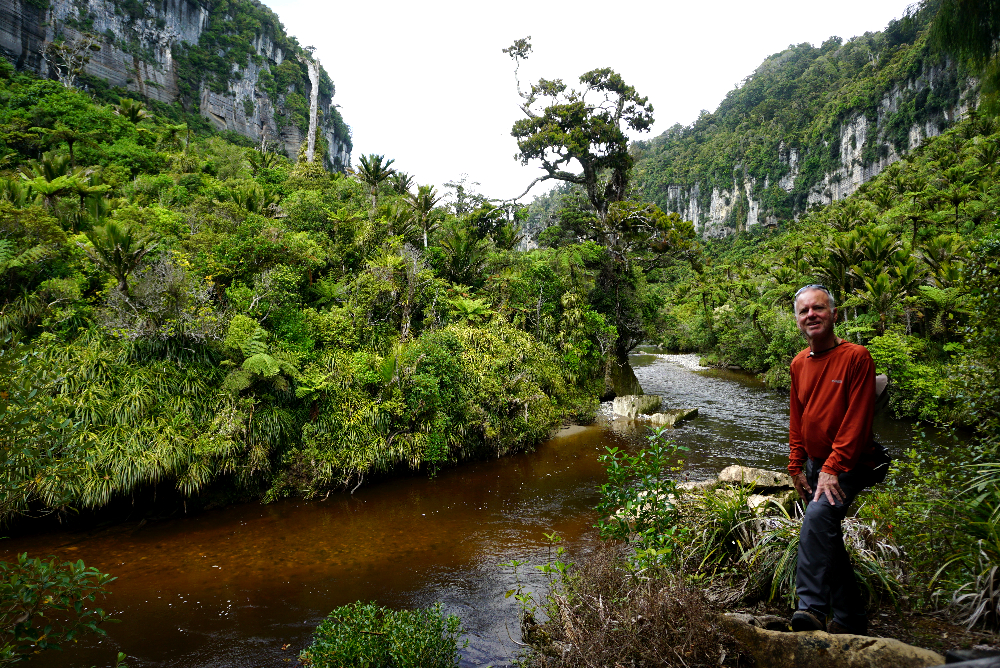
Refreshed, we drove across the highway and hiked the Pororari River Track. This is the first section of the 30-mile Paparoa Track, another of the Great Walks. This hike follows the Pororari River inland. The river runs inside sheer cliffs covered in palms, ferns and other rainforest trees and vines. It is like walking along a river in the Amazon jungle. Aimee likes hiking here because she doesn’t have to worry about dangerous animals. New Zealand, like Hawaii and the Galapagos, are new islands devoid of most mammals and reptiles. Only birds could fly here.

Back on the coast road we continued south for another forty minutes, passing great coastal scenery, stopping for the night in Greymouth at the mouth of the Grey River. After checking into our motel, we had dinner across the street at another pub.

Friday, November 18, 2022

November 19, 2022

November 19, 2022

This trip to New Zealand is going to be the opposite of our last one. No great art, no cathedrals, no long list of must-see sights. Instead it is a laid back visit to national parks with beautiful scenery. The one commonality is rain. Like Croatia, rain is in the forecast for the next ten days. It rained all night here in the supposedly sunniest spot in New Zealand. I guess sunny is relative. There must be a reason the terrain is so green.

Today we are going to explore the nearby Abel Tasman National Park. The park is named after the Dutch explorer who first discovered New Zealand in 1642. The coastal trail of this park is one of the ten Great Walks of New Zealand. Since rain is likely we hired a water taxi to ferry us up the coast so we can hike a short section of this 37-mile multi-day trek. We parked in Kaiteriteri Beach, gateway to Abel Tasman National Park. We had a very early lunch facing the sea and watching the non-stop rain. 

A small motorboat took us north up the coastline. It is beautiful but still rainy. The hilly coastline is lush with vegetation. It stands in nice contrast with the teal blue sea. In between are a few secluded golden-hued sand beaches. On the way we pass Split Apple Rock, one of the most photographed icons of the area.

We disembarked at Tonga Quarry Beach. The rain has stopped and we almost see the sun trying to peek through.

We found the Coastal Trail and began our hike south. We climb up the coastal headland through a wet jungle environment. Scattered within the many Beech trees are lots of ferns of all types, from the very small to a large tree variety. New Zealanders must like their ferns as it adorns many logos, including the Air New Zealand fuselage.

The trail was wet but very passable as much of it was hard granite. In a few spots we had to step carefully. We passed a guy who had sunk knee-deep in mud. Aimee almost did too.

Once over the headland we hiked down to Barks Bay Beach. It is low tide so we could have taken the short cut across the estuary but would have had to navigate across some deep streams. Instead we take the long route inland and across a swinging bridge.

We stop at the beach and have some snacks. There are several birds that want to join us, including a beautiful Red-Billed Gull and a large chicken-like flightless bird called a Weka or Maori Hen. The most brave were two ducks who literally were begging at our feet.

We passed two Maori carvings, or poupou that are placed to remind visitors that Maori were here before the arrival of Europeans. New Zealand is the third point of the Polynesian Triangle (along with Hawaii and Easter Island). The Triangle represents the farthest extent of Polynesian expansion across the Pacific. They only arrived in New Zealand 800 years ago making it the last major landmass to be settled by humans.


From Barks Bay, we climbed a short headland to Medlands Beach. After a forty-minute wait we caught a large catamaran-like water taxi back to Kaiteriteri Beach. Almost all the other hikers were much younger than us and most spoke a European language.

The weather is sunny and delightful so we decide to stay and have a delicious pizza dinner in a local pub. I wash it down with an English cider on tap. We toast the unexpected great weather we enjoyed today.

Thursday, November 17, 2022

November 15-18, 2022

November 15-18, 2022

We are off on another adventure. Neither Aimee nor I are quite ready to go. Thirty days is too short to decompress from our last trip and get ready for another. Especially when our orange trees are starting to ripen and the local varmints are taking a special interest in them. One decided to make his home in our BBQ pit to shorten the dinner commute. Unfortunately desert pack rats are smarter than me and quickly learn to avoid any deterrence I put in their way. Desperate, I borrowed a live trap from a neighbor and offered a whole orange as inducement. Fortunately he couldn't resist and now I feel free to leave.

We are headed on a long journey to the other side of the globe to New Zealand for many reasons. This is an outdoor adventure delayed by Covid that we need to do before I get too old. New Zealand also just reopened fully to tourists and we got a great early deal on flights. Airfare just a month later was triple the price.

Some nice friends took us to the Tucson airport for our late afternoon flight. Our flight attendant this time was hands down the best ever. American Airlines may now be our go-to carrier if British Airways is not involved. Landing in the Dallas Airport we were amused to discover a number of mosaic floor tile designs. It immediately reminded us of our recent stop in the Mosaic City of Ravenna, Italy.

Unfortunately that is where the good times ended. Just before we were ready to board our non-stop to Auckland, in the North Island of New Zealand, American announced a two-hour delay. That meant we were going to miss our connecting flight to Blenheim in the South Island, and our rental car pickup. We quickly got on the Internet and paid a stiff fee to take a later flight. Aimee and I both thought we probably should have planned for a delay better. But planning for disaster is balanced with long layovers and wasted days.

And then it got worse, when American later announced the flight would be scrubbed until noon the next day. A worst-case planning nightmare. American put the entire planeload up at local hotels. It was frustrating but probably a minor booking miracle on their part. At the hotel after midnight, we remade our schedule. But this time when I tried to delay the car pickup, the website said no vehicles were available! After a search of other cities, we found a car in Nelson and grabbed it. We paid another flight change fee and hoped there wouldn’t be any further delays. We also had to forfeit our first night hotel. Traveling these days is difficult without a fat credit limit. We fell fast asleep exhausted.

Up early the next morning, we had breakfast at the Business Lounge. It was worrisome that our flight was nowhere to be seen on the Departure board. I am just not up to making another round of changes. Since we are getting in very late now, we also needed a first night hotel at the Auckland Airport. We delayed that booking until the last minute.

Our Auckland flight left at noon on-time. The pilot related that the delay was caused by the recent launch of the Artemis moon-rocket interfering with our flight path. Since this is a fifteen hour flight, FAA regulations of crew member work times added to the problem. I wonder if I can get NASA to reimburse our considerable change fees.

Aimee and I spent the long flight watching movies and taking a few naps. We both watched Pretty Woman in tribute to our recent La Traviata opera attendance in Venice. Besides being based on this opera, Julia Roberts and Richard Gere attend a performance of it in the movie. In the middle of the flight we passed the International Date Line and jumped ahead a day. We will get it back on our return trip.

We arrived in Auckland after 10 PM. We get our luggage and through passport control quickly. Customs, though, wants to inspect our hiking gear for contamination. It is a joke as the inspector barely looks at them. With some difficulty we found the hotel shuttle bus. We have to buy a ticket. I am getting the feeling New Zealand charges for almost everything to fund their social system.

Up early again, we catch the shuttle back to the Auckland airport for our flight to Nelson in the South Island. The shuttle bus was a zoo with almost everyone manhandling humongous luggage. So glad Aimee and I pack light. Our puddle jumper was in clouds almost the whole way. The green landscape tells me that like Ireland and Scotland, New Zealand gets a lot of rain. Our nice Air New Zealand flight attendant is probably a Maori wearing a uniform inspired by native designs.

In the small Nelson airport we successfully get our rental car. We are back on track, just a day late and many dollars short. We stop at a local grocery store for supplies and then make our way north along the coastline. We are moving slowly until I get used to driving on the left again. In the town of Motueka we stop to view the Janie Seddon shipwreck, an old rusting hulk on a picturesque beach. In the ‘downtown’ area we find a Thai restaurant for lunch. The red curry was delicious.

We checked into our nearby accommodations just before it starts to rain. Rain is forecast for all week. Since we missed exploring the wine region of Marlborough, we bought a couple of local whites to test on our veranda. I am much happier now that we are finally here.
Newer Posts Older Posts