Friday, May 19, 2023

May 18, 2023

May 18, 2023

This morning we drove from Noto to the southeastern coast of Sicily to visit the Vendicari Nature Reserve. It encompasses the beach and wetlands of the area. On the walk from the parking lot to the shore, we saw lots of green lizards along the path and flamingos in the lagoons. Clumped up everywhere were thousands of fibrous balls. Apparently these are Neptune Balls that accumulate from a Mediterranean Seagrass called Posidonia Oceanus or Neptune Grass.

Along the shore is also the remains of a Tonnara or tuna processing plant. Tuna was a traditional fish caught in the Mediterranean until the Japanese moved in with their industrial fishing boats.

We then drove down the coast to the fishing village turned beach town of Marzamemi. There we shopped and had lunch. We ate local entrees. The boys ate Linguini with Anchovies. The girls had a Fettuccine with Red Pesto and local sun-dried tomatoes. The girls chose better.

We then returned to Noto for our walking tour. Noto is a new town built after the 1693 earthquake. Since it was built from scratch it is the Disneyland version of Sicilian Baroque. The facades of almost every building are elegant with lots of unnecessary monumental staircases everywhere.

Tomorrow is the start of the Noto Flower Festival, Infiorata di Noto. We watched the city get prepared. There are vendor booths everywhere. In particular one steep palace-lined street gets decorated with flowers. The theme this year is Italian cinema. We watched the artists use templates to design their entries. The flowers will be added tomorrow night after we are gone. We should have stayed one more night.

For dinner we went to the restaurant that Madonna ate at last year. It is underneath the Church of San Carlo where the crypt should be. The food was great. Aimee and I had Pasta with Pistachio Green Pesto and a Cherry Tomato Salad. The locally grown Pachino Tomatoes were extraordinarily sweet. We paired it with a Mt. Etna red wine. For dessert I had a Granita at the gelatoria. Granita is a fancy Italian sno-cone. I prefer the gelato. 

Thursday, May 18, 2023

May 17, 2023

May 17, 2023

This morning we set out from our hotel in Noto to explore the World Heritage site of the Late Baroque Towns of the Val di Noto. The Val is the southeastern corner of Sicily. The geography is very different from what we have seen. It is mostly a rocky plateau that is heavily eroded into steep canyons by several rivers.

We start in the city of Ragusa, clinging to the side of a steep canyon. This corner of Sicily was devastated by an earthquake in 1693 which leveled most buildings. All the cities were rebuilt in the 18th century at the same time in the same Spanish-influenced Baroque fashion. We first visit the Chiesa San Giuseppe that illustrates the style. It has a very ornate three-dimensional facade that was designed to demonstrate the power of the Roman Catholic Church. In comparison, the interior is surprisingly small and subdued in decoration.

We then walked to the Duomo of San Giorgio. This church has a similar Baroque facade. It is built on a hill at the end of a piazza with a long monumental staircase. It looks very impressive. The interior contains a statue of St George slaying the Dragon that is paraded through the city on holy days.

Before leaving town we have a quick lunch of Scaccia, an Italian sandwich. We had one with thin bread filled with ricotta cheese and fava beans. Tasty.

We then drove into the country to visit the Castle of Donnafugata. The Kingdom of the Two Sicilys (Sicily and Southern Italy) was one of the last feudal monarchies in Europe. The Spanish Bourbons were overthrown when Garibaldi invaded Sicily in 1860 and unified Italy for the first time. Peasants were then free to leave the estate. Wanting land of their own, many left for the US.

We toured the once elegant villa. It looks like a time warp to me. With the pealing wallpaper, dusty furniture, and timeless decoration, it looks like the villa was abandoned and never lived in again. I think it is interesting but my travelling companions are not impressed.

We also did a quick tour of the gardens but they are in need of maintenance. The private owners of the estate need a lot more tourist fees to recover that lost glory. One of the highlights of our tour was the return of the cattle and donkeys from the field to the barn.

On our way back to Noto, we stopped in Modica, another Baroque city clinging to a cliff. We started at a nice overlook to get a sense of the layout. We then visited the Duomo, another church dedicated to San Giorgio. Since it is built on the side of a hill it also has a long monumental staircase.

We then followed that up with a visit to a Chocolate store for tastings. Chocolate in Modica is made by a traditional Spanish process of cold mixing the ingredients. As a result it is a little crunchy with undissolved sugar grains. Aimee likes it. Across the street is the Church of St Peter. It has a long staircase filled with statues of the twelve apostles.

On our return to Noto, we had our welcome drink on the hotel terrace. The weather is nice and sunny albeit a little windy. We then went to dinner down the street, where Aimee and I had Swordfish with Caponata. For dessert we found a gelato store.

Wednesday, May 17, 2023

May 16, 2023

May 16, 2023

We woke up to cloudy weather, but it is not raining. Aimee and I have our fingers crossed it stays that way. We need no rain for our outdoor museum visit this morning.

From our Agrigento accommodation we can see the Valley of the Temples Archeological Park, a World Heritage Site, on the hill above. The Greek temples were lit up last night.

We met our guide and we drove up to the park. Akragas was the third largest city in the Greek world. At its peak there were more Greeks in Sicily than in the homeland. The ridge top or acropolis held a long line of temples devoted to the many deities in the Greek religion. The population lived in the valley surrounding it. A few miles away was the seaport. We started at the east end and walked downhill to the other side. 

We began with a visit to the Temple of Juno. This temple was re-erected. Sicily is very seismically active and the majority of temples collapsed over the centuries. Oftentimes the carved stones were repurposed over the years for new structures. We are lucky there are any original stones left. In Sicily the local limestone, while easy to carve, does not weather well. After construction the temple would have been faced with plaster to mimic the marble of the Greek homeland. It also would have been gaily painted.

The Temple of Juno is unusual in that it is fronted by a large stone sacrificial altar. Most every temple would have had one but these stones were the easiest to carry away.

We then walked down the ridgeline following the outer wall. Even in ancient times it was a dangerous world. There were enemies all around. Besides rival Carthage and the other Phoenicians, there was also warfare with the other Greek city-states. For protection the entire acropolis was surrounded by a wall. In medieval times, the local Christian community used the ridge top as a cemetery. We see many burial niches carved in the wall and rock outcroppings.

Continuing on, we pass lots of almond and pistachio trees. We also see the Acanthus flowers blooming. The leaves of this weed are the ones portrayed in Corinthian capitals, popular with the Romans. Here though the simpler Doric order capital predominates.

We soon come to the jewel of Sicily, the Temple of Concordia. It is probably the best-preserved Greek Temple anywhere. It is in great condition because it was converted into a church and maintained over the millennia. We can see arches cut into the inner sanctuary walls. This Cella or inner sanctum of a Greek temple would have contained a large cult statue. Unfortunately, none of these statues were found. Neither were any of the exterior pediment decorations.

Further along we come to the Temple of Hercules. Most of this temple lies scattered around. Only a few columns have been re-raised. We can see the notches used to align and lock the columns. We can also see some remnants of the white plaster used to face the columns.

Next we come to the Temple of Zeus, which was the largest temple ever built. It was constructed to celebrate the Greek victory over the Phoenicians of Carthage in 489 BC. Besides being immense, it had the unusual feature of having numerous figures of Atlas holding up the pediment around the facade. The temple is all rubble and only a few of the Atlas statues remain, all lying on the ground.

The Temple of Dioscura finishes our tour. Only a corner of columns has been raised. Outside the exit, we run into a line of Porsches leaving the parking lot; another car club event. Sicily must be a mecca for car clubs and rallies.

It is late and we have a long drive ahead, so we make a quick stop at a sandwich shop for lunch. Aimee and I split a ham and cheese Calzone. Delicious! My sister made me eat part of her Chocolate Pistachio Truffle.

We drove for a couple hours northeast into the middle of Sicily. Near the city of Piazza Amerina we find the road flooded for miles making travel slow. This is prophetic because that is key to our next site. We are visiting the World Heritage Site of Villa Romana de Casale. This is a massive Roman villa that was well preserved because it had been buried by a mudslide during a long-ago Sicilian rainstorm. Casale is the Pompeii of Sicily.

The roof and most of the walls of this villa were washed away by the landslide, leaving the mosaic floors. This villa easily has the largest intact set of Roman mosaics anywhere. Only in a few minor areas do we get any glimpses of how the walls were decorated.

We start our visit with the thermal baths that were an essential part of Roman life. We see the wood furnaces that were used to heat the warm air that circulated through the spa. It had three rooms of different water temperatures and a room for massage. Next to it is a gymnasium with a mosaic featuring a chariot race ala Ben Hur.

We then enter the villa through the grand entrance. It is a circle just like Italian villas today. I can easily imagine horse-drawn chariots arriving.

The center of the villa is an enormous columned peristyle hall encircling a grand fountain. The perimeter has a mosaic floor of the heads of wild animals of all sorts. Adjoining either side are guest rooms with mosaic floors of geometric patterns. Complicated floors were reserved for important spaces.

A dining room has a series of hunting scenes showing how the meat would have been captured. A similar room shows how fish were caught.

On one end of the peristyle courtyard is a great hall with an amazing 200-foot-long mosaic floor. It contains complicated scenes of wild animals, like ostriches, lions, and elephants being gathered from every corner of the known world and loaded onto ships for transportation.

The owner of the villa is unknown. Because of its palatial style, it was thought he must be one of the Tetrarch emperors of the late Roman Empire. This animal gathering scene strongly suggests it was someone involved in the collection of animals from distant lands for use in gladiatorial combats. That must have been very profitable business as the demand was probably insatiable. He might have been the Bill Gates of the Roman world.

The most popular room is one that has bikini clad women doing sports. And we thought that was a modern invention.

We next visit the owner's suites. Interestingly the male rooms have Playboy-like floor mosaics, while the wife’s is decorated with flowers and fruits.

The last room we view is the Basilica, or Great Hall. This would have been where business was conducted. It is the most lavish and the only one without a floor mosaic. Instead, the floor was constructed of solid marble slabs of various colors.

From the villa we need to drive southeast. Because of the flooding we encountered, we decide to take the long way around to the north, keeping to the highways as much as possible. We pass vast stretches of unforested land filled with farm fields. In Roman times, Sicily was the breadbasket of the Empire, at least until Egypt was conquered.

We stop for the night in the cute town of Noto. Our hotel is in the old section and we have a third-floor balcony overlooking the area. We have a nice dinner of Grouper and salad, followed by Cannoli for dessert. Cannoli and Ricotta cheese are Sicilian specialties. A Cannoli is a sugary ricotta mixture scooped into a fried wafer.

Monday, May 15, 2023

May 15, 2023

May 15, 2023

The weatherman forecasted severe rainstorms for today. Unfortunately for us, he was correct. In response the government issued a Red alert for western Sicily and ordered the shutdown of schools and government facilities. That means no museums or archeological sites are open today and our touring plan is void. Even our hotel shutdown the breakfast buffet. We loaded our luggage onto the van in driving rain. With Plan A and Plan B shut down, we moved to plan C.

We drove south to the city of Marsala. The city's modern name comes from its Arabic period. It means Harbor of Allah. We were going to take a boat to the island of Mothia just offshore to see the ancient settlement of the Phoenicians. Instead we toured the Salt Museum. The western shore of Sicily is very shallow making the region ideal for the production of salt. It is probably why the Phoenicians built a trading colony here.

We watched a video of the salt-making process, then toured an old wooden mill, and finally climbed the stairs to an observation deck. This ancient process requires expansive flat ponds adjacent to the sea in a sunny dry climate. The primary ponds are filled by tidal surges. After initial evaporation, the brine is pumped using windmills and Archimedes Screws to higher ponds where further evaporation precipitates impurities. Another series of ponds continue the evaporation until the salt begins to crystallize. Mother Nature does much of the initial work. After that, significant manpower is required to loosen the salt so the brine can drain away, and the crystals shoveled into piles for drying and transportation. A small quantity of very pure 'Flower of Salt' can also be skimmed off the surface of the brine ponds.

Besides salt, the city is also famous for Marsala Wine. This is a fortified wine similar to Port and Sherry. We visit a winery to learn about wine making in Sicily. Fortified wine was derived from a local practice of making Perpetual Wine. Many locals would keep a barrel of wine for personal consumption, adding to it every year. Over time water would evaporate from the barrel increasing the alcohol content.

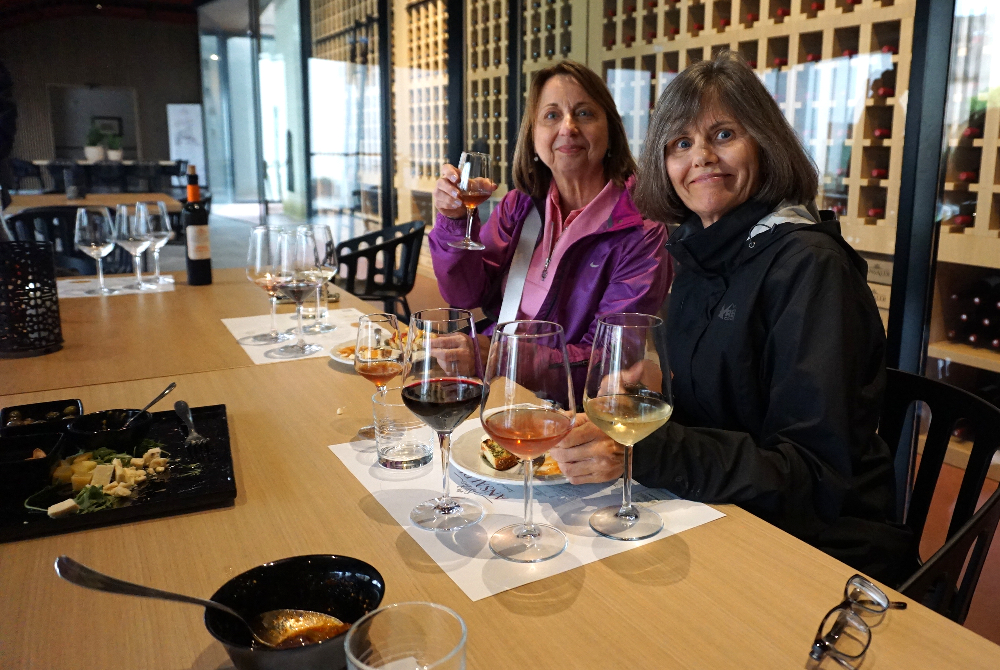
After touring the winery, we sat down for a tasting and light lunch of Sicilian snacks. Besides Cheese, Olives, Marcona Almonds, and Bruschetta, we had Caponata. This is eggplant in a sweet and sour sauce. Quite tasty.

From Marsala we drove east across the interior of Sicily. It is almost all rural and full of farm fields. Surprisingly for a poor region, the roadway has many mountain tunnels and raised viaducts. Sicilian highways were expensive to construct.

Because of the weather and government edict, we bypassed Selinunte, the largest archeological site in Europe. It was one of the most important Greek colonies in Sicily 2500 years ago. Fortunately we saw the most important relics of Selinunte in the Palermo Museum a few days ago.

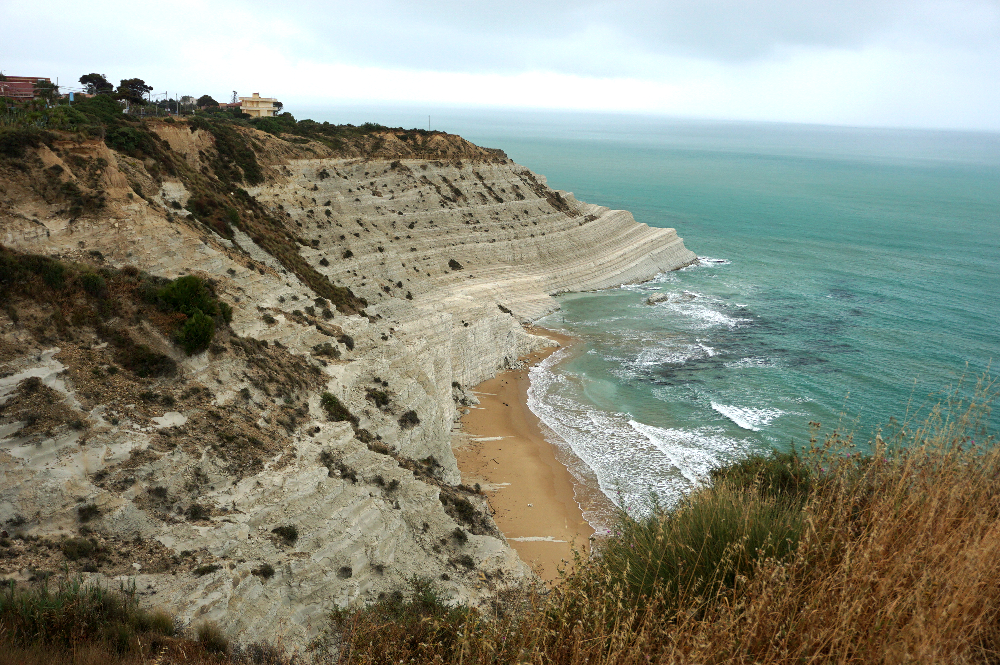
Near the end of the day, we made a brief stop to see the Turkish Steps on the southern coast. Here the easily eroded white limestone cliffs have been transformed into a beautiful staircase of rock.

We finished the day in Agrigento where we checked into our Baglio, or Fortified Farmhouse accommodation. In olden days, even farmhouses had to worry about being attacked. Especially those near the coast who were vulnerable to Barbary pirates. Tunisia is only a hundred miles away.

We had dinner in their dining room. It was outstanding. We started with a Zucchini appetizer followed by two portions of a Sweet Potato pasta dish. For dessert we shared a decadent Pistachio Parfait. I also ordered an after-dinner glass of Marsala wine. As expected, it tasted like Sherry.

May 14, 2023

May 14, 2023

We awoke in Palermo, Sicily. It is Mother’s Day and we see runners assembling in the piazza below. While packing up we hear the starter pistol and watch them begin the race to the theme of the Queen song, Don't Stop Me.

From Palermo we drove west along the coast. It is cloudy and it looks like rain. After an hour we turned inland to visit the Temple of Segesta. Once parked we notice a line of old motorcars pass by. An antique car club must be having a road rally. We then see a bunch of Ferraris parked near us.

From the parking lot we walked uphill towards the Temple. We laugh seeing Agaves lining the path. Many are in bloom. These are not native. Agaves and Prickly Pears are both transplants from the Americas but seem to have taken over Sicily.

The Temple of Segesta sits atop a small hill all by itself. It seems in very good condition. It is constructed of limestone rather than the typical marble we expect from other Greek and Roman temples. Our local guide tells us this Doric Temple is not actually Greek. Archeologists believe it was built by the local inhabitants called the Elemi, who like the Romans, enthusiastically adopted Greek culture. The Greeks expanded from their traditional homeland and built colonies all along the coast of Sicily and Southern Italy. Despite not being Greek, the locals must have been superb stonemasons. The joints are almost perfect without the use of mortar.

The temple was built around 420 BC but looks incomplete. From above it looks like a child's cradle with only the outer columns in place. There is no inner sanctuary, nor are the columns fluted. There was continual warfare for control of Sicily between the local inhabitants, the Phoenician trading ports, and the many Greek city-state colonies on the island. It is likely one of these wars stopped the construction.

From the temple we took a shuttle bus up the steep hillside to the actual town of Segesta at the top of the hill. For defense most cities were located atop an Acropolis (high city). On the drive up, we get good overviews of the temple.

The hilltop contains several ruins from history, including the Agora or marketplace. None are in good condition except for the theater, which dates to the Roman era. The lower half of the seating still exists and has a great view of the valley leading back to the coast. The theatre was an important part of Greek culture. Here plays were performed and government policies debated, whereas the Romans mostly used them for crude entertainment and mock battles. In many ways the Greeks were the philosophers, and the Romans their practical counterparts.

Along the walk, we noticed the local vegetation. Except for the invasive Prickly Pear, it was very different from our own. The most unusual was a weed that grows in the shape of a Christmas tree.

Leaving Segesta we worked our way overland to the western shore. While climbing the mountain to the hilltop town of Erice, we get great views of the northwest coastline with Monte Cofano in the distance.

In Erice we stop and begin our tour. It is a cute town. It should have great views but we are above the clouds now. Fog is a problem with western coastal regions. We stop for a lunch of the local pasta specialty, Busiate al Pesto Trapanese. Busiate is a narrow corkscrew pasta that holds sauce very well. Interestingly the Pesto here is red, not green. The basil-based Green pesto is Genovese (Genoa, Italy region). Pesto refers to the method of the paste preparation, i.e. crushing in a Mortar with a Pestle.

It seems our luck ran out today. The fog is thicker and it is starting to rain. But since we are in the clouds and not below them, it is more of a mist. Either way we cannot see anything. Since hilltop Erice is mostly about the expansive views, this visit is a bust.

We do visit the Royal Cathedral before leaving. While it is ancient the interior nave was totally reconstructed in the 19th century. It is very unique with the ceiling looking like carved ivory scrollwork, or maybe since we are in Italy, it looks like a Pasta Church. There is also a Madonna shrine that is paraded through town during times of need. An interesting plaque lists the years and what prayer the townspeople needed fulfilled from war to plague to drought. I think people today forget that there have always been crises of some kind. Life is never easy.

From Erice, we made our way down the mountainside to the coastal city of Trapani. The city sits on a narrow peninsula sticking out into the sea. Our hotel sits on the open ocean side. After checking in, we walked the very short distance to the opposite shore that is filled with cruise ships and ferries. In the distance we can see piles of salt, from the many saltpans that line the shallow western shore. The city of Trapani is mostly modern as it was bombed to smithereens in WWII during the run up to the Allied invasion of Sicily.

For dinner we walked down the street to a pizzeria. Our pizza was made with Mozzarella di Bufala, a cheese variety made from the milk of a Water Buffalo.
Newer Posts Older Posts