Sunday, July 14, 2024

July 13, 2024

July 13, 2024

We got a late start today to help our body clocks adjust and to enjoy our nice hotel. Midmorning we strolled across Waterford past some ruins of the old city walls. Next to the Cathedral we encountered a modernistic statue of Strongbow and Aoife. Strongbow was an Anglo-Norman knight who was invited here in 1170 by the Irish regional king for help to recover his throne. As a reward Strongbow married the king’s daughter and inherited the kingship of Leinster. Unfortunately he brought along his friends and soon Norman knights were ruling most of Ireland. On the plus side they were also Catholic, married the local women and assimilated. So much so that they famously became “More Irish than the Irish”. This also explains why my Irish DNA analysis has a lot of Scandinavian. I have one ancestor with the Norman name Lovett. I don't know if it is a compliment or hubris that the Brits most popular cider is named Strongbow.

We finished our walk at the House of Waterford where we signed up for the Waterford Glass factory tour. With an Irish mother-in-law, our house has a large inventory of glass from this production site. Since we are early we start by exploring the retail shop. General production has been moved to Slovenia, with this site now only producing specialty products like sport trophies.

Waterford glass is lead crystal that is blown, shaped, and polished. Then comes the tedious process of grinding the cut-glass decorations. We see examples of the entire process.

After the tour, we return to our hotel, check out and drive west on the motorway. So much better than the winding roads of yesterday. Just east of Cork we briefly stop to see a unique sculpture titled Kindred Spirits. This relatively new installation has nine large metal feathers because it was made to honor the Choctaw Indians who donated to Ireland during the Great Famine. The Irish have a soft spot for other people who feel they also have been overrun by stronger nations.

Our next stop is the island city of Cobh in the Cork Harbor estuary. Named over the years, Cove, Queenstown, and now Cobh, it has been a major naval and commercial port. After parking by Cobh Cathedral, the tallest in Ireland, we walked down the very steep streets to the shoreline. Uhoh, we see that Cobh is still a major cruise port! The presence of a large ocean liner means we have difficulty finding a spot for lunch.

Our hunger satisfied, we walked the port of this tiny but cute town. My ancestors probably left Ireland from here. There is a memorial to Annie Moore, an emigrant who was the first processed at Ellis Island. All Cobh emigrants weren’t so lucky. This was also the last port of call for the Titanic. The White Star Line office is still standing and now holds a museum. A few blocks away is the old Cunard office. Three years after Titanic, Cunard’s Lusitania was sunk by a German U-boat just off-shore. Most of the recovered bodies were buried here in mass graves. We visited the old cemetery on our way into town. The Lusitania is of special interest because Aimee and I both recently read Dead Wake, a stirring book about this tragedy.

From Cobh we bypass the city of Cork and finish in the port of Kinsale. We have a delicious Indian curry for dinner.

Friday, July 12, 2024

July 12, 2024

July 12, 2024

We checked out of our Dublin hotel and taxied back to the airport. There we picked up our rental car so we can explore more of Ireland. We take it slow until I get the hang of driving on the left again. That part came back easily unlike the driving of curvy narrow roads of this country. I forgot how tedious and draining it is. I was hoping that Ireland rising to become one of Europe’s richest would have improved things.

We drove south of Dublin into Wicklow Mountains National Park along the old Military Road over Sally Gap. This route down the spine was built in 1800 to make it easier for British forces to track Irish insurgents hiding in the remote area. The road crosses extensive treeless tracts of heath and bogland. It has a raw beauty.

Near its center we stop at the Glendalough Monastic Site. This remote glacier carved valley was the perfect site for St Kevin, the 6th century hermit monk looking to be close to nature and away from temptation. Today though it is mobbed with tourists from Dublin wanting to hike the beautiful area. The highlight of the small settlement is one of the iconic Round Towers of Ireland. It is in great condition. This bell tower could also be used as a place of refuge when Vikings raided the site. After watching the park film we did an abbreviated hike down the valley. It is colder than we expected. We cut it short and had a hot soup lunch in a local hotel.

We continued our drive south to the coast at Waterford. Waterford is the oldest city in Ireland, the first permanent settlement of the Viking Raiders. The city name means Winter Port in Old Norse. Raiding is easier if you have a local home base. Settling down meant the Vikings married local Irish ladies and diversified into trade focusing on silver and slaves. We learned this history at nearby Reginald's Tower, the best surviving part of the defensive walls of Waterford.

We had dinner back at the pub in our historic hotel, one of the oldest in Ireland. The pub is a very hopping place. Interestingly it is named after Thomas Francis Meagher. He was born at the hotel, became an Irish freedom fighter, and was sent to a penal colony in Australia. Escaping, he made his way to the US where he became a hero again fighting in our Civil War. There is an equestrian statue of Meagher in Waterford as well as one outside the Montana Capitol.

Thursday, July 11, 2024

July 11, 2024

July 11, 2024

I tossed and turned last night while Aimee slept like a baby. We were both up early with the time change. After it stopped raining we got out and took a walk for exercise across the Liffey River to Dublin's large Phoenix park. On one end sits the Wellington Monument, a 200-foot obelisk, the tallest in Europe. This is a great tie-in to the movie Napoleon that I watched on the flight here. The 1st Duke of Wellington was born in Dublin back when it was the second city of Britain and ruled by the Anglo-Irish elite. Wellington, a war hero, was probably Britain’s greatest general who defeated Napoleon at Waterloo in 1815. With the English long gone, this monument is an historical anachronism.

Later in the morning we walked a mile east to St James Gate to visit the Guinness Brewery. I bought pricey tickets while waiting in-line. Instead of the standard brewery tour, it was a Disney-like self-climb up a repurposed old fermentation plant. The only interesting part was the vintage video of how the original wooden kegs were painstakingly made. Brewing the beer was the easy part. Even the explanation for why Guinness uses nitrogen to create its distinctive head was weak. The highlight of the tour was the pint of stout we received on the top floor while enjoying 360-degree views of Dublin. Fortunately the weather obliged. Both Aimee and I thought it was way too early in the day to be drinking a heavy beer.

Leaving the brewery we caught a cab downtown to visit the National Museum of Ireland. For a small country that spent most of recorded history as an agricultural backwater, Ireland must have had a significant pre-history based on the wealth of artifacts discovered. The abundance of gold jewelry on display indicates the ancient pre-Celtic Irish must have been wealthy and skilled metalworkers. For some unknown reason much of it was unearthed while digging up turf or peat for fuel. It is thought the gold may have been ritually discarded in the bogs!

Ireland was obviously also a violent land because of the abundance of bronze weaponry, especially swords and spear tips. Bodies have also been unearthed. They are in remarkable shape because of the acidity and low oxygen of the bogs. There is also a large section on Viking Dublin. Interestingly after raiding, the Vikings quickly pivoted into overseas trade and commerce. They introduced the first balance scales and standard weights.

We are reaching Aimee’s limit in archeology, so we fly through the medieval periods and exit the museum to get some exercise and fresh air. In Merrion Square Park we pass a colorful statue of Dublin-born poet and playwright Oscar Wilde. Nearby we stopped for a Thai lunch.

Crossing the Liffey River, we see a harp-shaped bridge, a replica Famine (or Coffin) ship, and a memorial to the Great Famine. We stop in the Neoclassical Palladian-style Custom House. There is a small museum about its role in the Irish War of Independence. To the indigenous population this building was the epitome of English Rule, so it was purposely burnt down despite the heavy loss of life. Tragically for me and others of Irish heritage, we also lost a lot of irreplaceable historic genealogical documents.

Afterwards we walked past the General Post Office, which was the epicenter of the 1916 Easter Rising, and then back across the Liffey to the Temple Bar area. From there we taxied back to our hotel. We are exhausted from all the walking on hard pavement.

Wednesday, July 10, 2024

July 9-10, 2024

July 9-10, 2024

We are up early to finish packing before our driver arrives who shuttles us to the Phoenix airport. Our first flight to Chicago is delayed, as is our second overseas leg. That is the new normal for travel today. However, we are thankful our Aer Lingus flight even takes off. Their pilots are striking for higher pay causing the airline to cancel lots of flights.

Not unexpectedly we arrive in Dublin to rainy weather. We dig out our rain coats and take a taxi to our hotel. This trip to Ireland is a replacement for the 2020 one that Covid cancelled. Aimee’s Irish mother would have approved.

After an hour nap and a couple cups of coffee, we are out the door for a walk. We know we need to get our body clocks reoriented. Across the street is the park-like grounds of the former Royal Hospital. From the small history exhibit we learn this facility was really a military retirement home similar to the one in Washington DC. The building now houses a modern Art museum. The art installations do nothing for me.

Also next door is Kilmainham Gaol. We signed up for a tour almost a month ago. We start in the disorganized museum. The gaol started life as a normal prison; normal that is for the Victorian era. Heat was non-existent, food scarce, and the clientele, both men and women, spanned all ages. The youngest was an unbelievable three-years-old, convicted of begging (vagrancy). The gaol was designed for 1500 prisoners but swelled to six times that during the Great Famine, when people decided going to prison beat starving to death. It reminds me of WWI where we learned men joined the Army just to get new shoes and a reliable meal.

At our appointed time we met our docent for a guided tour. It was excellent. We started in the old section of rows of dark cells, before moving into the ‘modern’ section that was well-lit and in the round so guards could more easily observe prisoners. The prison became infamous and an Irish national monument in the 20th century when it went from housing ‘criminals’ to political prisoners. When fourteen leaders of the 1916 Easter Rising were executed by firing squad here, it lit a public storm that resulted in open rebellion, English capitulation, and the creation of the Irish Free State a few years later.

After the tour we went across the street to a Pub for a burger and Guinness dinner.

Saturday, June 29, 2024

June 27, 2024

June 27, 2024

Once again my back popped so we didn’t play golf this afternoon. Instead Aimee thought we might get out of the heat by seeing a movie at the theater, something we probably only do once a year now. I remembered why when we went to buy a ticket. No clerk and a non-standard kiosk. We purchased two Fathoms, whatever kind of ticket that is. The movie was already starting when we entered a few minutes late. That is a first. What happened to fifteen minutes of previews?

We came to watch “Something to stand for”, a movie made and narrated by Mike Rowe, famous for the TV show Dirty Jobs. Aimee is in love with his deep voice. I should be jealous but I like his practical down-to-earth perspective. Common Sense is so rare today. The movie featured a series of vignettes telling Paul Harvey-type stories about a famous person and a little known event in their life. You are left guessing who the subject is. They are all feel-good stories about people who made America great. Good timing just before the Fourth of July.

We got home just in time to watch the Presidential debate. Just the opposite. Depressing and sad. I couldn't watch it. What has become of our country. And yet we are head and shoulders above the rest of the world. We succeed despite our incompetent government.

Wednesday, June 19, 2024

June 18, 2024

June 18, 2024

Three months ago after prepping for the March Presidential Preference Election we noticed a strange eerie cloud in the western sky. We later learned it was the setting sun reflecting off the vapor trail of a SpaceX rocket launch out of Vandenberg Space Force Base on the California coast. I was surprised we could see it from 640 miles away! That sparked a mild interest in actually seeing it launch real time.

Last night Aimee and I and our next-door neighbor drove to a high spot in the neighborhood and waited at the expected launch time. This time the Falcon-9 rocket launched on-time with 20 satellites aboard and what a spectacle it was. It started as a flare rising from the western horizon. The rocket's exhaust plume expanded as it rose into the sky while the long tail drifted in the wind still reflecting the sunset. Incredibly the first stage rocket booster landed upright on a drone-ship in the Pacific Ocean minutes later to be reused again for a future launch. What a remarkable age we live in.

While Vandenberg polar orbit launches are not as frequent as Canaveral equatorial ones, they are becoming quite common. Last night was the 20th this year. SpaceX has put over 6000 satellites into orbit already to support their Starlink Internet program. This is a huge percentage of the total 9000 functioning satellites. While this program will advance Internet availability around the world, its negative effect on space junk, astronomy, and earth atmospheric chemistry remain to be seen.

Thursday, May 16, 2024

May 4, 2024

May 4, 2024

Aimee and I have been remarking for months that we need to get out and hike occasionally to complement our daily walking routine. Well today we made good on that threat by driving to nearby Catalina State Park. In particular I have been wanting to see the effect of the 2020 Bighorn fire which slowly burned and smoldered for six weeks. The trail was closed for a long time for safety and to prevent erosion. Except for a poster board at the trailhead, one would never know there was a recent fire. The only evidence was a couple Saguaros with what looks like scorch marks on the lower half. Even then it was only a few specimens. Aimee and I have always commented on how Mother Nature quickly reclaims territory in the desert.

Like the more destructive Maui Fire, our Bighorn fire was blamed on invasive grasses that were introduced to our environment. The fear is that these grasses would subject our iconic saguaros to devastating fire. That seems to have been overblown. Desert bushes and Mountain Goats seem to be keeping it in control in the mountains. But not so for our yard. The unusually wet winter is fostering grass growth anywhere the desert has been cleared.

Our six-mile, three-hour hike in beautiful weather ended at Romero Pools. It is always a treat to find water in the desert. The shade, waterfalls, and higher elevation was refreshing.

Tuesday, April 16, 2024

April 13, 2024

April 13, 2024

Before leaving Tupelo, MS we drove south of town to visit Elvis Presley Birthplace Park. Despite being born in 1935, his Shotgun shack still stands in the original spot. After he became famous the city bought the property and Elvis donated money for a park around it. It is now a large tourist attraction despite his family only living here three years. His musical legacy is similar to New Orleans in that he revolutionized music by combining Blues with Country, Pop, and Gospel.

After this brief stop, we drove east towards Birmingham. We bypassed the city and continued another hour. It is a beautiful drive through rolling forested hills. We passed the Talladega Speedway just west of Anniston. Anniston is having a bike race and street fair, so the downtown streets are blocked off. It looks like a nice city. Sixty-three years ago, it wasn't so inviting. We park and walk through the festival to Freedom Riders National Monument.

Alabama was a hotbed of Jim Crow and segregation. Blacks were required to sit in the back of buses. Civil Rights activists organized resistance movements taking a bus from Washington DC through the Deep South to New Orleans in defiance of segregation laws. In Alabama these riders were met with violence. Anniston police were eager to get the trouble out of their town. Just outside city limits, the bus was stopped and firebombed. On the exterior of the old Greyhound Bus Station is a mural with lots of storyboards recalling the event.

We retrace our drive back west to Birmingham. Eerily we follow a Greyhound bus downtown. We stop at the Birmingham Civil Rights National Monument. This park commemorates the events centered around the segregation epicenter of Birmingham. We start at the Civil Rights Institute. It begins with a short film that concludes with the screen rising and doors that open into the museum. The exhibits chronicle the many steps that it took to establish freedom for blacks in this state and in particular this most industrialized city of the Deep South. Unfortunately the response was particularly violent here, led by the infamous local sheriff “Bull” Connor. The museum is particularly well done. There are numerous videos of Democrats making insane comments which just reinforces some things never change.

One interesting tidbit I learned was that Republican president Warren G Harding was the first president to visit the Deep South since the Civil War. In 1921 he came to help Birmingham celebrate its 50th birthday and praise its growth. His speech concluded with advice that the city could achieve more by harnessing the industry of all their citizens black and white. A wonderful "free market capitalism" speech that fell on deaf Democrat ears just as it continues to this day.

Afterwards we walked the neighborhood. Across the street is the 16th St Baptist Church which was firebombed killing four young girls. One more reason Birmingham got the moniker of "Bombingham". Today the church is hosting a wedding.

Around the corner is the Gaston Hotel where civil rights activists often met and stayed. It was owned by a wealthy black entrepreneur who financially supported the effort. He was worried that tensions would lead to destruction of the city. His secret entreaties to his fellow white businessman may have been the nail that finally solved the desegregation problem. Money is what often talks.

We finished the day at the Birmingham Airport where we ditch the rental car. We drove too many miles on this quick tour, so we are happy to be flying back home. We had drinks and dinner in a pub. Photos of Charles Barkley grace the walls. We learn he is a favorite son of the area. The flights back are mostly uneventful though we don't get home to Tucson till after midnight.

Saturday, April 13, 2024

April 12, 2024

April 12, 2024

This morning we drove to the north side of Jackson, MS and found Medgar and Myrlie Evers Home National Monument in what in the 1960’s was a new suburban black community. We read the storyboards around the parking lot to learn their story. Medgar was the NAACP Leader of Mississippi and active in organizing voter drives, boycotts, and integration campaigns. The Ku Klux Klan targeted him. He was murdered in June 1963 outside his home. His death caused a national uproar. The assassin was only convicted 31 years later.

We then walked into the subdivision to find and tour his home. The ‘60’s decoration looks like my family childhood home.

We left Jackson following the Natchez Trace Parkway northeast to the interstate and then headed north. After an hour we descended bluffs into the Mississippi Delta National Heritage Area. This crescent in northwestern Mississippi is the flat fertile bottomland between the Mississippi River and its tributary Yazoo River. It was a prime cotton growing region.

We stopped in Greenwood, MS, Cotton Capital of the World. Cotton would be hauled here and loaded on barges that sailed down the Yazoo River to Vicksburg for shipment overseas. To celebrate the Delta Heritage we tried to find a southern restaurant in Greenwood. We first stopped at a BBQ stand but it had no bathroom or tables. We next found a cute southern diner but the wait was too long.

We crossed the Yazoo and kept on driving north until we found Graball Landing down a long dirt road on the Tallahatchie River. This is supposedly where Emmett Till’s body was recovered. Wanting to learn his story, we stopped in Sumner looking for Emmett Till and Mamie Till-Mobley National Monument. It is located in an affiliated Interpretive Center. We arrived just in time to join seventeen Minnesotans on a Civil Rights tour of the South. We followed their group across the street and into the courthouse. For the next hour we listened to the docent relate the murder.

Emmett Till was a Chicago kid who came to spend the summer of 1955 with his cousins. Not knowing the local “rules” he almost immediately got himself into trouble. He was kidnapped and killed and his body recovered at Graball Landing. The two murderers were acquitted in this courtroom. His mother exhibited his body in an open casket in Chicago for the world to see.

Afterwards we drove east past Oxford and the University of Mississippi ending in Tupelo, MS. We walked across the street to a BBQ joint. I had the brisket and Aimee had the pulled pork.

Friday, April 12, 2024

April 11, 2024

April 11, 2024

We checked out of our hotel and drove toward the French Quarter of New Orleans. With the unplanned park closure yesterday we need to cram that agenda into this morning's schedule. We found a parking lot and walked towards Jackson Square. The Police are setting barriers up for a parade and the start of the French Quarter Festival. Unfortunately we can’t stay. The center of the square has an equestrian statue of Andrew Jackson who saved the city.

The National Park Visitor Center thankfully opened on time. Because of budgeting, it is now a two-fer housing both Jean Lafitte National Historical Park and the New Orleans Jazz National Historical Park. The exhibits here focus on New Orleans as a melting pot of cultures. Major port cities usually are multicultural but here it was intensified by the change of ownership from Indian to French to Spanish to American. It was doubled by the addition of thousands of African slaves. The result is unique (and delicious) foods, Creole languages, and new musical styles like Jazz, Swing, and Zydeco.

Afterwards we retraced our path back to the car and drove to the Chalmette Battlefield, the main unit of Jean Lafitte NHP. At the end of the War of 1812, Britain wanted to capture the city of New Orleans. Learning of this, General Andrew Jackson rushed here and assembled a confederation of militias, Indians, and Jean Lafitte’s smuggler-pirates. Fortunately New Orleans is not easy to sail to and is protected by a maze of rivers, canals, and swamps. Jackson had a fortified wall built across a Sugar Plantation, blocking the British advance, forcing them to make a suicidal frontal assault. 2000 British soldiers were killed in two hours. Unknown to either side, a peace treaty had been signed a few weeks before in Paris. The victory made Jackson a national hero.

We did a quick driving tour of the battlefield before heading out of town north into Mississippi, and our next hotel accommodations outside the capital city, Jackson. On the way we passed the Lynyrd Skynyrd Monument where the band's plane crashed in 1977 killing five.

We had dinner next door at a Catfish restaurant, one of my favorite Southern meals. We were a little shocked at their explicit Christian decor.

Thursday, April 11, 2024

April 10, 2024

April 10, 2024

We wake to pouring rain in New Orleans. Mid-morning, we get a break, so we put on our raincoats and grab an umbrella from the desk clerk. One of the original streetcars still operates just outside our hotel. We buy a day pass and ride it to the French Quarter along with a group of French tourists.

We walk to Jackson Square and visit the Cathedral Basilica of St Louis. Named after the King of France, it is the oldest US cathedral in continuous use. It started raining again as soon as we left.

We walked quickly to the French Quarter National Park Visitor Center. For some reason this indoor facility is closed due to the rain. Suspiciously all six units of this park are also closed. They must do this often as the closure sign was pre-printed. I am sure all these government employees are getting paid during this extra vacation day.

With my well-oiled schedule worthless and needing something indoors to do on a rainy day, we Uber-ed to the National WWII Museum a mile away. It is privately run so of course it is open. The rain is coming down in buckets, and our lower half gets soaked running to the entrance.

We buy expensive tickets and begin our tour. The museum seems a little ramshackle and disorganized, but a very talkative docent told us that it started as a D-Day museum. A local entrepreneur, Andrew Higgins, designed and built the Landing Craft. Eisenhower once said Higgins was the man who won the war. Stephen Ambrose, author and local professor spearheaded the museum foundation. Over the years, with Federal money, the museum scope was expanded to cover the entire War. It now fills a half dozen interconnected buildings and continues to grow.

We started with the Prelude to War and the debate between isolationists and war hawks. The US has see-sawed between the two extremes for good reason. We have numerous examples of failed military interventions. The worst is WWI where our involvement probably led directly to WWII. We need to remember history but we often learn the wrong lessons from history. The one maxim worth never forgetting is that to avoid war, one must be prepared for war. We were woefully unready for WWII.

The next section was our role as the Arsenal of Democracy; unfortunately we couldn’t do it again if we wanted. We no longer have the means or ability. The next sections were on Pearl harbor and D-Day.

It is still raining and we are hungry, so we head to the museum restaurant, but there is an hour wait. Aimee has the bright idea to eat at the bar. I forgot that is our go-to MO now. We quickly get seats and had a delicious gumbo stew. The check comes with Tootsie Rolls, the candy included in GI rations.

After lunch we participated in the Final Mission venue. It is a hokey submarine-themed experience about the USS Tang, the most decorated sub. Hokey, until we learned we sank to the bottom of the sea on this final mission of destroying Japanese shipping. Incredibly of the 87 crew members, nine survived. Half were blown clear, while the other half used an escape hatch.

We then ran through the Road to Tokyo and the Road to Berlin halls. Each provides a great overview of that theater of operation.

The Museum has a new building covering some unique subjects. One covers the many art treasures that the Nazis stole and hid away. Hitler was an amateur artist and would tour captured art museums before picking his favorites.

There are also extensive sections on the extermination camps, the Anne Frank story, and finally the devastation and impact of this extended world conflict.

We were chased out of the museum at closing. This museum is huge. We have seen much of it before in all the museums and historical sites we have visited. Despite the repetition, it was well done. Unfortunately it is a complicated subject and very overwhelming. You need days to do it justice. Still it is a great spot for a rainy day.

It finally stopped raining so we walked back toward our hotel. We passed Harmony Circle that has a tall pedestal that once had a statue of Robert E Lee. This erasure of history is getting out of hand.

For dinner we stopped at the same pub as last night. Thankfully we are in time for Happy Hour and it is only a few blocks from our hotel. We really like our accommodations; it is roomy, with lots of pluses, a parking garage, and is situated in the sedate Garden Distinct away from the riffraff of the French Quarter, which is only a short streetcar away.

Wednesday, April 10, 2024

April 9, 2024

April 9, 2024

When we were making plans for watching the eclipse, both of us thought driving 24 hours to experience a 4-minute event was a little too much even for us. So we decided instead to rent a car, continue driving east, seeing a few sites and then fly back. So we left early again headed towards Houston. Expecting stop-and-go rush-hour traffic, we were delighted to find an HOV lane moving swiftly. Further along it turned into the Katy Tollway and we didn't get off in time. I saw a sign that said EZPass only, while Aimee saw one that said HOV free. We got through the center of Houston in record time. We just don't know if it is going to cost us a lot in tolls, penalties, and admin fees.

From Houston we drove an hour northeast to the Big Thicket National Preserve. The Visitor Center was manned by a retiree volunteer couple living out of their RV. We watched the park film about the establishment of this first-ever National Preserve. After looking through the exhibits, we hiked a little on the Kirby Nature Trail. We didn't take it too far. It is humid and I kept getting bug-bit every time I stopped to take a photo. Plus Aimee doesn't like swamps.

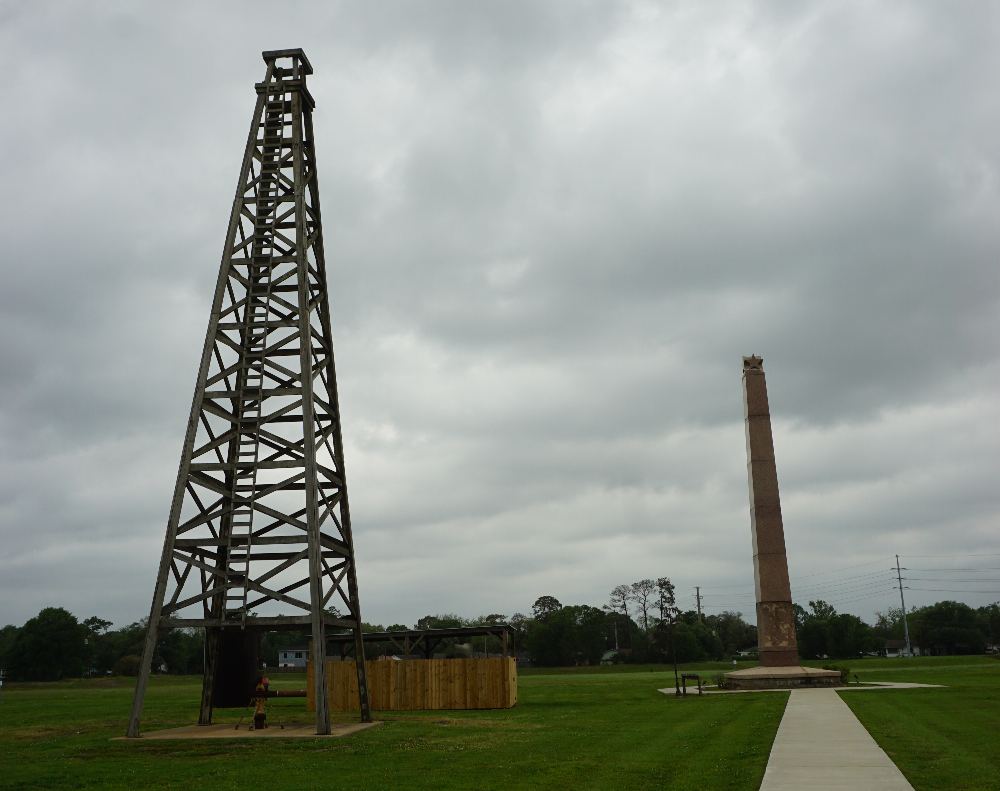
From Big Thicket we drove 45 minutes southeast to Beaumont, TX, where we stopped at the Gusher Monument on the Lamar University campus. This miniature Washington Monument is dedicated to the Spindletop Oil Well drilled here in 1901. It truly was a gusher, spewing oil under pressure for nine solid days. The volume of oil was so great it ushered in the Oil Age where petroleum wasn't just a lighting source but a fuel, especially for the new automobile. We then tried to visit Spindletop Park, where the Gusher occurred. Unfortunately the entrance is blocked by a mile long oil tanker train that doesn't seem to be moving.

Instead we get back on the highway. We soon crossed into Louisiana. Finally! Texas is incredibly wide. For lunch we stop at a hole-in-the-wall restaurant in Lake Charles. Aimee has the Gumbo, while I choose an Etouffee. Both were delicious. I could easily eat my way across Louisiana.

We end the day in New Orleans. After checking into our boutique hotel in the Garden District, we walked to a local pub for refreshments and a delicious Fish Taco meal.

Tuesday, April 09, 2024

April 8, 2024

April 8, 2024

We woke early in Fort Stockton, TX. After breakfast, we made a brief stop at the town’s Visitor Center. Despite not officially opening until 9 am, we were greeted an hour early by a lady proud of her local history. Aimee and I are also very interested because we both recently read "Empire of the Summer Moon", a fascinating book about the rise of the Comanche Indians. They were among the first to adopt and capitalize on the horses that the Spanish brought to the New World. With this instant mobility they were able to dominate the entire southern plains. Like the Mongol Raiders of Eurasia they could attack from hundreds of miles away with no warning. They terrorized Indians, Mexicans, and Texans alike. Their brutal warfare was a major contributor to Indian hate by settlers who couldn't tell a Comanche from an Osage.

Fort Stockton was the site of Comanche Springs, the largest natural artesian spring in Texas. This vital water source was a major stop on the Comanche War Trail that allowed them to raid Mexico with impunity. With the introduction of large-scale agriculture, the spring has dried up. The Visitor Center has a recreation of the spring. Fort Stockton was built to guard this watery oasis. The 1848 treaty that ended the Mexican-American War required the US eliminate Comanche raids into Mexico. We did a drive by of the Historic Fort area and then headed east on I-10.

After a couple hours we crossed the Pecos River and hit the edge of the zone of totality for the eclipse. My lucky charm of a wife is feeling better and working her magic. We see patches of blue sky. Feeling encouraged we head another half hour closer to the center line where we could get the full four minutes of eclipse totality. We find an area off the Interstate exit for Fredericksburg where a large group of eclipse tourists have already set up.

While we were waiting for totality we introduced ourselves to our neighbors. They have traveled from all over. One family even traveled here from Poland and this is their third eclipse. There was a reporter from San Antonio interviewing all of us.

We eat our Subway lunch as the moon begins its transit across the sun disk. Unfortunately at the same time clouds start to move in. The high wispy clouds are tolerable, but low-level storm clouds are also coming in obscuring the sun totally. Over the course of the next hour, the sun peaks into and out of the clouds. With pure luck the low clouds part as the eclipse reaches totality. We watch the diamond ring flash appear and the sun disk become completely covered. Astonishingly we can then see significant solar flares emanating from the sun.

Even more captivating is the sudden darkness. Very eerie. After a long three minutes the sun flashes back into view. We got so lucky today.

We watched the sun re-emerge for a few minutes and got on the road. Despite the poor weather forecast, the traffic is fierce headed to San Antonio. I think the entire city must have been on the road with us. It is a long painful six hour drive to our next accommodation in Columbus halfway to Houston. Twice as long as expected. The only saving grace is all the wildflowers in the highway median.

Monday, April 08, 2024

April 7, 2024

April 7, 2024

The Annular Eclipse we witnessed last Fall whet my appetite to see the total version. So several months ago we made plans and reservations to drive to Texas. Unfortunately April sunny days are almost as rare as an eclipse. Most of the US path is cloudy with Texas the worst. In retrospect I should have made multiple reservations across the path of totality and then chosen the best one as the cloud forecast crystallized. Live and learn.

We almost canceled the trip this morning especially as Aimee is feeling a little under the weather. Since the next total eclipse in the US is not for twenty years and our reservations are mostly prepaid, we kept with our plan and drove fifteen minutes to pick up our rental car. Unexpectedly we were upgraded to an unwanted large gas guzzler. Also I had immediate problems trying to figure out how to turn on the dashboard menu screen, get the temperature adjusted and open the gas tank lock. New cars are just way too complicated today. Back home, we dropped off our car and loaded the rental. We used the bathroom one last time which activated the softener regeneration. Arrrgh! We had to wait another fifteen minutes for that to complete so we could turn the water off and leave. This vacation is not starting off too well.

We spent the rest of the day driving east past New Mexico into Texas, only stopping for gas and a quick lunch, arriving in Fort Stockton as the sun set behind us. After checking into our hotel, we were told the bar has complimentary taco dinners and cookies. Our first ray of sunlight on this trip.

Friday, December 15, 2023

December 2023

December 2023

Anyone who has a large Saguaro Cactus in their yard in Tucson is silently hoping for that day it matures and starts to grow its first iconic arm. Saguaro growth though is frustratingly slow. We often see Saguaros of incredible height without a single arm, and others much shorter with an oversupply of branching. The age of Saguaro maturity is shrouded in mystery but definitely counted in decades.

Four months ago sustained hurricane winds downed our favorite tree. It was a sad day because it was also the one that held our Owl Box. I soon noticed damage to our largest Saguaro, the one I held out the most hope for. In two places it looked like something had penetrated the Saguaro skin. Wondering if it was projectile damage or an infestation of the wound, I sent a desperate note to the local Agricultural extension for advice. I was shocked at their response. We have the beginnings of Arms!

I have been watching them ever since. In the relative life of a Saguaro, these arm buds are growing in the fast lane. In a month we can see they are clearly arms now. My “green thumb” is happy.
Newer Posts Older Posts