Thursday, September 05, 2024

September 3, 2024

September 3, 2024

We woke early again in the Dolomite Mountain hut Sasso Piatto. After breakfast we began the final day of our Alpe di Siusi circuit. Today we are circumnavigating clockwise the monolith Sassolungo. It is a beautiful sunny morning again. Unfortunately we are passing beneath the shadowed and cooler west side. We have to keep our warmer clothes on. We do however get great views of the Alpine Meadow and the mountains we traversed yesterday.

We pass a herd of grazing horses and then approach two donkeys on our trail. Almost immediately the male starts braying loudly and tries to mount the other. Aimee scrambles to get out of their way. I am laughing hysterically all the while.

As we circled Sassolungo, we broke out into the sunshine for a brief moment but then veered tighter to the mountain and back in the cold shadow. So cold we even passed a tiny glacier of ice.

We ran into a group of grazing cows. Aimee had to push a reluctant cow out of the way to open the pasture gate. We eventually reached the Comici Hut on the northeast corner. It is surrounded by chairlifts. It must be very active during winter ski season. The kitchen is not open yet so we settle for our now standard Radler Beer and Elderflower drink. We are facing another Dolomite cliff face. They are an amazing set of vertical mountains.

We push on and finish our circuit at Sella Pass. We need to take a bus back to our hotel. We discover that the bus is running ninety minutes late. Another American couple is also looking for the bus. We decide to join forces and share a pricey taxi back to town. We are glad we did. By the time the taxi arrives the bus line stretches into the distance. We got a lunch sandwich to-go.

Back at our hotel, we took a long luxurious shower. We relaxed for a while and then went for an early dinner at a pizzeria. We had the best Tiramisu for dessert. We drove home in pouring rain. Thankfully we are not hiking.

Wednesday, September 04, 2024

September 2, 2024

September 2, 2024

I finally slept through the night. I was either exhausted or over the jet-lag or both. Aimee and I woke early at Schlernhaus. After breakfast we packed up and hiked along the mountain ridge strewn with white Dolomite rocks that give this Alpine region its name. The weather is gorgeous, sunny, and warm. We feel lucky. We also get a great view of our last accommodation in the distance. Although our route is a gentle uphill, I am dragging behind Aimee. The 8000-foot altitude must be affecting me more.

When we reach the end of the ridge we get spectacular views to the south, with jagged cliffs and a valley far below. In the distance at the top of the next saddle, we spy another mountain hut. Along the way we pass a herd of sheep all with bells. A shepherd and his dog are bringing them uphill to the hut.

Aimee is feeling her inner hobbit and wants a second breakfast even though it is only 10:30 am. She orders hummus, and it is surprisingly tasty and I gladly help her eat it. She also orders an Elderflower tea that she raves about. I broke down and had a Radler Beer. I have seen it on every menu. It is half beer, half lemonade. It turns out to be tasty and perfect for quenching my thirst during a hike. Radler is German for Cyclist. They were the first to drink it.

On the descent from our lunch break, we ran into lots of bikers riding up the steep gravel access road. I have to believe they are getting an assist from their e-bikes. Otherwise it would be a killer. We have great views in every direction.

We had a long conversation with a German couple. She identified this Alpine flower called Silver Thistle for us. Apparently its roots helped with alleviating the Plague.

She also told us we had crossed from German South Tirol into Italian Trentino. Mussolini had combined these two provinces to ensure that Italian speakers dominated the regional government. That lingering tension means confusing signage because every town, building, and geographical feature has both a German and Italian name. I see parallels with Ireland and Northern Ireland.

The last part of our hike is an ascent to our next accommodation at the base of looming Sassolungo. It is a distinctive Dolomite monolith. We are too early to check-in so we have drinks on the patio while enjoying the sun and scenery. We can see Schlern Mountain in the distance. We can’t believe we hiked all the way here. But the scenery today was awesome. No wonder the Dolomite region is a World Heritage Site.

We checked in at 3 pm and were happy to find this mountain hut is much newer and modern, with more bathrooms and showers. We even have great views from our corner room. One is toward Marmolada, tallest peak in the Dolomites. Dinner was great too.

September 1, 2024

September 1, 2024

This morning we were awakened by a local rooster. He crowed all day yesterday. Fortunately he sleeps at night. We started our hiking adventure today. Our driver picked us up at our hotel at 8:30 am and delivered us to the cable car on the south side of Ortisei in Sudtirol, Italy. In a few minutes we are at Europe’s largest alpine meadow Alpe di Siusi (Italian) or Seiser Alm (German). Over three days we are going to circle it.

This morning starts out as an easy stroll across hilly green fields. We play leap-frog with three German men who keep us on the correct path. In the summer the area is full of bikers, but in the winter it is a vast ski-field. Along the way we stopped at an outdoor restaurant with a great view of a mountain cliff. Aimee had a cappuccino and I had a beer and we then got moving again.

It doesn’t take long before I realize instead of turning left, we are headed straight up the scenic mountain. It is a long slog uphill with no let up. In addition the high alpine altitude is a killer. We stopped a couple times along the way to rest and eat a snack lunch. It takes us 2.5 hours to reach the rocky summit.

Remarkably, Schlernhaus hotel sits isolated near the top. The Italians call these mountain hostels a Rifugio, the Germans a Hutte. All the supplies for this location come up from the valley far below by cable car.

We are chilled because of the altitude, the mountaintop breeze, and the sweat pouring off of us. We have one of the few private rooms. Unfortunately there is only one shower for the entire hut. Aimee and I wait in line for our three minute rinse. Warmed up, we sat outside and enjoyed the sun and spectacular scenery.

At 6 pm, we were fed a full dinner. It was too much food for us. At the end we had to tell them to only bring one dessert. There are about 100 hikers with us. We seem to be the only Americans and likely the oldest. That turns out to be a blessing for there are only three toilets. These youngsters sleep through the night leaving the bathroom all to us.

Saturday, August 31, 2024

August 31, 2024

August 31, 2024

After breakfast we checked out of our hotel, put the luggage in the car, and took the bus into nearby Ortisei, Italy. We signed up for a hiking adventure into the mountains above us and we need a trial run. We only get to pack once and we don’t know what weather to expect at higher elevation. 

In Ortisei we bought pricey cable car tickets that whisk us quickly some 3000 feet above the valley to the Seceda Ridgeline. Despite facing the opposite direction as yesterday it seems the sun again is foiling my photos. There also seems to be a haze in the air. We make the final hike to the top and then along the ridge. The photos get a little better as we go. We are also surprised at the temperature. It is warm and not nearly as cold as we expected. We over-packed bringing thick shirts and a fleece jacket. I am quite comfortable in my thin shirt.

From the top we hike along and down the ridgeline. As we progress the view changes dramatically and the air seems to clear making the mountains pop. Humorously there are cows grazing in the fields and they all are wearing noisy bells.

The hike is easy but it is continuously downhill putting constant pressure on our knees and feet. The big advantage of hiking in Europe is that we are never far from civilization. Scattered throughout the Alps are mountain huts in spectacular locations waiting to satisfy our thirst and hunger. After a long hike the beer tastes great. I tried practicing the couple words of Italian and German I know to our waitress at Rifugio Firenze, but she informed me her native tongue is Ladin, an obscure Romance language indigenous to remote parts of the Dolomite mountains.

At the end of our lunch, it starts to rain. We don our raincoats and march on. Fortunately after about thirty minutes we find another cable car and we ride it back down to the valley floor. Surprisingly it is dry at the bottom. We take a bus back to our car and then drive to our next accommodation in Selva. It is much more rustic but our room has a balcony with an awesome view.

Friday, August 30, 2024

August 30, 2024

August 30, 2024

On the road early, we drove into nearby Innsbruck (Bridge on the Inn), capital of Austria's Tirol region. We turned south crossing the Inn River and headed uphill over Brenner Pass. It is a toll road today and has been for centuries since it was a major trade route connecting German kingdoms with the Mediterranean empires. The route is scenic but very crowded, especially with trucks and RV trailers. It is still a major trade route.

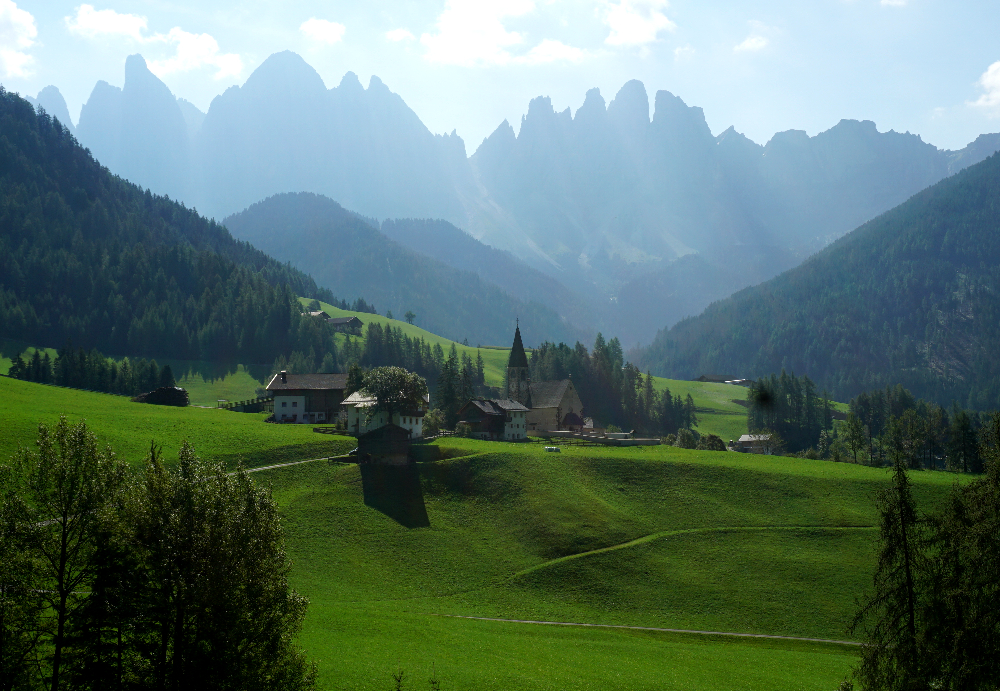
In Italy we take a detour to explore the Val di Funes. It is a winding road up a narrow valley. In the town of Santa Maddalena, we park and walk through the town and uphill to a viewpoint. We pass a farmer cutting hay with an over-sized mower off the very steep hillside. He will have to rake it by hand. The viewpoint looks like it might make a nice photograph but the sun is absolutely in the wrong position in the morning.

We punt and move on continuing south to Bolzano or Bozen, capital of South Tirol. Despite being German-speaking and part of the old Austrian Empire, this part of Tyrol was given to Italy as an inducement to join the Allies during WWI. Mussolini built a Victory Monument here and tried to Italianize the region, changing the name of every town, and banning the German language. Resistance and ethnic disputes followed until Italy finally gave the region significant autonomy in 1992.

We had a delicious pizza lunch on a terrace restaurant before visiting the South Tyrol Archeological Museum. It is famous for holding Otzi, the Iceman. His body was accidentally found high in the Alps frozen and mummified in 1991. Otzi is more than 5000 years old and has provided archeologists with an unending treasure of Stone Age discoveries. Besides his genetics, he had remarkably well-preserved clothing, copper axe, bow and arrows, and a dagger. His story is fascinating.

Afterwards we walked the old town center. Bolzano is a big city surrounded by mountains. It has a large almost medieval layout but with a modern upscale Alpine architectural style. 

From Bolzano we drove back north exiting at Val Gardena. Ten miles up this valley we found our next accommodation outside the ski town of Ortisei. Conveniently our little hotel has a great restaurant.

Thursday, August 29, 2024

August 28-29, 2024

August 28-29, 2024

We are up early to finish packing. Both Aimee and I are thinking that four weeks was too short a time between trips. Oh Well. The same driver shuttles us to the Phoenix Airport. Humorously for the second time she misses the Airport detour sign, and hits construction traffic. Aimee is annoyed but we are way early, so no problem. I spend the time reading the newspaper, while Aimee knits. Shockingly our flight to Chicago takes off on-time. That is a first for us in a long time.

After a layover at O’Hare, we are crossing the Atlantic again landing in Zurich airport. Our approach takes us down the Rhine River right over Switzerland's largest nuclear power plant. It supplies one sixth of the country's power. Unlike their neighbors to the North who shut down all their nuclear power in a fit of green folly, the Swiss are practical and get half their electricity from nuclear and the other half from hydro.

We are not staying in Zurich. It is just our European gateway. We are headed for the Dolomite mountains of northeastern Italy. There is no direct way to get there. The downside of two on-time flights is that we had to wait two hours for our rental car. Aimee had a German pretzel to tide her over.

Once we had wheels we crossed Switzerland to the Lake Constance border in heavy traffic. Annoyingly there were few posted speed limit signs. We crossed the Rhine River into Austria and stopped to purchase a highway sticker for the country.

The drive through the mountain valleys of the Austrian Tyrol region was beautiful. It reminded us of the Canadian Rockies drive from Banff to Jasper. Unfortunately the highway was slow-going with two dozen tunnels, lots of road construction and two road detours. Despite the scenery, we struggled to stay awake.

We stopped for the night just west of Innsbruck. Our hotel room has a view of an Alpine cliff that resembles Yosemite's El Capitan monolith. We celebrated our anniversary at a local restaurant dining al fresco with a nice Garlic Cream soup and tasty rib meal.

Saturday, August 03, 2024

July 31, 2024

July 31, 2024

We are up early and after breakfast we drive the last leg back to Dublin Airport completing our circle tour of Ireland. We turn in the rental car without a problem. I am happy to do so. While I quickly adapted to Left-side driving, narrow Irish roads are an accident waiting to happen. There is no room for any lapse in attention.

Our flight home is delayed. Big Surprise. After several hours of waiting, we boarded our flight to Philadelphia. We flew over several cruise ships steaming into Dublin’s harbor. On our approach to Philadelphia we followed the Delaware River passing the Walt Whitman Bridge, the modern cranes of the Marine Terminal and the old Navy Shipyard with its several dry docks. They are reminiscent of the Belfast Dry Docks where the Titanic was built. We arrive to find our next flight to Phoenix is also delayed. Flying has to be the worst part of travel. Our driver was waiting patiently for us and got us safely home albeit after midnight.

We had a great trip to Ireland but we are happy to be home. We miss the warm weather and sunny skies. Ireland is a great place to visit, the people are some of the nicest in the world, the scenery is gorgeous, and the history is extensive.

While it did rain often, we were never rained out. Just wait an hour and the weather will be different. Weather forecasting must be impossible there. Like New Zealand, the west is much rainier. But Irish weather has its benefits. We saw flowers everywhere. It seemed everyone had a colorful garden. Aimee’s favorite flower, the Hydrangea, is abundant there. Not surprisingly Aimee loves the blue variety. She gave me a chemistry lesson telling me gardeners change the color from red to blue by acidifying the soil. I learned later that the pH drives the supply of Aluminum ions to the flower pigment.

Having visited Ireland many years ago we were lucky to witness the transformation of Ireland. Ireland used to be one of the poorest in Europe; now it is one of the richest thanks to American investment. Ireland is clinging to their old Gaelic language. You would think we visited someplace more exotic based on the signage. Every street sign and storyboard were in dual Gaelic and English. When questioned if they spoke Gaelic, the answer was almost always,” God No!” Ireland would be better off with signage in a Slavic language to accommodate all the Eastern Europeans working there.

July 30, 2024

July 30, 2024

We left Belfast early heading south back into the Republic of Ireland. We have a long day planned exploring the Boyne River Valley. This fertile area has long been the heart of historic Ireland.

Our first stop is at Monasterboice. This is another monastic settlement founded in the 5th century by a follower of St Patrick. Besides a round tower, the site has two exquisite Celtic High Crosses. They are in remarkable condition after being exposed to rainy Ireland for 1300 years. After visiting Derry’s Tower Museum, now I am pondering how they would have looked with colorful paint.

Our second stop is at the Battle of the Boyne site. We are a little early and we missed breakfast so we head to the cafe for coffee and scones. Aimee loves the break and we buy a couple fruit cake slices to-go for lunch. They remind her of the loaves her late Irish godmother used to make every year.

In the Visitor Center we start with the park film. This was a major battle of the Williamite War in 1690. James II, the Catholic monarch faced off against William, his son-in-law, a Protestant who took his crown during England’s Glorious (and bloodless) Revolution. Unfortunately for Catholic Ireland, James was not up to the task. Despite losing few men he turned tail and fled back to exile in France, leaving the war to his Irish and French allies. Today this event is celebrated as THE pivotal battle of Irish history. Interestingly the later and far bloodier Battle of Aughrim of 1691, that we visited a week ago, used to be considered the decisive event. Its date of July 12 is still celebrated by Irish Protestants as their Fourth of July.

Our third stop is at Bru na Boinne, or Palace on the Boyne. This World Heritage Site and new National Park is the premier Megalithic burial site of Ireland. Dozens of mounds are scattered around this two-mile bend of the Boyne River. In this phase of Stone Age burials, Portal Tombs were covered with a cairn of dirt and stone forming huge Passage Tombs. We start in the Visitor Center going through the extensive exhibits.

We then boarded a shuttle bus for our guided tour of Knowth. We visited Knowth on our earlier Irish trip in 1998. Knowth consists of an enormous Burial Mound surrounded by a dozen smaller ones. The central mound has two passage chambers, neither of which is open to visitors. Like Carrowmore, the cremated remains of many bodies were deposited in the internal burial boxes.

The central mound is encircled by 127 giant curbstones, most of which are decorated with megalithic art. We see no human or animal figures. It is all abstract consisting mostly of spirals, wavy lines, circles, and half-circles. It is easy to see how this ancient custom was incorporated into early Christian Celtic art. Afterwards we watched a film about the site. The 5000-year-old art was preserved because it had been buried for most of its life. It was only rediscovered in the 1960s.

We then shuttled over to Newgrange. Newgrange is another enormous passage tomb. However its curbstones have little art. Instead it is faced with pieces of shiny white quartz rock. None of the huge curbstones or quartz rock is local. All of it was transported here with enormous effort. Bewildering for people having to grow and hunt their food, weave baskets, mold clay pots, and tan their leather clothes.

The draw of Newgrange is its passage chamber. It is precisely aligned so that on the winter solstice, the shortest day of the year, a fleeting shaft of sunlight illuminates the burial chamber.

We are escorted down the shaft by our tour guide. It is narrow and I have to squeeze through. This is the highlight for me. This rather large room at the end has a remarkable corbelled ceiling. I am hoping my Stone Age engineer-ancestors were skilled enough to keep the immense stones from falling on my head. Since this room has been protected for 5000 years, the Neolithic art decorating the interior is exquisite. There is a checkerboard pattern in one niche, and in the opposite a fern, or perhaps a feather, or maybe a sheaf of wheat. The third niche has my favorite, a triple-spiral.

We are running short of time, so we skip the Hill of Tara and proceed to our accommodations in Trim. Our hotel is across from Trim Castle. Aimee is tired of castles, so she goes shopping in the cute town. She buys an Irish Cookbook. I am thinking that it is really a gift for me.

While she is having fun, I keep working and run across the street for a guided tour of the castle Keep. It is great. While the Keep is just an empty shell, the tour guide is a history buff and a fount of knowledge about medieval life. This castle was built by Hugh de Lacy, a Norman knight who followed Strongbow to Ireland. It is the largest Norman castle and from here de Lacy ruled the ancient kingdom of Meath. In modern times, Mel Gibson filmed parts of the movie Braveheart here.

Afterwards Aimee and I met back up for drinks (and our belated Fruit Cake lunch) on the hotel terrace facing Trim Castle. It is warm and sunny. This cannot be Ireland! Aimee has a tasty Orchard Thieves Wild cider draught from the bar. Later we had a Lentil entree at a nearby Indian restaurant and then took an evening walk on the opposite bank of the Boyne River.

Friday, August 02, 2024

July 29, 2024

July 29, 2024

We left the Antrim coast and drove ten miles south to the Dark Hedges. This attraction is a grove of gnarly beach trees lining a narrow lane. It is the Northern Ireland equivalent of Oak Alley in Louisiana. It is famous because it was another film location for Game of Thrones. Too famous. Now the street is pedestrian-only, there is a pay-parking lot, and loads of tourists. We left right after breakfast, so I was able to double-park at the entrance. We are five minutes too late. A family got here ahead of us and is in the prime spot. I quickly got a reasonable photo and left, watching dozens of cars file-in right after us. This spot loses its mysterious atmosphere with a crowd of tourists walking the lane.

We found the highway and had an easy drive south. The better roads in Northern Ireland are due to this area being part of richer Britain and also because the terrain is mostly flat. The English were no dummies. They stole the best land; not the rocky hilly boglands of western Ireland. On the way we passed another overturned car. I am actually surprised we haven't seen more.

After an hour we reached the capital Belfast and found our hotel in the Titanic Quarter. Our first stop is the new Titanic Museum. On our drive in we saw a cruise ship docked. That means the next available entrance for us is not for three hours. We punt and walk into downtown Belfast. The Titanic Quarter has been transformed in recent years and there are tons of curiosities along the riverfront. After checking them out, we cross the pedestrian bridge over the River Lagan, observing the Weir that controls the tidal flows.

In Belfast city center we see the Albert Memorial Clock in the distance. This Clock Tower was built as a tribute to Queen Victoria’s husband's 1861 death. It was built on reclaimed land so it is now the Leaning Tower of Belfast.

A few blocks farther we reach City Hall. It was built after Queen Victoria granted the town City Status in recognition of the thriving linen and shipbuilding industries powering its rapid growth.

We spot a taxi line across the street so we negotiate a tour with one of the Black Taxis. Our driver takes us all over the city showing us the partisan districts outside the city center.

There are long walls that separate the partisan neighborhoods. I thought these were artifacts of the Troubles of many years ago. Sadly they are still needed. The neighborhood gates are closed every night. Schools and housing are also still segregated by religion. The Troubles have died down since the 1998 Good Friday Agreement but animosity still simmers just below the surface.

We drove through both sectarian neighborhoods; each side has their murals and memorials. The Greens or Republicans have murals and memorials extolling their martyrs killed by the Army or imprisoned unjustly. The Orange or Unionists are flying the British flag, and have memorials to the bombings and assassinations done by the IRA guerrillas. Both sides can’t let it go and forget. Children growing up here have constant reminders of past injustices. Sometimes it is best to forget and move on. Our liberals at home need to come here and learn why countries need to focus on the good, and put grievance politics in the trash bin. It corrodes societal cohesion.

I enjoyed hearing first hand from our driver about conditions here. I am shocked to learn that most Belfastians live in Public housing. I always thought the Brits left socialism behind with the Thatcher revolution. No wonder they are struggling. After ninety minutes of this, Aimee and I are both mentally exhausted and have our Black Taxi driver drop us at the Titanic Museum.

The Titanic Museum is housed in a unique building with four shiny prow-like corners. We joined the crush of museum goers. It started with exhibits covering the industrialization of Belfast. For a new museum it is sort of a disorganized maze. Very disappointing. We also find the exhibits open up later as visitors naturally spread out, just the opposite of ideal crowd flow.

The next section covers the construction of the Titanic. The Titanic was an amazing engineering feat. When we board a cruise ship, we forget how much infrastructure lies just out of sight necessary to meet the needs of a small city of passengers. I especially related to one fact from my working days. Titanic had 29 steam boilers powered by 600 tons of coal daily with an army of 317 operators. Wow!

From a window we can see a layout of the Titanic in its now filled-in dry dock in the plaza below. Once the frame was completed, the Titanic was launched and moved to the fitting-out wharf. Here the infrastructure was added and all the hotel components installed. Plumbing, furniture, flooring; it took 3000 men nearly a year. The museum has mock-ups of the accommodations for each passenger class.

There were lots of storyboards about the passengers. Many were fascinating. Each had a story to tell. Ultimately all the hard work constructing this luxury ship came to a sudden end on April 15, 1912 with 1512 lives lost. Despite having state of the art Marconi Radio communication, the sinking was an amalgam of errors and bad luck. Icebergs had moved south into the shipping lane. The ship didn't have closed bulkheads, there weren't enough lifeboats, and the crew and ship were brand new. Due to a mix-up, the lookout had no binoculars.

Less than half the passengers survived. Luckiest were first class women. Almost all lived. If you were a man, or a crew member or third class, your chances were very poor.

We rested back at our hotel room and then walked to the Titanic Hotel for dinner. It is located next door to the museum in the former headquarters of Harland & Wolff, builders of the Titanic. We sat in the large bar which is the former drafting room. After ordering, I gave myself the nickel tour. Several rooms have been preserved as they would have been a hundred years ago, especially the original entrance and the President’s office. Belfast did a great job preserving this heritage.
Newer Posts Older Posts