Tuesday, September 17, 2024

September 15, 2024

September 15, 2024

This morning we took the subway and commuter train to the Berlin suburb of Potsdam. We caught each one with seconds to spare. Our luck caught up with us in Potsdam when we found the tram line we wanted was down for construction. So we hailed a cab that took us to Glienicke Bridge.

The many lakes around Potsdam formed the western edge of the former West Berlin. Because the Glienecke Bridge crossing remained under Soviet control during the Cold War it was often used for prisoner exchanges. The captured U-2 pilot Gary Powers was transferred back to US control over it. The 2015 Tom Hanks movie Bridge of Spies is a great retelling.

We then walked west along the formerly-fenced lakefront to Neues Garten. The Potsdam area was a summer playground for the Prussian Hohenzollern Kings. This new park was a late addition. We ended our walk at the newest palace in this World Heritage Complex of Palaces. The Celienhof was built for the last prince heir of Kaiser Wilhelm.

After Germany surrendered in 1945, the three Allied powers needed a place to meet to decide Germany’s fate. Berlin was in ruins so they chose this newest of Potsdam palaces. We followed an audio guide tour through the Celienhof and the role of the Potsdam Conference in history.

The most important room was the main conference chamber. Here Stalin, Truman, and Churchill met. Unfortunately Truman was new, and Churchill lost his reelection and was replaced mid-meeting with Attlee. Stalin got his way. 14 Million Germans had to migrate west from their former homes. The borders of Poland were shifted dramatically west to allow Soviet expansion.

Finished with our excellent audio tour, we walked the length of the New Garden southwest. Along the way we stopped at the Orangerie (citrus greenhouse) to briefly view an exhibit on Immanuel Kant, a famous German Enlightenment philosopher. This is the 300th anniversary of his birth. I can’t get excited about philosophy.

We crossed Potsdam town to Park Sanssouci. We are too early for our timed ticket to tour the next palace so we have a Caesar salad lunch at the historic windmill restaurant. I tried another version of Radler beer with Orange soda. Not as good. We are sticking to the Lemon soda standard.

After lunch we ran through the kitchen and wine cellar of Sanssouci Palace and then entered the main palace at our assigned time. The tour is by audio guide again. Sanssouci was built by the most famous Prussian King Frederick the Great. Sited on a low hill, he called it ‘his Vineyard’. It was his summer escape from the political pressures of Berlin. Hence the French name ‘without care’.

Sanssouci has a modest ten main rooms. He had no children, his wife lived in the city, and there were few invited guests. He loved music, the arts, and Rococo decoration. There are lots of gold accents. A little gaudy for my tastes. Both Aimee and I liked the last room we toured best. It was decorated with colorful Porcelain chandelier and accents.

After the tour we crossed the large Park Sanssouci only stopping at the China House. This is a gold leafed four-lobed fantasy house built for guests to party in.

We finished our walk at the Neues (New) Palace. Frederick built this palace later in life to entertain and house guests away from his personal retreat. It is oversize and also decorated in Rococo even though this style was on the outs being replaced by Pompeii-inspired Neoclassical. There are also two grand Neoclassical service buildings across the courtyard.

We have to walk across the grounds to get a timed ticket even though every time slot has open spaces. Back at the entrance we follow the German tour listening to an English audio guide. By this time Aimee and I are tired of palaces and we both think the tour and audio are unexciting. There is an interesting Grotto room with lots of inlaid shells and fossils. And the required large nicely decorated ballroom. Most rooms have lots of French paintings. Interestingly this Prussian king spoke better French than German.

We took the train and subway back to Berlin and had another Tapas meal by Checkpoint Charlie. It was a long day with lots of walking.

Monday, September 16, 2024

September 14, 2024

September 14, 2024

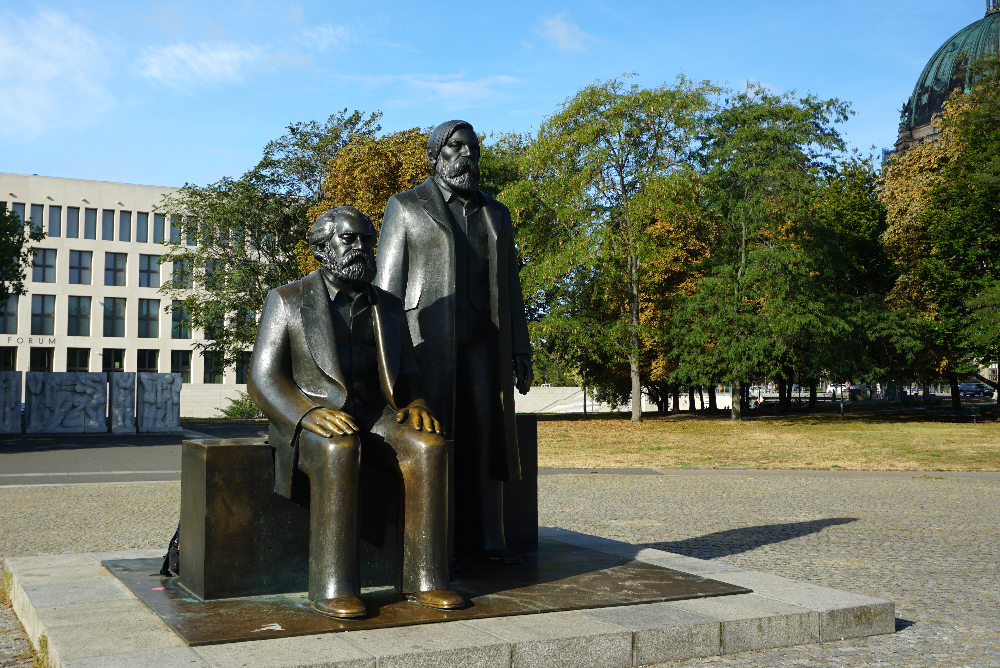
The Berlin museums don’t open until 10 am so Aimee and I take our morning walk east across the Spree River and then up the bank. Near St Nicholas Church, the oldest in Berlin, we run across an impressive statue of St George slaying the Dragon. Just north is the Marx-Engels Forum containing a statue of these two German philosophers who got so much wrong and caused the world too much trouble. Humorously we met several Chinese taking lots of photos. I am guessing they are employees of the nearby Communist Chinese Embassy.

Across the street is Alexanderplatz with a Neptune fountain and the Berlin TV Tower. This 1200-foot structure was an icon of East Berlin and can be seen for miles. I used it as a homing beacon on my venture across the Iron Curtain many years ago. Walking north we passed the old Berlin Palace to Museum Island.

We entered the Altes or Old Museum. It was the first built almost 200 years ago and has a broad Neoclassical facade, two lion hunter statues and an enormous granite bowl.

The archeology collection starts with Greek culture. Early statues were stiff-looking like the Egyptian versions they probably copied. As Greece flourished and expanded east onto the Turkish coast, and west into southern Italy and Sicily, their sculpture became lifelike and much admired.

Much of their creativity apparently came from Symposiums. This was their word for male drinking parties. The ubiquitous Kraters and Amphora would be filled with a wine and water mixture and ladled out generously. Women attended for entertainment only. The pottery was highly decorated.

Our visit to the Greek wing ended at the central rotunda ringed with statues of Greek gods, goddesses and heroes.

The next section is on the Etruscans, an early civilization of Italy centered around present-day Tuscany that would be subsumed by the Romans. Their culture would be greatly influenced by the contact with the Greeks. The Etruscans are a mysterious culture mostly known for their painted sarcophagi that seem to have come off an assembly line. This museum nicely has some other artifacts like jewelry.

The Romans famously were enamored by the Greeks and copied their culture almost wholesale, adopting their religion, just changing some of the names of the gods. Fortunately for us they copied their statues on a mass scale giving us a rich history of Greek sculpture. Most Greek sculptures on display are likely a Roman copy.

Romans usually cremated their deceased and interned the ashes in a small urn. It wasn’t until much later in the period of Imperial Rome (2nd century) that they started burying the bodies in the decorative stone sarcophagi that I love. The Romans must have deployed an army of sculptors to carve these detailed facades.

The other Roman art I find fascinating is from Egypt. Here they had to adapt to local practice. The result was painted portraits atop mummified remains. The paintings are amazingly realistic giving a detailed look into the diverse ethnic makeup, their clothing, and even their jewelry.

Whereas Greek sculpture tended to display an idealized representation, Roman sculpture, especially the head, is amazingly realistic. That makes it easy to identify the person being portrayed. Romans copied these statues and portrait busts in an assembly line.

One interesting find was an entire room full of silverware. Surprisingly this horde was found in Germany outside of Roman control. It surely was stolen, carried away and buried, never to be retrieved.

Like the Naples museum, there is a small room devoted to Roman erotic art, which they obviously loved. Some of the pieces make me laugh out loud. Besides wall art, every Roman must have carried an erotic charm around with them. Aimee spent a little too much time in this room.

We had lunch outside the museum eating Thai food at a Chinese restaurant. It wasn't too bad.

When I visited East Berlin in 1984, I made a point of visiting the Pergamon Museum. Seeing the large-scale Pergamon Altar and Ishtar Gate was a highlight of my visit. Sadly this amazing collection is closed for a years-long renovation. Instead a Panorama was painted to satisfy the curious. Aimee and I are not impressed. Pergamon was an ancient Greek city on the Turkish coast. It became rich producing writing material made from animal skins. The word Parchment is derived from this city name.

We finished our Museum Island visit at the Bode Museum. This one is housed in a cool looking building on the northern tip.

Surprisingly the first floor is almost exclusively religious art. It makes sense. Artists have to follow the money and the Catholic Church held the purse strings. Plus in olden times, there were churches everywhere that needed decoration. Triptychs in wood were the most common. Some were painted. While the majority look mass-produced or created by amateurs, a few are stunning showing great craftsmanship and creativity. Some artists devoted their life to their creations. Unfortunately the best are behind reflective glass.

Aimee and I were both amused and happy to find a Byzantine mosaic piece from Ravenna, Italy in the collection.

The upper floor of the museum had a mish-mash of religious and secular art and coins. Running through the collection, it is obvious art comes in many flavors, forms, and mediums from intricate ivory carvings, to wood, gold, stone, and porcelain. It is not just oil painting. Also artists are not all created equal, or I just don’t appreciate some. For me, I only find a small fraction interesting, which means walking by lots of stuff I don’t appreciate. Most museums could use more filtering of their collections.

One piece nicely described Aimee’s view of the last two days of marathon museum going. A Screaming woman!

On the way back to our hotel we stopped at the German History Museum. We find it also closed for renovation. That seems to be a common theme in Berlin. We see construction cranes everywhere. Instead the museum has a special exhibit in a new I.M Pei wing called 'Roads Not Taken' or ‘What if’. It takes a handful of pivotal events in German history and supposes the outcome if only different choices had been made. Sadly Germans have often been unlucky and made a lot of bad decisions. One sculpture called ‘Mourning Germania’ sums up the exhibit.

For dinner we had Potato soup and salad at our nearby German restaurant. Tasty!

Sunday, September 15, 2024

September 13, 2024

September 13, 2024

We saw in the news yesterday that one of the downtown bridges in Dresden collapsed the day after we left. Oooh, that was a little too close for comfort! From our downtown Berlin hotel we walked northeast through the city. It is chilly and I am wearing my thick fleece. I had been telling Aimee I over-packed bringing it. Not Now!

We passed through Bebelplatz, a square facing Humboldt University. In the center is a memorial to the book burning the Nazis did here in 1933. We then passed an equestrian statue of the Prussian leader Frederick the Great. It sits at the beginning of the Unter den Linden boulevard that stretches toward Brandenburg Gate. We walked east past the Neue Wache and its modern Pieta dedicated to the victims of war and tyranny. We crossed the River Spree onto Museum Island running into the massive Berlin Cathedral.

We are going to spend the day seeing the many great Berlin museums crowded together on this World Heritage island. It seems the opening time got pushed back an hour with the end of summer. We stay warm having a donut and coffee at a local cafe.

At 10 am we return to the Neues (New) Museum, buy a 3-day pass, and stuff our pack in a locker. We start on the first floor and immediately run into a number of Egyptian Scribe statues in various styles. More than we saw in the Cairo Museum.

I tell Aimee Germany was very active in archeology in the 19th century. The proof becomes clear when we enter a large room with just one artifact. A bust of Nefertiti, probably the finest piece of Egyptian art. It is the Mona Lisa of Berlin. This mother of Tutankhamen is beautiful in so many ways. If this was the only thing we saw today, I would be happy.

We have barely made a dent in this museum so we push on. The next section is Roman, with the greatest number of artifacts coming from an oxbow lake off the Rhine. It is thought these artifacts were looted by barbarian raiders but lost trying to cross this former bend of the river. The artifacts are generally quite ordinary (like pots and pans, iron chains, and cow bells) but fascinating that the Romans had the skill to make these items especially in a far-off colony in Germany. Who could imagine the Romans manufactured padlocks. And their glassware was exquisite.

After this long morning, we needed a break so we had lunch in the small museum cafe. Appropriately we had an Egyptian meal of Falafel and Hummus on Pita bread. It was quite tasty.

After lunch we moved forward in history with the Barbarian invasions, euphemistically called the Migration Period. Not surprisingly there are lots of metal weapons, but also nice jewelry, and humorously big metal buckles.

Moving to another floor we ran into more Egyptian relics, but on a larger scale with sarcophagi, temples, and wall murals. There were also papyrus scrolls, canopic jars, grave offerings, shoes, cosmetics and jewelry. Egyptians had their stuff just like us.

The next wing covered the quasi-amateur German archeologist Heinrich Schliemann, most famous for discovering the city of Troy on the Turkish coast. He snuck these artifacts out of the country for display here.

In the Celtic section was a lot of weapons. Apparently they were mounted warriors as this hall displayed lots of harness bits and other horse tack. There was also an unusual tall golden hat shaped like Merlin's wizard hat. The relics also included the tools used to stamp the decorative design.

In the end, this museum is too overwhelming for one day. We ran through the last half. You really need to focus on one historical era and ignore the rest. I would love to come back and listen to the audio guides.

We still have an hour, so we went next door to the Alte National Gallery. It is a museum on German painting and sculpture. The museum building is like a Greek temple on a hill.

Aimee surprised me when she said she recognized a painting. It turned out to be Alex von Humboldt. We have run into him a lot lately. He was an explorer, who is considered a father of geography and ecology. The Humboldt Current off South America is named after him as is the local Berlin University. He was emphasized in the Amazonia Panorama we visited in Dresden.

It started to rain as we left the museum so we hurried back towards our hotel. Aimee had to stop in a store devoted exclusively to Traffic Light Man gifts. This is the character on Crosswalk signs. We actually found something we needed and was small enough to pack.

We had dinner next door in a traditional German restaurant. We had their Pork and dumplings with sauerkraut. It was tasty.

Saturday, September 14, 2024

September 12, 2024

September 12, 2024

This morning we checked out of our Leipzig hotel and hopped on a train north. Our $49 German pass allows us to use any train or bus, as long as it is not an express train. It is an absolute steal compared to an unrestricted Eurail Pass that costs $2000 for a month. No wonder German trains are breaking down frequently for lack of maintenance funds.

We disembarked at the little town of Wittenberg and dropped our luggage in a locker. Wittenberg sits on the Elbe River downstream from Dresden and was the capital of Saxony before Dresden. We walked into the town center stopping at the castle. The attached castle church is a World Heritage site because in 1517 Martin Luther nailed his 95 Theses on its door setting off the Reformation. The ensuing religious wars killed millions, one of every three Germans. The original door is long gone but has been replaced by a bronze version with permanent Theses. We toured the church seeing Luther’s grave along with that of his little-known partner-in-crime Philipp Melanchthon. Luther’s Reformation survived being crushed by the powerful Catholic Church because he was protected by the reigning Wettin Dynasty Saxon king.

After a quick Bratwurst lunch, we toured Luther’s parish church of St. Mary sitting off Market Square. It is the site of the first Protestant service and where Luther often preached. There is a big statue of him in the center of the plaza.

After this quick stopover, we took a train headed northeast. Ninety minutes later we got off in Berlin and rode the subway to our accommodations. Berlin is our splurge hotel location for the trip. And what a view we have from our balcony of Deutscher Dom Cathedral and Gendarmenmarkt, the most beautiful square in Berlin. Too bad there is construction going on at the base.

I visited Berlin 40 years ago and took a one day trip across the Berlin Wall into East Berlin. It was eye-opening and I have been anxious to return and see how the city has changed. Checkpoint Charlie where I crossed on foot past opposing guards is now a tourist attraction in the middle of a street. You have to dodge speeding cars to take a photo. Checkpoints Alpha and Bravo were the crossing points for drivers from West Germany.

Potsdamer Platz 1984
A few blocks further west in Potsdamer Platz was an observation deck I climbed to take this photo peering over the wall into the no-man’s-land between the two wall layers.

Potsdamer Platz 2024
The same view today is now unrecognizable. The wall is gone; only a brick line in the pavement shows the prior location. The modern Mall of Berlin fills the former kill zone. I never thought the Wall would fall during my lifetime.

A few blocks north is a sign indicating where Hitler’s Bunker was located. He committed suicide here in the final days of WWII. Interestingly I got into a discussion with several Brits my age who grew up on Jersey, one of the Channel Islands. They told me it was occupied by the Germans during the War. The island is still full of bunkers and they all have discarded Nazi military equipment.

I got a pleasant surprise a few more blocks north. We turned the corner and ran into the Brandenburg Gate. Forty years ago, it was the border, unreachable, between the walls, and stained dark with grime. Today it is wide open, gleaming, and again the icon of the city.

We walked a little bit of the grand tree-lined Unter den Linden boulevard past the US and Russian Embassies.

Happy with our quick lay-of-the-land tour, we found a Spanish Tapas restaurant for dinner. Having some tasty Spanish wine instead of beer was a nice change of pace.

Friday, September 13, 2024

September 11, 2024

September 11, 2024

In Dresden, we had train noise when we opened our hotel window. Last night in Leipzig we had to listen to an annoying protest march. I think it was about Palestine.

This morning we are going to explore Leipzig’s Cold War history. Just behind our hotel is St. Nicholas Church. In 1989 it was the site of weekly mass gatherings to pray for peace and basic rights. This Peaceful Revolution contributed to the fall of the Iron Curtain, earning Leipzig the moniker City of Heroes. In reality, the new Russian president Gorbachev decided change was needed and Russia was no longer going to intervene in the Eastern Bloc. Sadly after decades of repression East Germans didn’t believe him.

Our next stop was the Contemporary History Forum. This museum covers the history of Leipzig and East Germany after 1945. The Soviets took over after WWII. They systematically moved East German factories to Russia, and put in place a socialist government-run economy. A 1953 Revolt was brutally crushed and children were indoctrinated into the new system. While everyone had a job, progress came to a halt and the East fell further behind their Western counterparts every year. With the gap widening, a wall had to be built to keep people from leaving. No amount of propaganda and censorship could hide the truth.

The museum continues with the fall of the Iron Curtain and reunification with West Germany. With privatization, older obsolete state factories shut down and unemployment skyrocketed. It was a very tough transition for East Germans. (N)Ostalgia for the old system became rampant. It almost seems to me this free museum was set up to remind East Germans what it was like before capitalism and freedom were re-established.

Outside the museum is a modern art sculpture that combines both Nazi and Soviet symbolism. To me it summarizes the museum perfectly. All forms of Socialism run headlong into human nature. In every instance, governments have no choice but to react with coercion. Only capitalism preserves personal freedom.

After this sad review of local history, we needed a mental break. We had a lunch of Soljanka washed down with some local beer. We then went to an historic cafe for coffee and dessert.

In the afternoon we checked out some brighter moments of local history. Leipzig was a music capital. We stopped at St Thomas Church where Johann Sebastian Bach was the music director. He is buried in the choir floor. Outside is a memorial to composer Felix Mendelsohn who introduced the world to this musical genius. Not far away we pass a memorial to opera composer Richard Wagner who was born in the city.

Our next stop was Leipzig University to peruse their small Egyptian Museum. I am always surprised at how many different cities and museums have significant collections. It is a testament to the millennia length of ancient Egyptian history.

Aimee needs some retail therapy after these museum sessions so we check out the mall underneath the main train station. For dinner we have Indian cuisine. We finish with drinks in the hotel bar.

Thursday, September 12, 2024

September 10, 2024

September 10, 2024

This morning we checked out of our Dresden hotel and walked over to the train station. While waiting for our train, a chocolate croissant was beckoning Aimee so we indulged. We then boarded our train west. In ninety minutes we reached Leipzig and checked into our next hotel across the street.

We walked through the Old Town and found a restaurant to have a pizza lunch. It is cool and breezy so we eat indoors. We really like the Radler beer/lemonade combo so I tried the Diesel beer/coke combo. It is not as good.

Afterwards we took a tram southeast to visit the Battle of the Nations Monument. This huge memorial was built on the 100th anniversary of the 1813 Battle of Leipzig, the largest and deadliest prior to WWI. At 300-foot tall, it is the largest monument in Europe.

We bought entry tickets and an audio guide for our visit. Touring the interior was a little tricky as it has a couple elevators and two narrow one-way stairs. The interior is adorned on two levels with over-size grim hulking Teutonic knights. We eventually make it to the very top where we get nice views of the region.

We then continue in the ground floor museum. This portion of the audio guide starts off very interesting talking about how Napoleon saved the revolution in France and gave hope to other Europeans hoping to also gain personal freedom. In particular Napoleon developed a uniform civil law code that overthrew feudal laws favoring the Royals. Unfortunately after that the narrator got long-winded. Apparently people got tired of the constant warfare, and Napoleon over-extended himself by invading Russia. This allowed the Royals of Russia, Austria, Prussia, and Sweden to gang up and defeat him here, restoring the old feudal order.

After stopping back at the hotel, we set off to explore the city. Leipzig has a number of covered shopping arcades in its central core. Aimee was in heaven window shopping. We finished in Madler Passage which has a statue of Faust making a bargain with the devil Mephisto. One scene of this famous Johann Goethe play occurs at the historic Auerbach Cellar restaurant below this shopping arcade. Aimee and I decided to have dinner there.

We have soup and then share a meal of pork strips with gravy and vegetables and potato pancakes. It was very good. Leipzig is famous for Gose Beer. It is supposed to be very sour. I try a version that is sweetened with raspberry liqueur. It is tasty but it looks a little girly especially since it came with a straw. Thinking I can handle the real stuff, I order the straight Gose. To me it is more tasteless than sour.
Newer Posts Older Posts