Tuesday, April 05, 2016
March 24, 2016
Tucson has lots of attractions for the visitor. We went with my sister and her family to the Titan Missile
Museum. This is a relic of the Cold War
that we last visited in 2007.
Titan II was an enormous liquid fueled rocket used not only for the
Gemini space launches by NASA but also for defense. Three clusters of Titan II ICBM rockets with 9-megaton hydrogen bomb
payloads were built in the early sixties to “dissuade” the USSR from starting
WWIII. Despite being accident-prone, manpower
intensive, and very expensive this missile platform lingered in our arsenal for
many years, eventually being replaced by Minuteman solid fuel rockets. All 54 Titan launch sites were destroyed by
SALT treaty except for this lone Tucson silo.
Most of the facility is far underground. Only a massive sliding door and a few antennas grace the
surface. Climbing down the stairs we
look inside the missile silo (by treaty always open) and tour the central control room.
This visit seemed more interesting, maybe because this time we had a guide that
actually worked here many years ago as a young teenage Air Force crewman. He added a lot of color and realism no one
else could have.
Sunday, April 03, 2016
March 23, 2016
March 23, 2016
My sister Vicki and her family came into town to visit again for Spring Break. Tucson is a wonderful escape from Chicago’s lingering winter weather. We went with them to visit the Arizona-Sonora Desert Museum. We had a good time despite the Raptor Flight being cancelled. The weather was unusually cool making the animals more active than normal. Plus Spring means the cacti are starting to flower and the birds are building nests. The facility is well staffed with dozens of volunteer docents and has lots of activities for kids. Our youngest nephew was kept busy looking for the dozen Animal Tracking stations so he could collect every footprint stamp. He reminds me a lot of what I was like at that age.
Aimee and I love the Desert Museum. We would go all the time if it was a little closer to home. Aimee loves the animals, especially the hummingbirds, and I like taking their photo. We even made a follow-up visit on Sunday after my sister left.
Soon after setup, the moon made a visit quickly popping up over our mountains. To my delight, our guide was able to take several photos with my sister's I-phone showing the hilltop trees and rocks silhouetted against the moon’s magnified surface. We then got to see the planet Jupiter and the clearly visible red stripes on its stormy surface. I liked the view of the Great Orion Nebula the best because those types of objects were the most difficult to see with the little shaky telescope of my youth. What a wonderful birthday surprise!
My sister Vicki and her family came into town to visit again for Spring Break. Tucson is a wonderful escape from Chicago’s lingering winter weather. We went with them to visit the Arizona-Sonora Desert Museum. We had a good time despite the Raptor Flight being cancelled. The weather was unusually cool making the animals more active than normal. Plus Spring means the cacti are starting to flower and the birds are building nests. The facility is well staffed with dozens of volunteer docents and has lots of activities for kids. Our youngest nephew was kept busy looking for the dozen Animal Tracking stations so he could collect every footprint stamp. He reminds me a lot of what I was like at that age.
Aimee and I love the Desert Museum. We would go all the time if it was a little closer to home. Aimee loves the animals, especially the hummingbirds, and I like taking their photo. We even made a follow-up visit on Sunday after my sister left.
Since it is my birthday, Aimee baked a cake and our niece decorated it. I have had a telescope from a very young age, so my sister invited a local astronomer to stage a Star Party in our backyard. Aimee and I have participated in a couple while camping at National Parks so I wasn’t expecting much. This one was fantastic. The guide was very knowledgeable and had a humorous patter to go with his entertaining lecture. He set up a large 11-inch computer-controlled Schmidt-Cassegrain and had a well-planned itinerary.
The nice thing about Star Parties is they are all different. The sky is continually changing. And I love these new automated telescopes and the digital cameras that can easily be attached. They are a great leap forward especially for the photographer in me. I may need to budget one of these for our future.
Soon after setup, the moon made a visit quickly popping up over our mountains. To my delight, our guide was able to take several photos with my sister's I-phone showing the hilltop trees and rocks silhouetted against the moon’s magnified surface. We then got to see the planet Jupiter and the clearly visible red stripes on its stormy surface. I liked the view of the Great Orion Nebula the best because those types of objects were the most difficult to see with the little shaky telescope of my youth. What a wonderful birthday surprise!
Friday, April 01, 2016
March 16-20, 2016
March 16-20, 2016
Since Aimee and I spend a lot of our free time playing golf,
we again volunteered to work the PGA golf tournament that comes into town every
Spring. For the second year it is a
Champions Tour event, which is euphemism for Seniors. That is ok; if we could hit the ball as well as these 50+
year-old guys still do, we would be ecstatic.
Aimee was again hole marshal and I was a standard
bearer. The first two days was a Pro-Am
to raise money for a local charity. On
Friday the real play got started. I was
kicking myself for agreeing to work all five days but that turned out to be
fortuitous. It gave me a chance to walk
with the leaders on day Two. One of
them, Scott Verplank, had another good round putting him at the top of the
pack. The cameraman following our
group, apparently recognized my acting ability and pulled me aside. On the 18th green, he had me pose
with my sign while Verplank sank his last putt. I was front and center of the telecast for almost 15
seconds. I am a Star!!
Sunday, March 13, 2016
March 6-7, 2016
March 6-7, 2016
Our organized tour is basically over. Now we start the multi-day journey back home. From Jaipur it is a 155-mile drive to New Delhi. Even with a toll road it is agonizingly slow. The highway disappears inside big towns and there is all kinds of non-motorized traffic. We stop at a roadside diner for lunch. We have the Thali plate which is a sample of several different vegetarian dishes. Yummy!
India will be a trip we will long remember. It is almost the exact opposite of our home in every way. To Westerners India is an enigma, a land of extreme contrasts, where high-tech lives next door to ancient. Travel through India is an assault on our senses and our modern sensibility. It is a kaleidoscope of cultures with colorful, painted Hindus, black burqa-clad Muslims, and Turbaned Sikhs wearing daggers. Where else can you see tigers, camels, elephants and cobras outside a zoo?
Our organized tour is basically over. Now we start the multi-day journey back home. From Jaipur it is a 155-mile drive to New Delhi. Even with a toll road it is agonizingly slow. The highway disappears inside big towns and there is all kinds of non-motorized traffic. We stop at a roadside diner for lunch. We have the Thali plate which is a sample of several different vegetarian dishes. Yummy!
We drop off one couple at the Delhi airport and the rest of us head to a hotel restaurant for a buffet dinner. Then it is back to the airport for our 1:35 am flight. Because we are heading into the wind it is a bit longer. And the flight is packed. I guess more people want to leave India than go. We can relate. India was a cool experience but the dirt and pollution are taking a toll. All of us have scratchy throats and sniffles. We are ready for some fresh Arizona air.
We get into JFK early, and since we carried-on and are ahead of the rush, we make it through Customs in record time. We are facing a very long layover, so we break down and pay the unwarranted ticket change fee to take the earlier flight to Phoenix. We are saving less than four hours but we still have a long way to go. Our American flight is a grueling six-hour completely-full flight. I feel like a sardine. I think we should have overnighted again in NYC. I am cursing our decision, but I shouldn’t really complain. We traveled to the other side of the world. Less than 100 years ago, this would have been a month long journey. How easily we lose perspective. After retrieving our car it is two-hour drive to Tucson. We are home!
India will be a trip we will long remember. It is almost the exact opposite of our home in every way. To Westerners India is an enigma, a land of extreme contrasts, where high-tech lives next door to ancient. Travel through India is an assault on our senses and our modern sensibility. It is a kaleidoscope of cultures with colorful, painted Hindus, black burqa-clad Muslims, and Turbaned Sikhs wearing daggers. Where else can you see tigers, camels, elephants and cobras outside a zoo?
Saturday, March 12, 2016
March 5, 2016
March 5, 2016
India is studded with stone forts because like Europe it consisted of a multitude of little kingdoms always fighting among themselves. With the invasion of Muslims beginning in the 12th century, culminating with the Mughals, all the forts were enlarged. Just north of our hotel on a hillside in a narrow valley is the Amber (or Amer) Fort which played an early role in stopping the conquests. Eventually the local ruler thought it better to join the enemy than die fighting, and this fort became a bastion of the Mughal Empire.
Amber Fort, now a World Heritage site, has a series of long ramps to reach the entrance. Pretending to be visiting Maharajas (high kings) we sit side-saddle on the back of an elephant and join a procession of dozens of gaily-decorated elephants up to the fort. While great fun, it feels a little anti-climatic. Between the driver, the blanket, and where we sit, we can’t really see our own elephant. The elephants also lumber up the ramp, so we sway left and right in great sweeping movements.
We disembark at the soldier’s parade square and walk up a grand staircase to enter the palace. Allying with the Mughal Invaders apparently was profitable as the interior is regal. The decorations are mostly Islamic (to appease the conqueror) with Hindu symbolism tossed in. The most spectacular building is the Mirror Palace that has inlaid glass pieces that make it sparkle. There is also a courtyard garden that has the same ornamental pond and dance platform we saw yesterday at Fatehpur Sikri. One of the features of Islamic architecture is the multitude of stone screens. Behind these screens is where the unveiled women of the harem could watch activities without being seen. We have the opportunity to look through these screens and see how harem women would have viewed the world.
Whenever I tour ancient living spaces, the engineer in me is always asking practical questions (e.g. How do you get water to a hilltop?). I got this one answered by accident. For a 10 Rupee note (about 15 cents), a guard led us down a secret passage to the king and queen’s bathroom and a water pump. Like out of an old Tarzan movie, water was raised up here via a servant-powered conveyor of clay pots tied to a rope. Very cool!
Since mining is a big industry in Rajasthan, our factory visit today was to a gem cutter and their jewelry store. We saw how the gems were cut in ancient times. I can’t get excited since I have faceted gems myself at the Tucson Gem Show.
Our next stop is in the heart of Jaipur. When warfare began to wane, a later king of Rajasthan, Jai Singh, moved his home from the Amber Fort here to this planned city and named it after himself. This walled city is nicknamed the “Pink City” because it was plastered and painted pink for the 1878 state visit of the British Prince of Wales.
A Textile museum has dozens of royal gowns and ceremonial robes. Uninteresting except I see that two of the garments are named the Jama (top) and Pajama (bottom). I didn’t realize I already have drawer full of Indian Maharaja clothes at home.
Afterwards we were dropped off at a downtown bazaar. Aimee really wanted to buy fabric and an Indian top but we both found the task too grueling. Between the constant “bait and switch” and need to bargain constantly, we finally just gave up. It didn’t help that Aimee almost got gored by a sidewalk cow. Shopping for women is supposed to be fun, not work.
India is studded with stone forts because like Europe it consisted of a multitude of little kingdoms always fighting among themselves. With the invasion of Muslims beginning in the 12th century, culminating with the Mughals, all the forts were enlarged. Just north of our hotel on a hillside in a narrow valley is the Amber (or Amer) Fort which played an early role in stopping the conquests. Eventually the local ruler thought it better to join the enemy than die fighting, and this fort became a bastion of the Mughal Empire.
Amber Fort, now a World Heritage site, has a series of long ramps to reach the entrance. Pretending to be visiting Maharajas (high kings) we sit side-saddle on the back of an elephant and join a procession of dozens of gaily-decorated elephants up to the fort. While great fun, it feels a little anti-climatic. Between the driver, the blanket, and where we sit, we can’t really see our own elephant. The elephants also lumber up the ramp, so we sway left and right in great sweeping movements.Since mining is a big industry in Rajasthan, our factory visit today was to a gem cutter and their jewelry store. We saw how the gems were cut in ancient times. I can’t get excited since I have faceted gems myself at the Tucson Gem Show.
Our next stop is in the heart of Jaipur. When warfare began to wane, a later king of Rajasthan, Jai Singh, moved his home from the Amber Fort here to this planned city and named it after himself. This walled city is nicknamed the “Pink City” because it was plastered and painted pink for the 1878 state visit of the British Prince of Wales.
The City Palace is still owned by Jai’s descendants. One side of the compound has its iconic landmark, the Hawa Mahal, or Palace of Winds. It is a façade of screens that the harem women could use to watch life on the city streets below while safely hidden away.
Our tour of the City Palace starts in an outdoor audience hall that has two enormous silver vessels. They were used by the king to bring Ganges River water to England during a state visit. We continue to the throne room of the Maharaja. It looks like out of the movies where the king would have sat on a big pillow to meet visitors. When the British took over rule of India from the Mughals, they continued the same strategy of supporting dozens of local monarchs. These puppet rulers lived liked kings making them loyal British subjects.A Textile museum has dozens of royal gowns and ceremonial robes. Uninteresting except I see that two of the garments are named the Jama (top) and Pajama (bottom). I didn’t realize I already have drawer full of Indian Maharaja clothes at home.
Jai Singh was also an astronomy buff. He built the Jantar Mantar observatory we saw in Delhi. That was a prototype for an improved version he constructed here. This World Heritage Site has dozen of huge instruments including the world's largest stone sundial, accurate to just a few seconds.
After a short break at the hotel for lunch, we went for a shopping spree to please the ladies. Dodging a couple elephants our bus stopped first at a textile factory where block printed fabric is made. To make patterns an inked wooden die is repeatedly stamped onto the fabric. We then learned about the chemistry of fixing the dye.
Afterwards we were dropped off at a downtown bazaar. Aimee really wanted to buy fabric and an Indian top but we both found the task too grueling. Between the constant “bait and switch” and need to bargain constantly, we finally just gave up. It didn’t help that Aimee almost got gored by a sidewalk cow. Shopping for women is supposed to be fun, not work.
Friday, March 11, 2016
March 4, 2016
March 4, 2016
Today we journeyed west into the state of Rajasthan. Watching the scenery from the bus continues to be our major entertainment. We are heading to the drier desert part of India. Desert must mean camel as we now see them replacing horses as the major beast of burden. Rajasthan also must be the brick capital of India. We pass several huge operations with very tall chimneys belching black smoke. Like everything in India the bricks are made by hand. The clay is hand-shaped, stacked to dry and then put in large kilns for baking. All the transport is done by camel cart. Stonework seems to be another local industry. We see slabs of granite and marble for sale, along with decorative carvings of sandstone. Large fields of grain and oilseed are ready for harvest and being reaped by hand scythe. Herders are also in abundance with big flocks of sheep, goats and donkeys crossing the road. And of course, cow patties. They are stacked everywhere, including the center of large cities.
After some ninety minutes we arrive in the town of Fatehpur Sikri. This World Heritage Site is a Mughal Ghost Town. Akbar the Great moved his capital here from Agra. After spending 14 years building his palaces and center of government, he realized there wasn’t enough water to sustain it, so it was abandoned.

We transfer to a tour bus that takes us up a small rise to the fort complex. After a brief history we walk around this shell of a city. Even though it is deserted we can sense it must have been magnificent. The interior palace contains dozens of buildings and courtyards entirely built out of red sandstone carved with intricate decorations. There is a giant Parcheesi board in the center of one courtyard. I really like the ornamental pond with a dance platform in the middle. Around its periphery, each of the emperor’s wives had a separate home.Today we journeyed west into the state of Rajasthan. Watching the scenery from the bus continues to be our major entertainment. We are heading to the drier desert part of India. Desert must mean camel as we now see them replacing horses as the major beast of burden. Rajasthan also must be the brick capital of India. We pass several huge operations with very tall chimneys belching black smoke. Like everything in India the bricks are made by hand. The clay is hand-shaped, stacked to dry and then put in large kilns for baking. All the transport is done by camel cart. Stonework seems to be another local industry. We see slabs of granite and marble for sale, along with decorative carvings of sandstone. Large fields of grain and oilseed are ready for harvest and being reaped by hand scythe. Herders are also in abundance with big flocks of sheep, goats and donkeys crossing the road. And of course, cow patties. They are stacked everywhere, including the center of large cities.
After some ninety minutes we arrive in the town of Fatehpur Sikri. This World Heritage Site is a Mughal Ghost Town. Akbar the Great moved his capital here from Agra. After spending 14 years building his palaces and center of government, he realized there wasn’t enough water to sustain it, so it was abandoned.
We have a couple hours before dinner so we take
a stroll into town. We have to walk single-file dodging cars,
motorcycles, and cow droppings so we only go a dozen blocks. After
spotting the remains of Nahargarh Fort (Tiger Fort) on the hill above the city
we turn around. On the way back we
visit a fabric store where Aimee can amuse herself. She is not happy with
the quality of the fabric and the high “foreigner” price so we pass on buying
anything.
Thursday, March 10, 2016
March 3, 2016
Our train ride last night was a couple hours long and
surprisingly we were served snacks, a meal and later ice cream. Aimee and
I both thought it was pretty good. By the time we got our luggage and
took the bus to the hotel, it was almost 11pm.
Aimee and I go straight to bed because we have another early
wakeup call. We are on the bus at dawn for the short ride to Agra’s main
attraction, the Taj Mahal. From the parking lot we have a long walk to
the western entrance and its long security line. Inside, we pass through
a large ceremonial gate to our first glimpse of the Taj. It is very
beautiful but we are greatly disappointed. Three of the four surrounding
minarets are covered in scaffolding! That is one of the uncontrollable
vagaries of travel I hate.
We take a group photo and then walk up the long reflecting pool toward the Taj. While there are not millions of tourists, they are numerous enough to make taking a good photo difficult. Taj Mahal means “crown of palaces” but it is actually a mausoleum. When we enter the dimly lit Taj we see the tomb of one of the three wives of the Mughal emperor Shah Jahan. He loved her so much he built this most beautiful memorial of all time in her memory.
The Taj is flanked by a Mosque and a mirror twin.
There are a bunch of Rhesus macaque monkeys running around the exterior.
As I am untying my shoes to enter the mosque, a macaque runs up, grabs a
Flip-flop and starts chewing on it. I can’t stop laughing. Aimee
decides she doesn’t want monkey spit on her shoes so she holds mine while I
go inside.
The Taj is constructed of white marble
decorated with inlaid gems and semi-precious stones. To explore
this art, we stop at a nearby factory that still practices this craft.
They demonstrate how it is done and then we peruse the showroom. The
tabletops are gorgeous but unfortunately large, heavy and pricey. And the
salesmen, like all in India, are very annoying. They think if they hound
you enough they will wear you down and you will pull out the wallet.
Indians have not learned the art of the soft sell.
From the factory we head back to the hotel for breakfast and
then on to Agra Fort. Agra was the first capital of the Mughal Empire.
It was also where Shah Jahan, builder of the Taj, was imprisoned after his son
usurped him. The fort is made of red sandstone with tall walls and
surrounded by a moat. Inside the vast complex are a couple palaces and a
mosque. The main palace is princely with a courtyard garden and marble
walls and like the Taj, inlaid gem decoration. Seeing how fine the palace
is, I am thinking Shah Jahan didn’t have it too bad being imprisoned here.
From Agra Fort we went to the home of a local Indian family
that runs a Bed and Breakfast in their home. The family introduces
themselves and then serves us a snack of Indian spice tea and
Samosas. A samosa is deep fried dough filled with a spicy mix of potatoes
and chickpeas. It resembles a tiny version of the Cornish pastie.
While we eat we ask the family about Indian home life and then get a tour of
the house. Aimee really likes the experience.
Wednesday, March 09, 2016
March 2, 2016
March 2, 2016
Today was mostly a travel day. We boarded the bus and drove one hundred miles west to the town of Orchha. The road we traveled was one lane wide but had two-way traffic. I am glad I didn't have to drive the bus and dodge the oncoming trucks, cars, motorcycles, cows, and pedestrians. Every bus and truck has a co-driver who sits on the passenger side to help maneuver through heavy traffic.
The rural scenery brought new people watching opportunities. Indian farm life looks like it hasn't changed in thousands of years. We see ox-drawn plows, and goat herders. The major occupation of women seems to be collecting dung and shaping it into patties by hand. We see it stacked for drying everywhere. Running water is non-existent. Every little village we pass has a communal well where families gather to bathe, wash dishes and collect water.
Aimee and I continue to be shocked by the amount of trash. The sides of the road are filled with it. In general Indians are fastidious about personal cleanliness. Barbershops abound for men, often outdoors on the street. The women wear clean colorful saris, lots of jewelry, and sometimes paint themselves with elaborate henna-dye drawings. Not surprising, Indians invented and coined the word for shampoo. People sweep their personal area clean, but it seems they just move it into the public space. We have watched women come out of their house to throw garbage on the street. There doesn’t seem to be any civic pride.
We had a buffet lunch at an Orchha resort and then drove a few blocks across the Betwa River to the Fort. Orchha is a small town that used to be the capital of an independent kingdom that was captured by the Mughal empire. The town was later abandoned. The sprawling fort contains several palaces. The newest, Jahangir Mahal was built in the early 17th century by the local ruler for a one-time visit by the Mughal Shah. This three-story stone structure around a central courtyard is an example of Medieval Mughal architecture. Since the Mughals were Muslim, the artwork contains mostly geometrical designs with lots of stone latticework. Aimee and I explore the crumbling structure with its maze of stairs. Unfortunately I hit my head on a protruding stone and earn a big bruise on my forehead.
Afterwards we walk to a group of huge cenotaphs (memorials) to the local kings. They are in better shape and have a scenic garden amongst them. In the late afternoon we board the bus for a half hour ride to the next large town where we catch the train bound for Agra. Probably not unexpected, it is almost an hour late. I am glad we have a local guide as managing the trains in India is not as easy as in Europe or Japan.
Saturday, March 05, 2016
March 1, 2016
March 1, 2016
Our guide spends a couple hours with us showing us the highlights. The architectural style of all the temples is similar, a series of steep domes that resemble a mountain range. The figures that cover the lower periphery on some of the temples are very well preserved. They depict Hindus, gods, and court figures in all aspects of life including dancing, battle, and hunting. The level of detail is exquisite. Most of the female figures are very sensuous and humorously sometimes depicted in very ordinary human activity, like removing a thorn from the foot.
We also drive a few minutes to another cluster of temples that aren’t as well-preserved. These temples are from the Jain sect of Hinduism that arose about the same time as Buddhism. Jains believe in the sanctity of all life, including plant life. Thus they are strict vegetarians and practice non-violence. Some Jains even eschew wearing any clothes. Thus many of the male figures are nude.
We are on the road again.
Back to the airport for a very short flight to Khajuraho. As our flight approaches, I see the terrain looks different,
drier and less populated. Small mountains are scattered about. When we
land, we almost think we left India.
It is rural, clean, and almost devoid of people. What a pleasant respite from the gritty
cacophony of city life in India.
After a short break at our hotel, we drove around the
corner to a park containing a cluster of Hindu temples. Because this area was off the beaten track,
the 1000 year old temples here survived destruction from the waves of
Muslim invaders and are now designated a World Heritage Site. The exterior of the temples are full of well-preserved
intricately carved figures covering many aspects of Indian life. They leave nothing to the imagination. These sacred temples are famous or rather
infamous for the erotic depictions. But we must remember that Hinduism, and its
various offshoots are not centered on idol or god worship like western religions. They are about the right way to live
life. Hindus have four goals in life,
and kama, pleasure in moderation, is one.


Our guide spends a couple hours with us showing us the highlights. The architectural style of all the temples is similar, a series of steep domes that resemble a mountain range. The figures that cover the lower periphery on some of the temples are very well preserved. They depict Hindus, gods, and court figures in all aspects of life including dancing, battle, and hunting. The level of detail is exquisite. Most of the female figures are very sensuous and humorously sometimes depicted in very ordinary human activity, like removing a thorn from the foot.
We also drive a few minutes to another cluster of temples that aren’t as well-preserved. These temples are from the Jain sect of Hinduism that arose about the same time as Buddhism. Jains believe in the sanctity of all life, including plant life. Thus they are strict vegetarians and practice non-violence. Some Jains even eschew wearing any clothes. Thus many of the male figures are nude.
Tuesday, March 01, 2016
February 29, 2016
February 29, 2016
Last night we got back to our Varanasi hotel late, so we just had some snacks in our hotel room for dinner. Our suitcases are full of peanut butter, crackers, chocolate, and granola bars because we didn’t know what the food situation would be like. We need to start eating some of it up to lighten our load.
We were early to bed last night because we have a 5:00 am wake-up call today. Thirty minutes later we are out the door and the bus takes us back to the Ghats (steps) of the Ganges. This time a young boy rows us slowly upriver as the sky gets lighter. Our guide explains that the local ruler allowed other regional kings to build homes along the river so their subjects could pilgrimage here. We disembark at Kedar Ghat where many Hindus have come to bathe in the holy waters of the Ganges. Nearby is another cremation site with one pyre burning. From this vantage we watch the sun rise over the Ganges in a ball of blazing orange.
Our bus meets us and drives us through Banaras Hindu University to the new Vishwanath Temple. This temple is dedicated to the god Shiva. In the center of this Hindu temple is the Shiva Linga, a male and female phallic symbolizing fertility and rebirth. A crowd of Hindus are dropping offerings of flowers and milk atop it.
Back at the hotel, we eat a late breakfast while watching the Oscars live on an overhead TV. It is then back on the bus for the drive to nearby Sarnath. This site is famous for being the spot where Buddha taught his first sermon. Our guide gave us a rundown on the life of Prince Siddhartha and how he came to be Buddha, the Enlightened One. Buddhism never made it big in India but spread forcefully through China and Japan. The Buddhist Temple on the site is relatively modern but is a major pilgrimage location.
Next door is an archeological museum of the relics found when the British excavated the original temples on the site. It has lots of ancient Buddha statues but the most famous relic is the 2300-year-old Lion Capital of Ashoka that is now the national emblem of India.
The girls on the tour all want to shop so our guide took us to a silk factory. After demonstrating traditional weaving techniques, Aimee got a lesson on how to put on a Sari. It is basically just six yards of colorful fabric that one skillfully wraps around oneself. It is not easy.
Back at the hotel after a long day, we rested by the pool and had a beer. Our hotel has a park-size garden filled with colorful flowers and is truly an oasis from the dense urban life of India. I learn this used to be the grounds of the old Nadesar Palace. I guess I am living the life of a modern Maharaja.
February 28, 2016
With an early wake-up call, Aimee and I are checked out and waiting for our tour bus at 7:30 am. It never arrives because Delhi is hosting a marathon today and the main roads are closed. Improvising we jump into three ancient Hindustan Ambassador Taxis. With our luggage on the open car-top carriers, our convoy sets off for the airport. It feels like another “Amazing Race” moment. We dodge traffic successfully only to hit a roadblock a half mile from the hotel. Luckily a senior traffic cop shows up within minutes and lets us through. Despite the age of these 50+ year old vehicles, we arrive safely and on time to make our flight to Varanasi.
For the plane ride, I picked up a local English language paper and perused the articles. It is fascinating to read about the issues facing modern India. You think the US has troubles, politics in India is magnitudes worse. Besides the Hindu versus the Muslim minority, they have the caste system and all its constituencies, and the many regions and half dozen languages. The concept of a united India is a modern construct.
Aimee likes the personal ads better. Arranged marriages are still very common (our Indian-American travel companions even had one). So the classified section has pages full of match-making ads. Humorously most say they are tall, fair-skinned and beautiful. The ads are also pretty specific about desired castes and personal attributes.
It is a long drive from the airport to our hotel in Varanasi. All of us are rapt by the scenery. Lots of sacred cows roam the streets and shockingly feeding on garbage. We see big piles of cow dung drying ready to be used for fuel. The kaleidoscope of cultures makes for astounding people watching. The extent of poverty is very humbling. Yet, surprisingly, even the poorest women wear brightly colored clothing.
Our touring today starts late this afternoon. We board the bus and head to the banks of the Ganges River. For Hindus, Varanasi is the nexus of the universe, thus the holiest of Hindu cities. Dying in Varanasi breaks the cycle of life and reincarnation. We climb down steep stairs and load onto a tiny boat with a putt-putt engine and head upriver. The western riverbank of the Ganges is lined with a series of steep steps (called Ghats). We see flames in the distance at Manikarnika Ghat. As we get closer, we learn these are funeral pyres. There are at least a half dozen burning with two bodies waiting. We watch as one body is placed in the water for its final bath. The marigold decorations are discarded, the body placed on a concrete platform and wood stacked on top. The pyre is lit with butter fat. It will burn most of the day before family members can retrieve the ashes. All the while cows are hanging out eating the discarded flowers.
Further upriver we stop for an Aarti ceremony at Dashashwamedh Ghat. We first buy some floating candles from a cute little Indian girl that we release on the Ganges as an offering. When it gets darker we pull close to shore and watch a group of priests light fires, ring bells, and chant. Apparently the words are in the ancient Sanskrit tongue of the millennia-old Hindu bible. This Aarti ritual celebrates light and the removal of darkness.
Monday, February 29, 2016
February 27, 2016
February 27, 2016
When we landed in Delhi a few days ago, it was mostly sunny and clear. I thought Delhi doesn’t deserve its ranking as most polluted. Unfortunately that must have been a fluke as it has been severely smoggy ever since. We were hoping a smaller city like Amritsar would be better but so far it seems almost as bad. I can’t believe how thick the haze is.
After we retrieved our shoes we drove to the airport for our flight back to Delhi. On the way we saw our first accident, a minor fender bender. I am amazed that we haven’t seen dozens.
From our Delhi hotel we set out to find a restaurant for dinner with another couple. It was only supposed to be 15-minute walk, but because of the confusion of looking for a market versus a food court we got talked into taking an auto rickshaw. So the four of us crammed inside one of these three-wheeled taxis. When the driver veered left, then left again, and we found ourselves back at our hotel, we all started laughing. We got out and gave the driver 20 rupees (30 cents) and walked.
Saturday, February 27, 2016
February 26, 2016
February 26, 2016
We went back to the Golden Temple in Amritsar again this morning. It looks a lot different in the daylight. Our guide starts out with an overview of the Sikh religion. He said it was started by Guru Nanak as a challenge to the Hindu caste system. Sikhs believe everyone is equal and that there is only one god and he is formless and exists all around us. Sikhs who choose to be baptized never cut their hair, wear a turban, and carry a small dagger. The Sikhs as an ethnic group tend to be very tall and muscular, and thus highly sought after as guards and for the military.
Amritsar means “pool of nectar” and refers to the spring fed lake that the Golden Temple sits on. It is considered holy water and we see lots of Sikhs bathing in it.
The Golden Temple complex also has a kitchen that serves all visitors a vegetarian meal free of charge. They serve up to 100,000 people each day. Everyone eats sitting on the floor as equals. Servers come by dispensing water, naan bread, and ladles of vegetable soup. We toured the kitchen where an army of volunteers prepare the meals, bake the bread and clean the plates and silverware. It is something to see.
Very close to the temple is Jallianwalla Bagh. This garden, a sea of green, in an urban jungle is now a memorial to the 1919 massacre that occurred here. Renewed calls for Indian Independence arose after WW1. In an attempt to stomp it out, the British enacted some harsh laws . Protesters who peacefully assembled in this open square were fired upon by a group of British soldiers and 1000 people were slaughtered. The brutality stunned the nation and elevated the independence movement.
On the walk back to the car, Aimee couldn’t help but stop at a local shoe store. I bought her a pair of pretty sandals to go with an Indian outfit that a friend back home gave her.
The Grand Trunk Road has spanned the Indian subcontinent for 2000 years connecting East and West. After resting in our hotel room for a couple hours we drove a 20-mile section west to Pakistan. It takes nearly an hour because of heavy Amritsar traffic. West of town on the “open road” our driver is continually weaving left and right dodging cars, motorcycles and even ox carts. Short of the border we are forced to get out of the car and walk the last half mile. We pass through a half dozen pat-downs and Passport checks. Straddling the border on both sides are large grandstands so several thousand people can watch the daily border closing ceremony. It feels more like a party. A large group of girls is dancing to the beat of a Bollywood musical blaring on loudspeakers. An emcee fires up the crowd with cheers for India. The border guards all dressed in peacock like outfits start strutting and high stepping toward the gate. I get a sense that India’s movements are being mirrored on the Pakistani side but it is hard to tell. As foreigners we have preferential seating but we are still 50 yards away. Super VIPs are even closer, but two large metal gates that only open a short time hamper the view.
Friday, February 26, 2016
February 25, 2016
February 25, 2016
Last night we had our tour welcome dinner at a local restaurant. Aimee and I are both pleasantly surprised how good the food is. While very different from our own, it has very tasty flavors. Interestingly Curry is not a spice but refers to the gravy that sometimes covers food and which contains a variety of spices. Also Hindus are the original vegetarians, so many dishes use things like chick peas and cottage cheese as a base.
This morning we drove to the Delhi Airport for an afternoon flight to Amritsar in the state of Punjab in the northwest corner of India. It is a short flight, less than an hour, but surprisingly was filled to capacity and in one of the new big Boeing Dreamliners.
At Amritsar we are met by a local guide and driven to our hotel in separate cars. The architecture of Amritsar, consisting chiefly of concrete block buildings and dirt roads, looks less Hindi and more like what we have seen in shows about the Middle East. Our accommodations are in the Hyatt Amritsar, which is more dated than our last hotel in Delhi. We have several hours before our next tour, so we go next door to a shopping mall with another couple. Except for some of the store names, you would think we were back in the US. Eventually I nudge the group into a brew pub for a beer.
In the evening we drove into town for another group dinner and more tasty food. It was completed by some colorful spice blend breath freshener that supposedly aids digestion but tasted like perfume.
The Punjab is known for its high concentration of people who practice the Sikh religion. They can easily be identified by their beards and omnipresent turbans. The Sikh religion is a monotheistic faith that originated in the late 1400’s at the geographic intersection of the Muslim and Hindu worlds. Amritsar contains their holiest site, the Golden Temple. After dinner we drive close to the Temple and then walk the last few blocks along dirt alleyways, dodging traffic. The darkness, bright lights, smog, and third world setting makes our walk an adventure in itself.
Outside the Temple walls, everyone has to cover their heads with a scarf, and take off shoes and socks. At the complex entrance we wash our feet in a stream and then pass through the outer walls. Inside we see the beautiful Golden Temple, brightly illuminated and sitting like an island in a small lake. Every night the holy book of the Sikhs is closed and carried by procession from the temple to another building for storage. The process is reversed each morning.
We follow a large group of Sikhs down the causeway out to the Golden Temple while music plays and a Punjabi script is chanted. Right outside the Temple doors the throng suddenly sits while the Holy Book is closed and wrapped. We enter the temple, passing the holy book and then climb to the second floor of this temple completely covered in gold leaf. We walk with the procession as the book is carried by palanquin back out the causeway. It is a very cool ceremony for a westerner to participate in. It really seems out of the Dark Ages.
Thursday, February 25, 2016
February 24, 2016
Yesterday, the sky was clear and blue. Today, we realize why Delhi is considered the most polluted city in the world. The smog is so thick you can taste it.
We met our fellow travelers in the hotel lobby for an organized tour of Delhi. Our first stop was at a relatively modern Hindu Temple to learn about this faith of the majority of India’s population. It is the native historical religion and differs substantially from western ones. Hindu is more a way to live your life as opposed to a belief in some god. Hindu has 330 million gods with the primary ones being Shiva the destroyer and Vishnu, the creator. These gods have many manifestations and re-incarnations.
The temple is elaborately decorated but an interesting symbol used often is the swastika, which the Nazi’s co-opted from Hinduism. It is believed the HIndu religion and language were introduced thousands of years ago from central Asia by a group that called themselves Aryans. This dominant culture came to rule India. The indigenous languages only survive in the South. This domination of Aryans over everyone else is believed to be the source of the caste system. The Aryans also overran Europe, which is why Hitler adopted the Aryan culture and symbols as the basis of his racial superiority.
We then drove across town to learn about the main minority religion of the subcontinent, Islam. Jama Masjid is the largest mosque and sits in Old Delhi. This mosque has a large open central courtyard facing Mecca for prayer. Contrary to other mosques I have seen, it is rather dull and minimally ornamented.
Right outside the mosque our group got in bicycle rickshaws and were pedaled through back alleys of Old Delhi. It was like a cross between Slumdog Millionaire and the Amazing Race. Between, the sounds of honking, smells of pollution and burning, the visual of brightly clothed people, and crush of humanity, it was sensory overload.
After this excitement we needed a restful period so our next stop was Raj Ghat, the Gandhi Memorial. Mohandas Gandhi is revered because of his role in wresting independence for India from the British.
We then did a drive-by tour of memorials and building of the modern state of India, the largest democracy in the world. We finished with a small lunch and herbal tea served at a Kashmir Rug factory. In third world countries these kind of stops at high priced stores with kickbacks to the tour guide are a staple of tourism.
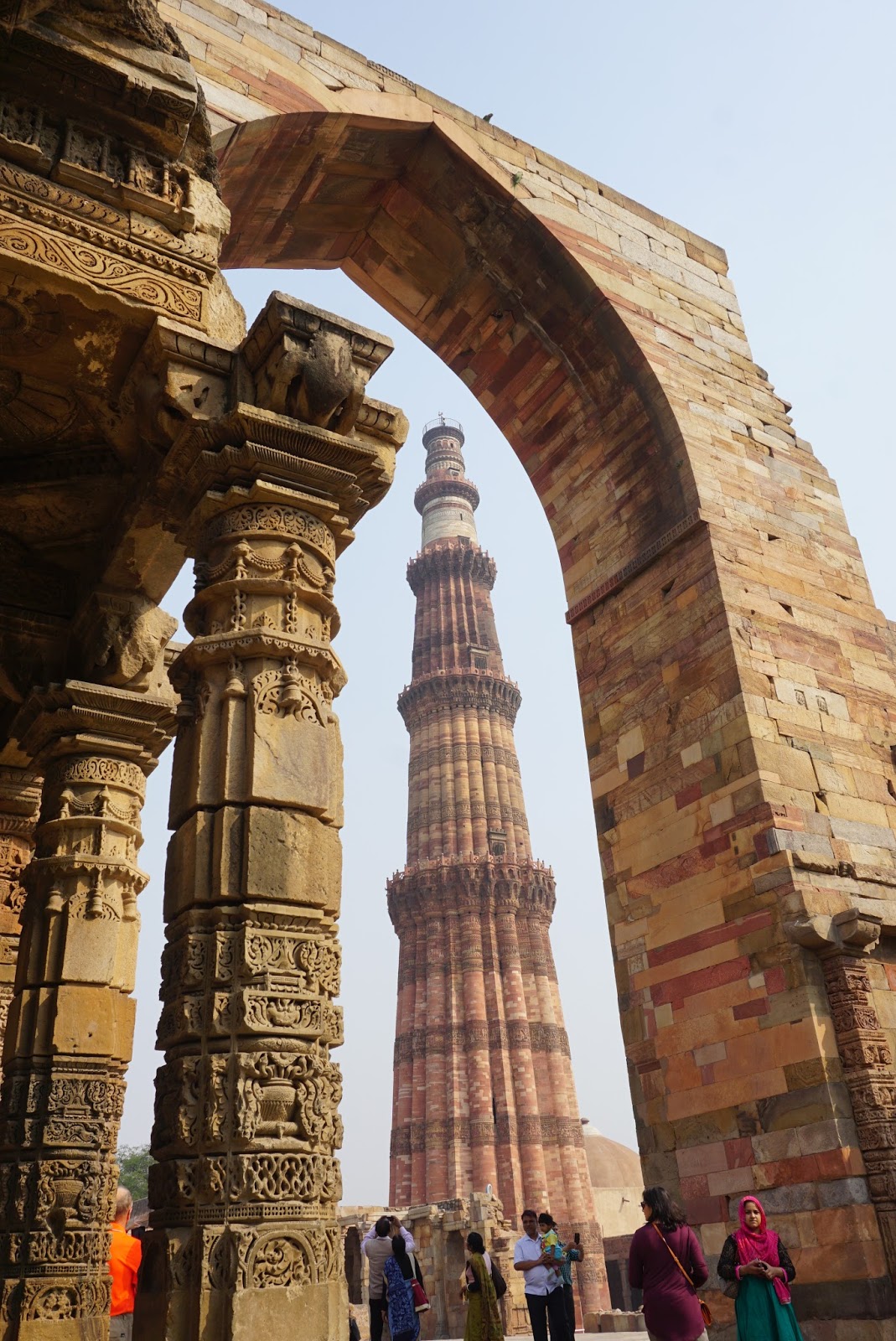
Our last stop of the day is south of Delhi at Qutb Minar, a UNESCO World Heritage Site. Delhi has been the capital of several northern Indian empires, most of which were Muslim invaders. The Qutb complex may have been the last Hindi Capital. The Hindu temples were destroyed by a Muslim invader and the stones used to build a mosque and a 240-foot stone minaret, the tallest stone tower in India. After the site was abandoned, the plaster veneer wore away and now the Hindu symbols on the original stones can be seen.Wednesday, February 24, 2016
February 23, 2016
February 23, 2016
We landed in Delhi, India in the afternoon. After clearing customs and retrieving our luggage, we easily found our tour guide waiting for us outside baggage claim. We are greeted with a fresh lei of marigolds. There are ten people in our group, all a little older, and all living in the US. That includes two German citizens, one Canadian, and an Indian couple.
Our group loaded up on a small bus and drove to our hotel. Slowly. Traffic in Delhi is ridiculous. The streets teem with cars, motorcycles and ubiquitous 3-wheeled green and yellow, soft-covered motorcycle taxis. Laughingly lots of the motorcycles and these auto-rickshaws are overloaded with riders.
The hotel we check into is wonderful making Aimee very happy. We don’t usually travel first class, but in India, it is much more affordable (and wiser). Since we need to fight jet lag, we decide to take a walk to a nearby archaeological park. It should be only a few minutes away but the sidewalks are crawling with humanity. And noise. Honking horns seems to be a requirement of every vehicle. It is like NYC on steroids.
We finally make it to Jantar Mantar, which is an astronomical observatory built 300 years ago. Each of the many instruments is building size and weirdly shaped and designed for tracking of the sun and planets.
Back at the hotel, we sit out at the outdoor bar and have our welcome drink. In the moment, we accidentally ordered an appetizer of Bruschetta containing uncooked lettuce and tomato topping. Something we were told never to do. We are both hoping we don’t get Delhi Belly!