Sunday, December 04, 2022

November 30, 2022

November 30, 2022

Of course it poured all night again, but we slept like babies. We were startled awake at Pompolona Lodge in Fiordlands National Park with our bed lights coming on with the generator start at 6AM. We have the routine down with a first stop at the coffee station, then breakfast, lunch preparation, before heading back to the room to restow everything in our backpacks.

The Milford Track follows two cliff-lined glacier-carved river valleys connected by a high mountain pass. Today we have to cross the pass. This will be the most difficult 9.5 miles of the track. Besides the challenge of climbing the pass, the weather conditions at the top could be miserable with cold, rain and wind. We are praying. Also to have any chance of a view, we need some clear weather, but that might be really pushing our luck.

The trail started with a gentle slope with nice views, then it got steeper and entered the forest. It drizzled on and off. The uphill was relentless. I am glad we went to the gym and practiced on the stepper, but both of us are wondering why we spent a lot of money to do this. At the two-hour mark, we made it to the public hut for a rest stop. We then soldiered on eventually making it above the tree line. We are thousands of feet up with great views looking back down the valley we came from. It is a slog but the conditions are way better than the weatherman forecasted. The rain is not torrential and the temperature is well above freezing and the wind is surprisingly calm.

At the four-hour mark we arrived at the Memorial cairn to Mckinnon, discoverer of this pass. We are greeted by one of the guides with a cup of hot tea. I went to look over the cliff to the next valley but it is completely fogged in. The edge looks incredibly sheer. A little further along we made it to the warming shelter at the top of McKinnon Pass. It doubles as an emergency hideout in extreme weather. There we ate our sack lunch along with several cups of hot chocolate. The hut is heated by helicopter deliveries of gas/oil cylinders. Because of the climb, steam is pouring from our bodies.

After almost an hour of rest, we begin the long slog downhill. For Aimee, this is the worst part. Because of late season snow the normal trail is still in danger of avalanches. We have to veer off and take the shorter but much steeper emergency route down an extremely wet and rocky stream bed. It was treacherous. One misstep, a twisted ankle and it would be a very miserable twenty mile walk out of the wilderness. Aimee was a trooper. She very slowly but methodically took every step aided by two hiking poles and my hand support on the most dangerous drops. The downhill route was relentless and slippery. We thought it would never end. The upside was comfortable temperatures and only minimal rain. One section was climbing down the side of a waterfall cascade for hundreds of yards.

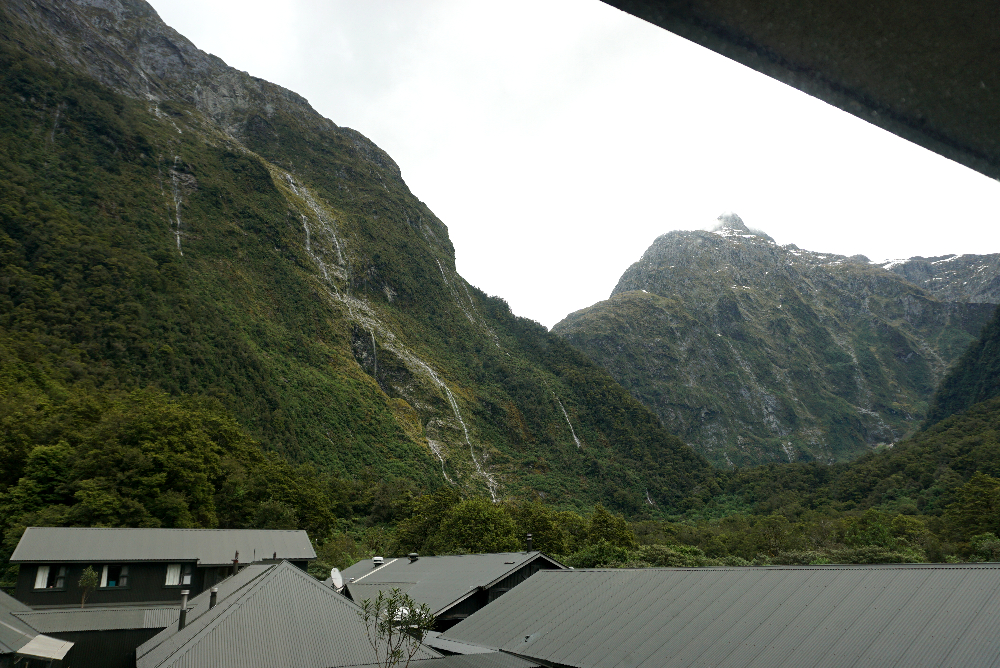
It took another 3.5 hours to reach Quintin Lodge. The sun popped out on arrival and our room view was the best so far. We are exhausted though. We had to skip the optional ninety-minute hike to see Sutherland Falls. At 1900 feet, it may be the highest in New Zealand. No problem. We have had no shortage of waterfalls on this hike.

Saturday, December 03, 2022

November 29, 2022

November 29, 2022

Last night when I woke up to use the bathroom, the lights were not working and the room was cold. Fumbling in the dark, I eventually remembered the power was off until 6AM. Electricity is something we all take for granted.

We wake at Glade House on the Milford Track in Fiordland National Park. It is not raining but the weather is overcast. We dress and then head to the dining room for breakfast. We also prepare a sandwich for our trail lunch.

At 8:30AM we all left as a group. It didn’t take long for us to stretch out on the trail. We cross over the wide Clinton River ten at a time on a swinging bridge. These swaying spans make Aimee especially nervous. We follow the river upstream through the forest. Interestingly, the distance markers are all in miles, despite the switch to metric years ago. I guess they kept it for us. I like having these mile markers because it allows us to track our progress. No other trail in New Zealand has these.

Less than an hour into the hike we have a Wetland Walk detour to investigate the plants that live in the many bog sections of the valley floor. I find the carnivorous Pygmy Sundew plant to be the most interesting. Getting nutrients in a landscape that rains constantly is difficult. Almost microscopic this red plant produces dew-like sticky secretions that attract and capture insects delivering much needed nitrogen.

The rain starts soon after we leave and doesn’t let up. But by now we are used to it. We soldier on. After three hours we finally reach a clearing where we can see the cliffs lining the trail. They are covered in thin waterfalls cascading down the nearly sheer cliff faces of this glacier-carved valley. The walk through the rain was so worth it! The rain never lets up but the forest disappears opening up the view. It is magnificent scenery. I have to work very hard though to take photos in the rain. I keep the camera in a plastic bag, trying quickly to snap photos with my free hand protecting the lens. One errant raindrop on the camera lens and all the shots will be blurry.

We stopped at a warming hut for lunch. The hiking company has built these structures along the trail and helicopters-in supplies. It is so nice to get out of our rain gear and have a warm beverage.

During the second half of the hike, we made a brief detour to see Hidden Lake sitting next to the cliff. Apparently a large landslide in the past caused this depression in the valley floor. The rain got heavier but nowhere near its potential. This is one of the world's wettest spots, with rain reaching thirty feet per year, that is more than a foot per month. It can come down so fast that the trail floods, requiring trekking through water above the knee. If the conditions are life-threatening, hikers are routinely helicoptered around the most dangerous spots. We are feeling lucky that the rain is manageable.

There is surprisingly little animal life on the trail, including birds. Like the Galapagos there are no indigenous mammals such as squirrels. New Zealand used to have a wide variety of birds, especially flightless ones. Unfortunately rats that stowed away on Europeans ships are raiding the ground nests of native birds. New Zealand has placed thousands of wooden rat traps all along the trail to help reduce the invasive pest damage. We do hear two bird types; some songbird whistling distinctive calls to each other, and a parrot squawk which we assume to be the Kea, the only mountain Parrot. Unfortunately, try as we might, we can't see anything in the dense jungle canopy.

After ten miles and six hours, we arrived at Pompolona Lodge. These private lodges have drying rooms for our wet clothes and equipment. There are a set of parallel government huts without these ‘glamping’ benefits. We took a hot shower and then put on our dry set of clothes that we packed inside a plastic liner bag. I then put up my feet to rest them. Our room has an even better view than last night. Aimee and I stopped at the bar for a drink before another big supper.

Friday, December 02, 2022

November 28, 2022

November 28, 2022

We arose early in our Queenstown, New Zealand hotel and double checked our packing from last night. We need to be prepared for the extreme elements the weather forecasters are predicting for our next excursion. We checked out and left our luggage with the hotel. We donned our boots and hoisted our backpacks and hiked into downtown. It is a beautiful day. We are praying it lasts.

At the assembly point, we meet our hiking guides. All four are ladies and three are young enough to be our granddaughters. After loading onto the bus at 9:30AM we began the drive to Fiordland National Park. We stopped in Te Anau for a simple but tasty lunch. Since we missed Thanksgiving, we had the Pumpkin Soup. Afterwards we drove the thirty minutes to Te Anau Downs where we boarded a boat. The Milford Track is unusual in that the beginning and end require water transport making it difficult to do day hikes on any of it. It takes an hour to reach the far tip of Lake Te Anau and the mouth of the looming Clinton River valley.

Disembarking we gather our packs and begin the 33.5 mile Milford Track. This trail was first blazed in 1888. For almost a century before the Homer Tunnel was cut, this was the only way to get to Milford Sound, outside sailing around New Zealand. It is still very popular and access is limited. You have to sign up far in advance to get a spot. It is an easy one mile walk to our first lodge at Glade House, where we are given afternoon tea, cookies and orange wedges, and then shown to our room. It has a view, and the weather is still good!

Since it is early we do a nature walk around the area with one of the guides. The walk is only mildly interesting. It is actually a quite difficult hike through the forest over a tangle of rocks and exposed roots. I am hoping neither of us twists an ankle. On the plus side we saw the huge New Zealand Pigeon and a Bush Robin.

For being off the grid, our backcountry lodge is very nice with running water and electricity, at least until the generator stops at 10PM. We had a drink in the bar and then a three-course dinner. I had the Fiorldand Venison in a red wine and cranberry gravy. Aimee had baked salmon. It was delicious. We may freeze and get soaked on the trail but we won’t starve.

It was announced that one of our young guides tested positive for Covid and is out. New Zealand closed their border through most of the pandemic and still has to go through the process of everyone getting Covid and developing natural immunity. They just delayed the inevitable.

After dinner we all got up as countries and introduced ourselves. It is a very international group. There are more than a dozen each of Aussies, Kiwis, and Koreans. The rest are couples from Japan, Ireland, England, Canada, and of course us lone Americans. Almost everyone said the Milford Track was on their bucket list. Most Americans have never heard of it.

Saturday, November 26, 2022

November 27, 2022

November 27, 2022

We awoke to nice weather in Queenstown, New Zealand. Aimee and I are wondering if that will last the whole day. We drove fifteen minutes east to the Kawarau Bridge Historic Reserve. This is an old suspension bridge built in 1880 that spans the deep Kawarau River Gorge. It was built here where the gorge is narrowest during the Otago gold rush. The river gorge also was a film location for Lord of the Rings.

Today the bridge is most famous for being the site of the first commercial bungy jumping operation. It continues to this day. We watch one person after the other make the leap of faith hoping the over-size rubber band holds. Aimee really liked the sign for the toilets.

After this little bit of amusement, we returned our rental car to the local airport and then picked up the public bus back to our hotel. Conveniently the bus stops right in front of our hotel. For lunch Aimee insisted we eat at an Irish Pub named Pog Mahones. It is the only Gaelic words (Kiss my Ass) her Irish mother taught her. I am not surprised. Aimee and I shared a Beef and Guinness pie. Surprisingly it is our first time ever eating it. Of course I washed it down with a real Guinness draft.

We spent a couple hours walking the lake and doing some shopping. We watched as the historic TSS Earnslaw left the harbor for a lake cruise. Queenstown is known as the Adventure Capital of the World. We pass dozens of shops hawking every imaginable adrenaline tour. The other half of the stores sell adventure gear.

At 2:30PM we mosey over to the Ultimate Hikes Center. We signed up for something completely different. We are going to do another Great Walk, supposedly the best in New Zealand. But this time it is for five days staying at backcountry lodges. This Milford Track is a 33.5-mile trail that runs from Te Anau through Fiordlands National Park to the Milford Sound Fjord. We are told the weather forecast is colder and rainier than normal. Curses! Where is Global Warming when you need it.

We spend the rest of the afternoon organizing our gear. It is a logistical concern. We have our hiking gear which will get very wet. We have dry clothes to change into on arrival at each lodge. This all has to fit inside our daypacks. We also chose some clothes that will be sent ahead for the last day touring Milford Sound. And finally all the rest needs to be packed inside our luggage for storage at our hotel while gone. We hope we sorted everything correctly.

Friday, November 25, 2022

November 26, 2022

November 26, 2022

We awoke to some sunshine and no rain. That is the trigger for us to do a hike. So we checked out of our Te Anau, New Zealand motel and drove down the Milford Highway for an hour. Unfortunately as we wound through the mountains, the clouds got lower and lower. Foiled again by the Southern Alps! We parked at the Divide Shelter Trailhead of the Routeburn Track, our fourth Great Walk excerpt. We hiked straight uphill for an hour to Key Summit. It is in the clouds with no view to be had. We had a snack at the top as a reward for making the climb. For a few brief seconds the clouds parted and we got a glimpse of the snow-capped mountains surrounding us.

We hiked the thirty-minute Alpine Nature Walk past some small mountain ponds (tarns) exploring the strange vegetation of this alpine landscape. It is very unusual and fascinating, plus we have the whole area to ourselves. On the hike back down we pass dozens of people coming up. Many of them are in t-shirts and shorts, while we are bundled up with hat and gloves! Total time on the trail was three hours.

We have a leisurely return drive. We only make a short stop at Mirror Lake for photos. Because we are here in the Spring, lots of flowers are blooming. The most abundant flower is from the Kowhai Tree. Its yellow flower is ubiquitous, lining half of the roadway. It is the unofficial national flower of New Zealand. Back in Te Anau we stop at the Fiordland Visitor Center to peruse the exhibits and watch the park film. Fiordlands is the largest park in New Zealand. It is also a World Heritage Site. Afterwards we stop at a pub for a hamburger lunch.

From Te Anau, we make the two-hour drive to Queenstown. It is only fifty miles as the crow flies but there are large mountains in the way. Queenstown sits on a bend in the middle of the fifty-mile long finger lake Wakatipu. It would be brilliant blue if it still had a glacier feeding it. There are loads of Yellow Lupines as we approach.

We check into our Queenstown hotel. We are tired and it is spitting rain so we have a pizza dinner at the penthouse bar. Queenstown is surrounded by mountains.

November 25, 2022

November 25, 2022

Blue Penguins are plentiful in New Zealand but cumbersome to view. Since they are the world’s smallest penguin, they are the most vulnerable when they come ashore to their nests. That is probably why they wait until sunset to return. With their dark blue back they can easily hide in the shadows. To make spotting them easier and more comfortable for penguins and tourists, the town of Oamaru, New Zealand has built grandstands and lighting astride one large colony. Unfortunately they charge a princely sum for the convenience. Sunset was 9PM last night.

At 8PM we went to the Blue Penguin Colony on the harbor front. We got the last two premium seats. This ticket price tier allows us to stroll the boardwalk through the colony. Blue Penguins dig holes in the shoreline dirt for nests. To expand the colony, Oamaru has built a couple hundred wooden box nests.

We had to be in our grandstand seats before dusk so not to scare the arriving penguins. Almost on clockwork the first ‘raft’ of a dozen penguins comes ashore at sunset and makes their way up the rocky slope. They wait in a group at the crest to see if the coast is clear. They then quickly waddle past us through a wooden gate into the nesting grounds. They are adorable creatures, about the size of a small rabbit.

For the next hour, these little Blues come ashore in groups. By the time we are ready to leave there are two hundred all over the nesting grounds. They make all kinds of sounds. The chicks sometimes sound like crying babies with a trill added. On the boardwalk out, the penguins are milling about right below our feet. If allowed, I could easily pick them up. Near the exit, two penguins sound like they are getting ready for a fight, but instead a male mounts his female.

On the drive home with our headlights, Aimee spots a couple penguins aside the harbor road. But when I stop and turn around, they pretty much disappeared into the dark. So glad we spent the money to see them under the spotlight.

This morning, we checked out of our Oamaru motel and continued our whirlwind tour of New Zealand. We would have liked to stay another day here. Oamaru is a pretty city, nicknamed the Whitestone City after the many civic buildings that were built out of this local limestone in a distinctly Palladian style (a connection to our recent visit to Vicenza, Italy). Oamaru got rich in the late 19th century servicing the export of frozen meat to England. The economy crashed when the UK joined the EU in 1973 and New Zealand lost its favored status.

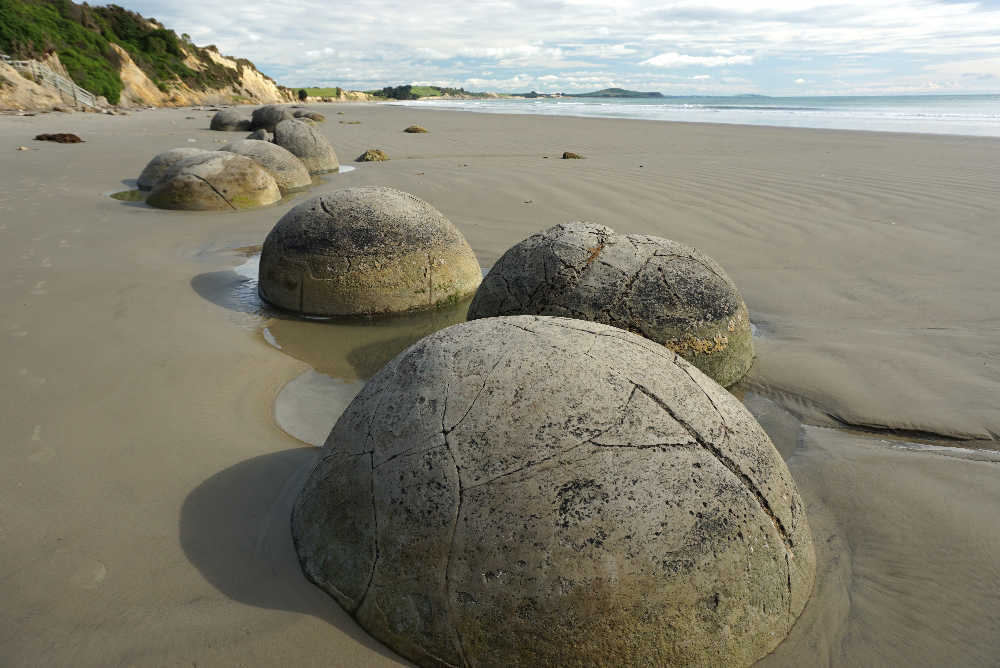
A half hour south, we stopped at Moeraki Boulders Beach. It is low tide and we can see dozens of huge almost perfectly spherical stones lying on the sand. We even see a couple boulders in the process of being weathered out of the cliff face. How these strange geologic concretions formed is not understood. Some stones are perfectly smooth, but others look like cracked dinosaur eggs with a seam of calcite gluing them together. Apparently there used to be many more, but the smallest were hauled off years ago by souvenir hunters.

Continuing south, our next stop is the major city of Dun-edin. Its name is the Gaelic version of Edin-burgh. We have only time for a quick stop in the pretty central square. It is in the shape of an octagon. Because of the Scottish roots here, there is a nice statue of the Scottish poet Robert Burns. We left Dunedin on a four-lane divided highway, the first we have seen. Unfortunately, it didn’t last more than a couple miles and it was back to two-lane country highway.

Cutting west across the southern end of the South Island, we stopped for an Indian lunch in Balclutha. It was surprisingly good, and the owner reminded us of Babu from Seinfeld. Farther on, I smiled when we passed a giant Trout statue in Gore. They call themselves the Brown Trout capital.

Most of the land on the east coast was rolling farmland that could easily be Hobbit land in the Lord of the Rings. The closer we get to the Southern Alps, the farms become perfectly flat like in the Midwest. Most farmers are raising Cattle and Sheep to provide China with their increasing desire for meat. We were shocked to see some farms raising European Red Deer. It is partly for the European Venison market but also to fill the Chinese demand for Antler Velvet used in traditional medicine. When I pulled over to take a photo, the deer scattered but the cows all came close.

At the base of the Southern Alps, we stopped for the night in the town of Te Anau. After checking in, we drove a few miles to the Rainbow Reach Trailhead of the Kepler Track. Named after the great German astronomer, this is another Great Walk. This 37-mile trek opened in 1988 to relieve pressure on the other nearby Fiordland National Park Great Walks. We donned our rain gear even though the weather looks good. We are hoping that will keep the rain away.

The trail starts with a bridge over the rain-swollen Waiau River. It played the River Anduin in the Lord of the Rings movie. The trail goes through Temperate rainforest versus the Tropical rainforest of Abel Tasman. That means more trees, with moss and some small ferns, but no palms or fern trees. We hiked two hours across several swinging bridges almost to Lake Manapouri.

We saw several cool-looking Fantail birds flitting through the forest. Their tail feathers open and close to help them catch flying insects. While trying unsuccessfully to take photos of these fast-moving aerial artists, Aimee spotted two of their nests, both with chicks. 

Back in Te Anau we went straight to dinner at a restaurant recommended by our hotelier.

Thursday, November 24, 2022

November 24, 2022

November 24, 2022

When we awoke this morning at Mt. Cook National Park, we could see a little more mountain outside our window, but it was still drizzling. We checked out of our Hermitage Hotel room, and went to the car to find some snow had fallen on it overnight. The auto temperature was just above freezing.

Before leaving the park we drove down Tasman Valley Road for one last hike. At road's end we hiked the short trail over the terminal moraine to an overlook for Blue Lakes. These three lakes no longer get much glacier melt water so algae is turning them green. We continued on to a view of Tasman Glacier and the large melt lake below it. All four of the glaciers we saw or tried to see recently descend from the same Mt. Cook massif.

Although it is still raining, looking down the valley we can see sunshine. That probably shouldn’t be too surprising as the east is the drier part of New Zealand. The mountains capture the clouds and wring out the moisture. We work our way back down the length of Lake Pukaki. At the southern end of the lake we stop at two public parks for photos. The scenery is gorgeous with the iridescent blue lake water against snow-capped mountains. One spot has a statue of a Himalayan Tahr, which is some kind of rare Nepalese Mountain Goat that was introduced here for hunting.

We stopped in the nearby town of Twizel for an early lunch of Thai food. Twizel started life as a temporary housing camp for workers building the Waitaki Power System. A cascading series of eight hydroelectric dams were built along the Waitaki River as it descends from the mountains to the sea. They provide 20% of New Zealand’s Power. We decided to follow the Waitaki Hydro Heritage Trail south to learn more about this energy generation system.

Along the way we stopped at a Salmon Farm that uses the cold lake water to raise these fish in large pens. A retail store is also attached. We had a good time watching some kids feed them by tossing pellets into the water and watching the fish compete with a duck for the morsels.

The first couple hydroelectric lakes are set amongst steep dry hills that look like the ones we often pass through in New Mexico. At Benmore Dam, we stop and stretch our legs along the Benmore Peninsula Track.

The lower elevation lakes are lined by rolling hills with some exposed limestone bluffs. We stop at Takiroa to see some crude Maori rock paintings in an overhang. The South Island was too cold for the Maori. They came mainly to hunt Moa and search for Greenstone. Nearby we visit Elephant Rocks which are some limestone boulders that have been weathered out of a small valley.

We finished our drive at the ocean town of Oamaru. We checked into our motel and then went down to the harbor front. Our motel clerk said we could probably see Blue penguins there tonight as they return to their shoreline nests from a long day feeding in the ocean. Humorously we saw Penguin Crossing signs. We went to Bushy Beach to see if we could spot Yellow-Eyed penguins. After watching unsuccessfully, a volunteer told us there were only eight of these rare penguins nesting here. We decided it wasn't worth the wait. Instead we celebrate Thanksgiving with an early pizza dinner at a brewpub.

Tuesday, November 22, 2022

November 23, 2022

November 23, 2022

It didn’t rain last night, and we woke to bright sunshine! A first for our New Zealand trip. Instead of leaving town, we decided to take advantage of the weather and hike to the top of the local Mount Iron hill. After checking out of the hotel, we head the short distance to the trailhead, sitting inside a local subdivision. It is a strenuous hike straight uphill to the peak. It was so worth the effort as we have glorious views of Lake Wanaka and the surrounding Southern Alps.

The weather forecast is predicting late afternoon rain, so we get back in the car and race east to our next destination. It probably took us longer than needed because our car GPS sent us on a long detour around Lake Dunstan. Since it is late Spring in New Zealand, Lupin wildflowers line the highway most of the route. 

The terrain on this side of the mountains is much drier with a lot less vegetation. The rain shadow of the mountains is to the east, just the opposite of Hawaii in the northern hemisphere. We stopped at the Lindis Pass lookout for a short hike to stretch our legs. Interestingly there was a burned out jeep in the parking lot. To save time, we stopped at a grocery store along the way for a pre-made chicken, brie, and cranberry jam sandwich. It was actually pretty good.

Just past the town of Twizel, we left the highway and followed the shoreline of glacial Lake Pukaki north. The water is an unreal blue color from the microscopic rock flour suspended in it. At the end of the lake we enter Aoraki-Mount Cook National Park. Unfortunately by the time we arrive, it is starting to rain.

Saddened, we check into the Hermitage Hotel, one of the most famous in New Zealand. Thinking the weather is only going to get worse, we don our rain gear and head out on the Hooker Valley Track. This trail follows the raging Hooker River over several swinging bridges towards Mueller Glacier descending from Mt. Cook, the tallest mountain in New Zealand. Unfortunately with the rain, it is nowhere to be seen. We can see the bottoms of many snow-capped peaks. It must be stunning in the sunshine.

On the hike we see a Paradise Shelduck and several ducklings. The mother has a white head while the father’s is jet black. They are endemic to New Zealand.

Back in Mt Cook Village, we stop at the National Park Visitor Center. The first explorers of New Zealand noted the snow-capped Southern Alps but for some reason never mentioned the lofty Mt Cook peak. That is not a mystery to me. From my experience Mount Cook is always in the rain clouds! The famed mountaineer, Edmund Hillary, was probably the most famous Kiwi. He honed his skills by climbing Mt Cook, before successfully scaling Mt Everest. His statue graces an outdoor courtyard here.

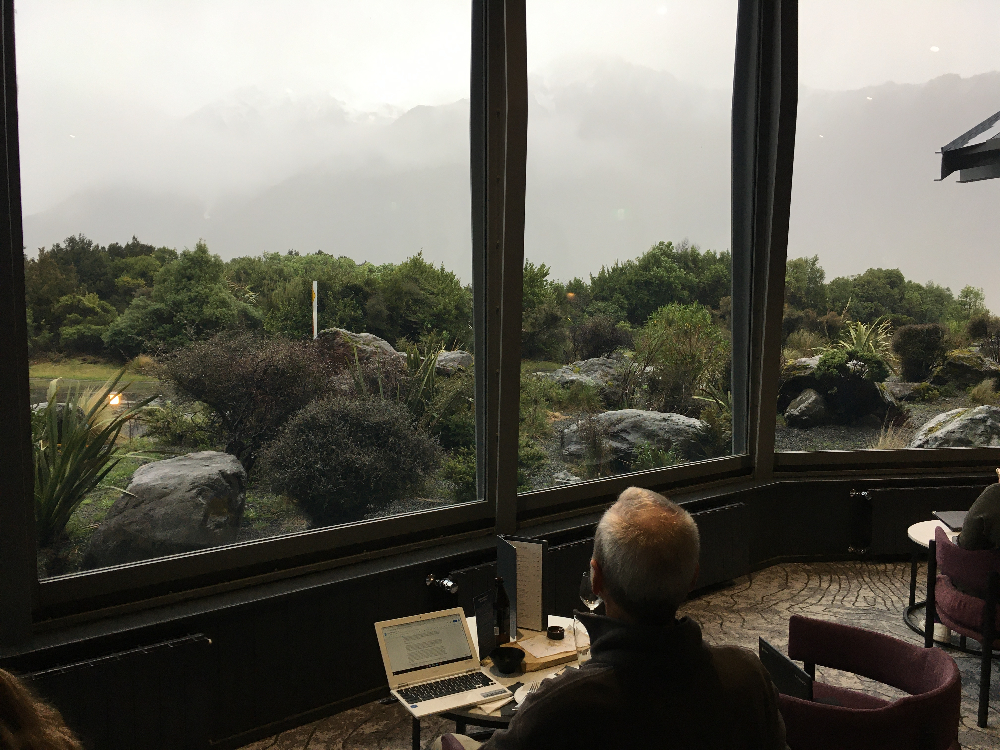
We finish off the last of our Hawke's Bay Chardonnay in the room, before going to the lounge for drinks and a cheese platter. Our seats would have a great view, except for the rain.

November 22, 2022

November 22, 2022

It rained again last night. That is sounding like a broken record on the Wet Coast of New Zealand. When we woke, Aimee looked out to see clearing skies. We hurriedly got dressed and as we stepped out of our room, it began to pour again. Darn. Back in the room, I read the morning paper.

After an hour or two, we left the town of Fox Glacier, continuing south. With twenty feet of annual rainfall, there is no shortage of rivers. To save money, New Zealand has mostly built narrow one lane bridges outside the urban areas. Combined with winding roads travel is slow.

We stopped at two scenic lookouts along the coast to use the bathroom and stretch our legs. We seem to be leapfrogging three tour buses doing the same itinerary. We are also seeing loads of camper vans. At one time that was going to be our plan. I am glad we deferred. RVing in the rain is no fun.

At the town of Haast, we turned inland and followed the large Haast River upstream. The road soon climbs a narrow gorge and we enter Mount Aspiring National Park. One benefit of rain is roaring waterfalls. We stopped at two; a very tall skinny Thunder Creek and a gushing Fantail Falls. We took an hour hike out to see Blue Pools, but with the rain it is not so blue. Unfortunately I am finding my old rain gear is not up to New Zealand standards and I am drenched.

Once over Haast Pass we descend down to Lake Wanaka. This is one of many glacier carved finger lakes on the eastern interior side of the Southern Alps. We follow the cliff road along this lake, before crossing to Lake Hawhea. They are probably a beautiful blue color in clear weather.

We end the day in the town of Wanaka on the southern tip of its namesake lake. We get a break in the rain long enough to haul our luggage into the hotel. After checking in we have a delicious Taco Tuesday very late lunch. We then went shopping for new rain gear. Wanaka seems like a nice town full of helpful friendly locals.

After an hour or so of chilling out, we noticed the sun has popped out. We can’t let this opportunity pass, so we get dressed and have a nice walk along the lakefront. With the snow-capped Southern Alps in the distance, the scenery is beautiful. We chuckle when we see the local attraction. For some reason there is a small tree growing thirty yards into the lake. A small crowd of tourists are bunched on the shore snapping photos.
Newer Posts Older Posts