Wednesday, March 02, 2022

February 28, 2022

February 28, 2022

For breakfast I finally had Falafel, a deep-fried ball of ground chickpeas. It is the one food I remember having on my first visit because I knew it was safe for a westerner to eat. I guess it is more of an Egyptian street food versus a restaurant serving.

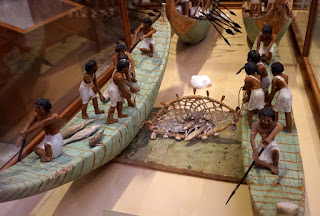
We walked out the back door of our Luxor hotel past the pool to the Nile Riverfront. There we boarded one of many ferries for a ride across to the west bank. In ancient times, the river was probably also busy with fishing boats, ferries, and cargo vessels.

On the opposite side we boarded a bus to begin our tour of the royal tombs. On the way we made a brief stop to photograph the Colossi of Memnon. These are two enormous seated figures (60 ft high) that once graced the entrance to the Mortuary Temple of Amenhotep III (Tut's grandfather). A mortuary temple was built to memorialize the king and provide a place for his devotees to worship him. Little of the temple remains. The Colossi garnered this Greek name because they were tourist attractions even in ancient times.

We also pass many other mortuary temples, including the Ramesseum of Ramses II. They were sited just on the edge of the desert with the Nile flood plain. All are in ruins because over time the annual inundation of Nile waters undermined the foundations of the stone structures.

Our first major stop is the Valley of Queens. This was the burial ground of royal relatives of the king. This small area is peppered with dozens of tombs; so many they have to be numbered. The cliffs and mountains resemble those of Tucson minus the cacti and all other vegetation.

We enter number QV52, tomb of Titi, wife of Ramses III. The tomb is a shaft and hallway cut into the earth ending with a burial chamber. The walls are all gaily decorated with colorful drawings and hieroglyphic inscriptions. Unfortunately it is all behind glass to protect it from the grubby hands of the public. Nonetheless it is simply amazing that so much of the decoration is intact with vibrant colors after 3500 years!

We next visit QV55, the tomb of Prince Amun Khopshef. He was the eldest son of Ramses III who died in his teens. It is just as impressive. One niche contains the mummified fetus of another son.

Remarkably, these tombs are not the best. We have to pay a queen’s ransom to visit QV66. This is the tomb of Nefertari, wife of Ramses II. Her name means ‘beautiful companion’. The tomb is spectacular. It is also a more complicated design with a pillared room.

The walls of Nefertari's tomb look freshly painted. What is more amazing is that the walls are not behind glass. I hope my fellow tourists respect this sacred heritage of humanity. It would be a tragedy to lose it after so many years.

There are so many wonderful sites, we have to keep moving. Our next stop is the Mortuary Temple of Hatshepsut. She is probably the most famous female Pharaoh. Her temple is one of the few to survive because it was built spectacularly terraced into the cliff side. The carved relief decorations are not in great shape. Most proclaim her descent from the gods. One story panel relates her naval expedition to some Red Sea nation to get incense trees. Her son felt she had usurped his rightful rule, so when he finally gained the throne he systematically had her image removed from almost every relief. Hatshepsut’s story seems so similar to palace intrigue that plagues royal families today. I guess some things never change.

Our next stop was another of the seemingly required local shopping trips disguised as craft demonstrations. I get tired of these even as many in our group always buy something. This stop was an Alabaster workshop selling hand-made stone vessels.

Our next stop was around the corner in the Valley of the Kings. Despite millennia of peaceful rule, on a few occasions, the Egyptians were racked with anarchy for decades, either because of dynastic problems or the rare foreign invasion. At these times, the valuable grave goods of the royals became targets. This even occurred in the short Arab Spring revolution in 2011. The Egyptian Museum lost major pieces. No wonder the Pharaohs decided to hide their tombs here. As a bonus the mountain they are buried beneath is pyramid shaped.
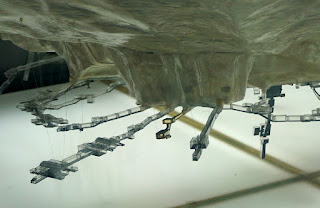
In the Kings Visitor Center is a model of the King’s Valley. It is very cool because underneath the table are models of tomb shafts extending into the earth. Very cool.

Our first stop is at KV62, the most famous tomb, Tutankhamun. First we get a description of what was found when the tomb was discovered one hundred years ago in 1922. When we enter, though, we have to laugh. It is shockingly small. Only a short hallway and a couple rooms, each of which had been packed with grave goods. Tut only ruled nine years dying when he was nineteen. Workers had little time to carve his final resting place. Long reigning kings had bigger tombs. Surprisingly, Tut's sarcophagus and mummy remain in the tomb.

We then went next-door to KV9. It was the construction of this tomb of Ramses VI (19th dynasty) that concealed Tut's tomb entrance. We had to pay a small premium to enter. It is one of the longest and better decorated. There is a columned room in the middle and it ends in a large chamber with a broken sarcophagus and astronomical ceiling.

We paid another big premium to see KV17, the tomb of Seti I, father of Ramses the Great. It is the deepest and longest tomb and the most decorated. It is Aimee’s favorite. She noticed the raised relief carvings on the wall. This differs from simple painting on flat surfaces and sunken relief where the outlines of figures are carved and then painted. Raised relief involves removing all the stone EXCEPT for the figure. After painting, this causes the figure to pop out like a sculpture. This takes much more time and effort.

The level of detail and decoration in Raised Relief hieroglyphs also helped Egyptologists realize what some of the obscure hieroglyph characters represented. While I love raised relief also, I really think Aimee liked Seti’s tomb because it had a room with a lot of Pharaohs and Gods touching each other's elbows. In Egyptian art that implies X-rated activity!

The general entrance ticket for the Valley of the Kings allows entry to three of the non-premium tombs, so we had to pick which ones we went to.

We first chose KV16, tomb of Ramses I, grandfather of Ramses the Great. It is small but brightly painted. The sarcophagus is dark red quartzite. The next was KV8 tomb of Merenptah, son of Ramses the Great. This one was deeper with lots of stairs. Its hallway was in poor condition but ended well. Aimee noticed lots of figures with their arms tied behind their back. This represented some kind of battle and these were captured prisoners. Our last visit was KV6, tomb of Ramses IX.

Having got our fill of tomb visits, we loaded on the bus and drove to the river. Along the way we passed lots of fertile agricultural fields. It looks like a wide variety of crops are being raised. We see a plot of tomatoes being dried in the field. Another one I can identify is sugarcane. We even see a sugar cane train crossing a canal in front of us.

At the riverfront we boarded a cruise ship that is going to be our home for the next few days. After checking in we had a late lunch. We spent the rest of the day lounging on the upper deck enjoying the warm weather.

Tuesday, March 01, 2022

February 27, 2022

February 27, 2022

We got up well before dawn at 3 am for our journey to the Cairo airport. Halfway there we stopped at the Unknown Soldier Memorial. It is a modern pyramid dedicated to those killed in the 1973 Yom Kippur War with Israel. It also contains the tomb of Anwar Sadat. He is a personal hero for our Egyptian guide. Sadat was gunned down in 1981 across the street during the October 6 parade celebrating the war. He was assassinated by the Muslim Brotherhood for making a peace treaty with Menachem Begin and Israel.

At the airport, we boarded our Egyptair flight to Luxor 400 miles due south on the Nile River. We arrive too early to check into our hotel so we detour to the Luxor Museum to learn about the local history. The original name of the city Luxor was Waset. When the Greeks took over they named it Thebes. When the Muslims took Egypt, nobody could read hieroglyphics any longer so they thought all the temples were palaces, so they called it ‘al Uqsur’ (the Palaces) which was Anglicized to Luxor. 

During the New Kingdom (around 1500 BC), the Kings (now referred to as Pharaohs) moved their capital here, probably because it was safer from invading armies from the Mediterranean. With the move, the Pharaohs adopted the local god Amun as their chief deity (hence they took names like Tut-Ankh-Amun, living image of Amun) and Amenhotep (beloved of Amun).

The Luxor Museum is not very large, but it has outstanding samples and unlike the Cairo Museum, they are all documented. It has the requisite Egyptian statues, which must have been produced in the thousands because examples are all over the world. We have even run across granite Sphinxes from Egypt along the riverfront of St Petersburg, Russia!

It also has collections of Egyptian weaponry, especially bow and arrow. This was the height of the Egyptian Empire's expansion abroad. Surprisingly it also has architect tools that would be necessary for building tombs and temples. There are two well-preserved mummies of Ahmose I (first New Kingdom Pharaoh) and Ramses I (founder of 19th dynasty).

Afterwards we checked into our hotel room and had a big buffet lunch. Since we got up early today Aimee took a short nap while I checked the news and did chores. Then for some exercise we walked north along the river corniche. The river is lively with boats probably not much unlike ancient times. There are mountains in the distance on the far side of the river. After a mile we reached Luxor Temple. We just take some photos from the outside.

We return to the hotel for a lecture on the archeological status of the area. The New Kingdom Pharaohs were buried in the City of the Dead on the West Bank. Unlike Memphis with its pyramids, here the Kings were buried in hidden tombs cut into the mountain. Our lecturer manages dozens of digs sponsored by countries from all over the world. It seems to be a never-ending task.

We then walk to the riverfront where we load onto two Feluccas for a sunset sail on the Nile. A felucca is a traditional Egyptian lateen-sail wooden boat. We don’t go very far as the air is very calm.

Back ashore we return to Luxor Temple with our Egyptologist for an evening tour. The Entire complex is lit up making it feel magical. Unfortunately, the onslaught of tourists breaks the spell. Karnak Temple, a mile to the north, was the home of the local god Amun. After harvest season an Opet Festival of fertility would be celebrated. During this multi-day holiday the statue of Amun would be transported to Luxor Temple to meet with his goddesses and rejuvenate the world. Our first stop was the Avenue of Sphinxes, the long processional way that Amun would travel to Luxor Temple.

We then approached the facade of the Pylon or entrance gate. Two Obelisks once flanked it; only one remains. The other was moved to the Place de la Concorde in Paris almost two hundred years ago. 

Past the pylon, we enter a courtyard encircled with dozens of columns. Every wall and column surface is richly carved with figures and hieroglyphs. We follow a colonnaded hallway to another courtyard before reaching the Inner Sanctum with dozens of rooms. Every ruler would add on to the temple. Many would assume responsibility by recarving the cartouches with their name. Humorously Alexander the Great even added on when he was crowned King of Egypt. We are able to find his image and cartouche.

After our temple tour we returned for a late dinner at our hotel.

Sunday, February 27, 2022

February 26, 2022

February 26, 2022

We finally got a good night’s sleep last night. Hopefully we are now over our jet lag. For breakfast we tried the Egyptian 'Ful'. This is a stew of cooked Fava beans topped with oil and spices. It looks and tastes like Mexican refried beans. Aimee loves it.

Being up early we heard the first call to prayer of Muslims about an hour before dawn. These five exhortations daily are carried on loudspeaker from the mosque minarets. Since Cairo is known as the 'City of a Thousand Minarets', it is heard throughout the city.

To learn more about this heritage we visit three mosques. The first is the Mosque of Muhammad Ali. It sits inside the Citadel, a sprawling stone castle sitting high above the Nile valley on the eastern edge of Cairo. This impressive fortification was first built by Sultan Saladin in the 12th century to protect Cairo from potential invasion by Christian Crusaders. Our guide gave us a brief history of Egypt and Cairo after the Pharaohs. It was mostly one of being conquered for its great wealth of resources. First by Alexander the Great, then the Romans, followed by the Muslims, the Ottoman Empire, and then Napoleon. Muhammad Ali was the Ottoman sent to recover Egypt from the French. He ended up ruling Egypt and modernizing the nation.

Pasha Muhammad Ali built Cairo’s most distinctive mosque inside the Citadel. It looks like the Hagia Sophia in the Ottoman capital of Istanbul. We take off our shoes and enter the outer courtyard with its ablution fountain where Muslims purify themselves before prayer. We then enter the mosque where Muslims are led in prayer while facing Mecca. Afterwards we go out to the plaza where we get a view of Cairo. We can see the pyramids on the opposite ridge. Modern Cairo is a forest of apartment buildings.

Our next stop is just below the Citadel with two side-by-side mosques. The first is Al Rifai. Inside our guide gives a rundown on how to be a good Muslim. For me the most interesting part is that the mosque also contains the tomb of King Farouk who was deposed by Nasser in 1952. Surprisingly it also contains the tomb of the Shah of Iran. He died while in exile here.

We then went next door to the Mosque of Sultan Hassan. This one is much older, being built in the 14th century.

Finished with our Muslim tour, we next explored Christian Coptic Cairo. Copt is merely a corruption of the Greek spelling of Egypt. While 90% of Egyptians today are Muslim, it was majority Christian for centuries, having been brought here by St. Mark around 48AD. 

The Christian churches are all within the Fortress of Babylon. The Romans built it to protect the river port of an ancient canal connecting the Nile with the Red Sea. Muslim invaders founded the city of Cairo outside the fortress walls. We visit the ruins of the main Roman Tower. Its next-door twin is incorporated into a church. We next visit Saint Virgin Mary’s Coptic Orthodox Church, one of the oldest in Egypt. It is known as the Hanging Church because it was built atop a gatehouse of the Fortress with the nave suspended over a passage. Surprisingly it is decorated with lots of Islamic features.

We also visited the nearby church of St Sergius and Bacchus. It is supposed to be nearly as old and is built atop the spot where the Holy Family lived when they escaped to Egypt. Joseph may have worked at the Roman Fortress.

We then drive through slow heavy traffic to the Khan el Khalili bazaar where we have a big lunch. We begin with the now standard Middle East starter of bread with Hummus, Tahini, Tzatziki, and Baba Ganoush (eggplant) sauces, and then a variety of spiced meats. It is finished with several small, tasty desserts.

We have some time after lunch to explore the massive outdoor market. I thought it was pretty cool years ago, but it has turned into a purely tourist market with very persistent vendors. Even Aimee has no interest in spending time here.

Saturday, February 26, 2022

February 25, 2022

February 25, 2022

This morning we drove south of Cairo toward the ancient Egyptian capital of Memphis. Little of it remains because most of it was constructed from mud brick. Once we leave the dense apartment buildings that characterize modern Cairo, we see a fertile valley of palm trees with lots of bird life. This is a glimpse of what ancient Egypt, 'Kemet', the Black Land, must have been like. It was probably the closest thing to paradise on earth.

The dead from Memphis were buried in Saqqara outside the city, to the west, where the sun also died. We climb up the steep sides of the Nile valley to reach 'Deshret', the Red Land. We get our word ‘desert’ from it. And it truly is a desert. Nothing but sand; nothing, no cacti that characterize the Arizona desert.

This dry desert has preserved thousands of years of Egyptian burial practices. We start our exploration of the huge archeological complex of Saqqara at the pyramid of the 6th dynasty king, Teti 1, who died around 2300 BC. Like many kings of the Old Kingdom, he was buried in a small pyramid. Small is relative. It still is a huge tomb that took a lot of manpower to build. Much of the outer casing stones were stolen to build Cairo, so today it looks more like a pile of rubble. Aimee and I enter the pyramid and crawl down the long, cave-like shaft to reach the burial chamber containing the now-empty sarcophagus. Virtually every tomb was robbed in antiquity. The walls however are still inscribed with carved hieroglyphics. The ceiling is covered with stars. We can easily see the many cartouches with Teti’s name on it. It is a simple name with three letters, TTY. Hieroglyphs had no vowels. The sound of T was represented by a half-circle loaf of bread. Egyptian bread is still the same shape!

We then toured the next-door tomb of his Vizier, Mereruka. This is the guy that actually ran Egypt. His very elaborate tomb illustrates his real power. We spend well more than an hour exploring the 33 rooms of this huge tomb. All the walls are decorated with scenes from everyday life in ancient Egypt. They are fascinating, especially the river scenes of crocodiles eating hippos and tax cheats being dragged into court.

We then drove to the Pyramid of Djoser (3rd dynasty) that dominates the Saqqara necropolis. This is the first attempt at building a pyramid. Previously royal tombs were in flat squares called Mastabas. Imhotep, the architect of King Djoser, got the idea of stacking one mastaba on top of another. As a result we got his Step Pyramid. The burial complex was surrounded by a high wall with several temples. One temple is decorated with a long entrance colonnade. The stone columns are carved to resemble the papyrus bundles that the original palace columns would have been constructed of. This would establish a tradition that the Greeks would copy millennia later.

After building the Step Pyramid, Imhotep got the idea to fill in the gaps making smooth-sided pyramids. It took several missteps before they got one to last. We can see these experiments, the Bent Pyramid, and the Red Pyramid, several miles to the south in Dashur.

Our next stop was next door at a Carpet School. Egypt is trying to develop a market for Egyptian rugs and they are training new craftsmen. Rugs contain millions of knots so these workers have to tie very fast, so fast that it is difficult to see the technique. Afterwards several in our group purchase rugs to be sent home.

We then drove downriver to Giza, where we had lunch at the famous Mena House restaurant overlooking the Great Pyramid. It is named after the founding First Dynasty King. Ever on the lookout for new bird species, Aimee spotted a half dozen Hoopoes foraging for insects on the manicured lawns. These cool-looking crested birds must be the African counterpart to our Robins.

With our bellies full, we explored the pyramid complex at Giza. This was the period of the Old Kingdom (4th dynasty) when pyramid construction reached its apex. The three main pyramids are enormous. Minor pyramids for the royal family surround them. King Khufu’s Great Pyramid is constructed with 2.3 million enormous blocks of sandstone. Placing that many finished stones in a short period (twenty years) of time is mind-boggling.

I climbed inside the Great Pyramid to view the King’s burial chamber. It is a long claustrophobic hunched-back climb up a ramp, to reach the Grand Gallery, which is a long stairway with a corbelled ceiling to reach the pyramid center. Then we crawl under the portcullis, which used to be blocked by three granite slabs. They were destroyed years ago to loot the tomb. The burial chamber is completely empty except for a great sarcophagus. By the time I get back out I am sweating.

On the outside we drove to the north end for a viewpoint of the Giza complex. There Aimee and I mounted camels to ride around the pyramids. Surprisingly camels were not domesticated by the ancient Egyptians. As a result the surrounding desert was considered a dangerous environment. The desert not only protected them from foreigner invaders, it was also their prison. Fortunately a Garden of Eden prison.

In front of each pyramid is a Funerary temple with a long causeway down to a Valley temple near the Nile River. We toured the Valley Temple of King Khafre, son of Khufu. It is constructed almost entirely of fine granite stones. Remarkable that the Egyptians could have cut this hard rock with the simple tools they had. They were consummate stone craftsmen. Khafre's pyramid, the second largest, still has some of the fine casing stones at its peak.

Next door is the Great Sphinx. A sphinx is a crouching lion with a king’s head. This one is carved directly out of the cliff side. Much has changed since my visit years ago. Then we could stroll the complex unimpeded. Now Cairo is much larger and tourism greatly expanded. Today the Giza complex is surrounded by fencing, mobbed with tourists and vendors, and costly to enter.

Friday, February 25, 2022

February 24, 2022

February 24, 2022


We got as good a sleep as can be expected with our bodies not fully accepting the jet lag of international travel. After breakfast in the hotel, we meet our tour group mid-morning. More than half the group started with the optional pre-tour to Jordan and Petra. The tour director gives us some particulars on Egyptian tourism. I learned most of the tour sites will charge extra for the use of a camera, but oddly not for photos with your phone. Egypt has greatly expanded their playbook in taxing tourists.


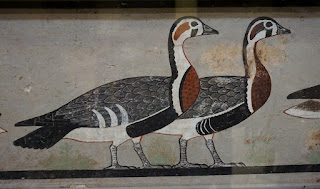
Meidum Geese
Afterwards our group heads down the street to the Egyptian Museum of Antiquities. On the way we pass Tahrir Square where the Arab Spring protests took place.

This old classic museum has the largest and finest collection of Egyptian antiquities. The government is in the process of moving the entire collection to the new Grand Egyptian Museum. Its opening has been delayed for months and months and unfortunately many items have already been moved. Despite that, there is still lots to see. We get a guided tour of the highlights remaining on a chronological basis.

Egyptian history begins with the Narmer Palette. It is a shield-shaped carved stone containing some of the first hieroglyphics documenting Narmer as the first king to unite Upper and Lower Egypt. His cartouche has a catfish (Nar) and a chisel (Mer). It is 5100 years old and in near pristine condition!


The most interesting items for me in the museum are the ones that combine history with great artisanship. I recognize one painted sculpture of a sitting scribe from the 200 Egyptian Pound note that I took out of the ATM this morning.


Rahotep & Neferet
The Egyptian Museum is overwhelming. That is partly because of the huge quantity of items on display. The other is because of the mind-boggling span of time that the Egyptian era covers. Ancient Egypt thrived not for decades nor even centuries, but three millennia. This is far far longer than any other civilization. Literally thousands and thousands of tombs are scattered throughout the country and they continue to be unearthed. Because of the dry desert weather, the majority of artifacts are in an excellent state of preservation despite their astonishing age.


Coffin of Thuya
Unfortunately the museum suffers from a distinct lack of signage. Much of the artifacts are unlabeled. That is probably why on my first trip many years ago, I was both overwhelmed and underwhelmed at the same time. Having a guide and studying Egyptology helps me appreciate the museum much better this time around. There are a few objects like the Treasure of Tanis (from Raiders of the Ark) that rival Tut’s tomb that have been already transferred to the GEM.


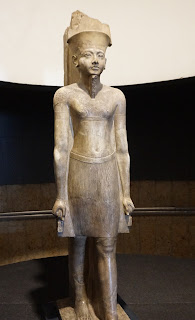
Our last major stop is Tut’s tomb treasures. His artifacts are astonishing, not because he was an important king, but because he was so insignificant, his tomb was overlooked and lost for millennia. His funeral mask is 22 lbs of solid gold. Unfortunately no photography is allowed. The mask is the one thing I remember of my first visit. What I don't remember is all the associated funerary goods, like his sandals and throne. They are also impressive but difficult to photograph because of their security behind glass and garish lighting. I like that after studying a little Hieroglyphics I can recognize his cartouche and translate his name. Interestingly on the throne is carved his early name of Tut-Ankh-Aten before he changed it to Tut-Ankh-Amun after his father (a "heretical" worshiper of the god Aten) died.


Tomb of Meketre
We finish our tour wandering rapidly through miscellaneous halls of archeology. The number of artifacts is staggering. It is comparable to trying to see the Louvre Art Museum in Paris in a couple hours. 


After resting up at the hotel, we met the tour group in the evening for a welcome drink. Then we walked to a nearby Lebanese restaurant called Taboula for dinner. We had a wide variety of spiced meats and finger foods washed down with some Sakara beer. We are hoping for a deep sleep tonight.


Wednesday, February 23, 2022

February 22-23, 2022

February 22-23, 2022

Traveling internationally today is not for the faint of heart. Covid has introduced lots of complications. Months of planning can be undone in a heartbeat with a positive Covid test, or a sudden change of government policies. Signing up for a tour and making our flight arrangements was the easy part. Egypt requires a negative Covid test for entry. Fortunately our PCR test came back negative so we are good to go. Egypt would have accepted our Vaccination status alternatively but our bureaucratic and bungling CDC can’t figure out how to convert that into a scannable QR code, despite a multi-billion dollar budget.

Our afternoon flight to Atlanta was uneventful. Once past the Rockies we crossed the Permian basin of New Mexico and Texas, scarred with hundreds of miles of fracking wells. It was followed by thousands of wind turbines, Texas’ new gold.

In Atlanta we boarded our overnight flight to Paris. In Paris, we pass a Concorde airplane on display in front of the Air France office. It last flew in 2003. I would have loved to have flown on it, at least once. Without its speed, and even with upgraded seat and lounge access, international travel is grueling.

In traveling to Egypt from Paris, we are retracing the footsteps of the birth of Egyptology. In 1798 Napoleon was sent to conquer Egypt to thwart the British trade route to India. His soldiers accidentally unearthed the Rosetta Stone while building a fort. In 1822, two hundred years ago, a brilliant French linguist using this discovery, finally solved the hieroglyphic riddle allowing archeologists to decipher the texts decorating all the tombs and temples of Egypt.

We get into Cairo just after midnight. We pass through customs, and meet our driver who delivers us to our downtown hotel location. We think he must be practicing for the Indy 500. Our hotel room overlooks the Nile.

Monday, February 21, 2022

February 21, 2022

February 21, 2022

Based on a recommendation from our neighbors, Aimee and I went to the theater today to see the recently released movie Death on the Nile. It is an adaptation of the classic Agatha Christie novel of the same name. It is a delightful romp of her typical murder mystery with super-sleuth Hercule Poirot. The scenery is also dreamy. The action takes place aboard a Nile River Cruise ship with the romantic scenery of the Pyramids and Abu Simbel in the background. It brings back memories of my trip to Cairo 38 years ago. I can't believe it was that long ago. I am also reminded that this year is the 100th anniversary of the discovery of King Tut’s tomb. I have to go back. Surprisingly Aimee agrees. A cruise on the Nile sounds like fun. We spend the rest of the day packing.

Saturday, February 19, 2022

February 16, 2022

February 16, 2022

The best part of home is our view East towards the mountains. We never tire of it. Our back yard is normally private and ultra-quiet. But three times in the last two years that tranquility has been shattered. In the summer of 2020, we witnessed wildfires on the mountain that lasted nearly a month.

Then in November we were awaken in the middle of the night by what I thought were explosions. Aimee thought somebody banged on our wall several times. We learned the next morning that it was gunfire. A police officer fatally shot the owner of the house we can see on a hill to our East. Apparently, the cop was called out on a wellness check and the elderly owner answered the door carrying a gun. Tragic in every sense.

And then tonight we look out the window and see a house on fire. Something very flammable must have been involved because the structure was totally engulfed in flames. It wasn’t just burning wood. Aimee and I are thinking our little piece of paradise might be fragile.

Monday, February 14, 2022

February 14, 2022

February 14, 2022

One of the unexpected benefits of living in Tucson has been our proximity to wildlife. Aimee's favorite experience, hands down, was the Great Horned Owl family that had triplets in a backyard tree. Aimee watched every night.

These encounters have diminished with the explosion of people moving here and taking up much of our open spaces. We rarely see Javelinas now and we found a Great Horned Owl killed in our street last winter. The pack rats however don’t seem to be impacted at all. So sometimes you have to help Mother Nature out a little. Based on a neighbor’s recommendation we installed an Owl Box last summer in a tree outside our master bath. When we returned from our East Coast trip in October, Aimee excitedly told me we had a tenant. Our vocal reaction must have scared him off. We never saw him again. Our friends told us to be patient; it was not the nesting season.

Hoping to make the home more appealing, I raised the box higher in the tree. We checked it every day to no avail. Now many months later, a Screech Owl finally popped its head out! Aimee is elated. Screech Owls are tiny, one half to a third the size of the Great Horned Owls that most frequent our yard. They must have great hearing and eyesight. Even if we stealthily approach the window, our new tenant notices, and stares straight at us. We are being careful not to scare this one away.

Every night we hear our Owl call out to any interested female in the area. Aimee would be overjoyed to discover Screech Owlets playing outside our window. Our bachelor finding true love today would make this a great Valentines Day!

Saturday, January 01, 2022

December 24-29, 2021

December 24-29, 2021

Aimee and I are driving to Amarillo, TX to celebrate the holiday with her family. While long, the drive is through some scenic stretches of New Mexico. The last section past the Pecos River, over the barren, treeless ultra-flat Llano Estacado is the most stark. Humorously because of the strong winds, we have to dodge hundreds of Tumbleweeds. This desert plant has developed the perfect method to disperse seeds in the blustery Great American Desert.

Following the Christmas festivities, Aimee feels she needs to stay longer and tend to her mother while she recovers from Covid and other medical issues. I start the long drive back on Wednesday. Driving alone, I seem to notice the terrain features more than normal.

Just outside Albuquerque, I stop to stretch my legs by visiting Coronado State Monument, now renamed a State Historic Site. It turned out to be a gem. I arrived just in time to join a guided tour. The docent explains archeologists excavated this site of the Kauau Pueblo hoping to find artifacts for the 400th anniversary celebration of the 1540 Coronado expedition. Instead they unearthed the only intact pre-contact painted Kiva (ceremonial chamber). To preserve the deteriorating murals, archeologists carefully peeled them off the wall only to find dozens of painted layers underneath. A few of the originals are on display in a Mural room. The most prominent figures are Kachinas (colorful masked dancers or spirits). Oddly my favorite is of a rabbit.

Our tour continued outside. The Kauau Pueblo consisted of over a thousand rooms surrounding three plazas. It is a beautiful site sitting alongside the Rio Grande with the Sandia Mountains in the distance. After excavation, the pueblo was reburied and a modern reconstruction built atop. All the adobe rooms were entered by ladder from above. We have to be escorted into the recreated painted Kiva. Here the Kachinas are brightly colored as they would have been centuries ago.

After the tour, I lingered watching the film, wandering the site, and running through the exhibits. After wintering twice here at Kauau and failing to find the legendary Cibola and the Seven Cities of Gold, Coronado returned to Mexico dejected. Unfortunately this Spanish Conquistador left behind a path of destruction. Kauau was never inhabited again.

Back on the road, I followed the Rio Grande Valley south, along the old Camino Real. This is the same route the Spanish retreated after the 1680 Pueblo Revolt. I arrive in Tucson after dark but not before watching an extended colorful sunset.

Monday, November 29, 2021

November 23-25, 2021

November 23-25, 2021

We are making one of our now rare returns to Chicago in the winter. Aimee’s Godmother passed away after a long illness. Since the Thanksgiving holidays are at hand, it will by necessity be a whirlwind trip. Surprisingly most of the flight across the Midwest was clear and sunny, something rare in a Midwest winter. Travelling along the Illinois River, I was surprised to see so many limestone quarries, all sited along the river. Most of these deep permanent gashes in the earth are all but invisible from the ground. When we arrived and felt the sudden cold ‘Windy City’, we remembered why we left Chicago.

We spent the next twenty-hours re-engaging with Aimee’s relatives and memorializing her very sweet and kind aunt. The family reunion is the one bright side of a funeral. Humorously Irish brogues still dominate her family!

Our return flight Thursday morning was one of only two delayed at O'Hare. We had clear skies the whole way, but the last hour had the most continuous turbulence we have experienced. Thankfully, we arrived in time for turkey dinner with friends.
Newer Posts Older Posts