Thursday, October 06, 2022

October 5, 2022

October 5, 2022

After the hustle and bustle of Venice, we decided to get off the tourist track. So we took a mid-morning train from Verona, Italy to the World Heritage city of Mantua (Mantova in Italian), forty-five minutes south.

From the train station we walked south. We passed a lady walking her spotted Dalmatian dog. Our first. We thought we would have seen at least one on our travels along the Dalmation Coast of Croatia.

Our first stop is at Palazzo Te. When I told Aimee that it was built by the local Duke Federico Gonzaga in the 16th century for his mistress Isabella, her interest level increased. She eagerly read the storyboards hoping to learn more. Humorously only one mentioned her and just in passing. The palace was built and decorated for him by Giulio Romano, a student of Raphael. The rooms are vividly painted with romantic scenes, perfect for a pleasure palace. In the Room of Amor and Psyche, Aimee noticed one scene was shockingly graphic.

Our favorite spot was the Room of the Giants. This space has rounded corners painted in cartoonish-size and color so it feels like an immersive artwork. With all the ceilings we have had to stare up at, we are getting sore necks.

We then explored the grounds of the Palace. The most interesting for us was the garden truck that was driving around and watering the bushes with a mechanical hose.

From Palazzo Te, we walked from this suburban tryst palace into the historic center along the Prince’s Path, the route the playboy Duke would have ridden between wife and girlfriend. Federico’s mother, Isabella d'Este, was very ambitious. She bought his Duke title from the Holy Roman Emperor. And then she insisted he marry for political advantage. But Federico refused to give up his lover Isabella.

In Piazza Erbe, we made a brief stop at the Rotunda of St Lawrence. This medieval church was built circa 1100 AD and is completely round. Next door is an old clock tower.

Farther along we reach Piazza Sordello where we buy tickets to tour Palazzo Ducale, the home of the Gonzaga family. They ruled the city for three centuries. Mantua survived amongst very powerful neighbors by maintaining a strong army that they rented out as mercenaries. Since the Italian city-states were always at war, they made good money. One of the Gonzagas was canonized a saint. The Jesuit Gonzaga University in Washington State is named for him.

Our tour started with the original brick Castle of St George. It was hard to get excited after spending so much time touring Venice. The Gonzagas were rich but not uber-wealthy like the Venetians. Instead of real marble, the walls were faux-painted to look like it. We were not that impressed with the famous Wedding Chamber, painted in 1470 by Mantegna. It does however have a cool ‘oculus’ ceiling. Probably the first artist to paint the illusion of an open ceiling with cherubs looking down.

Our tour then continues in the New Court of the Ducale Palace. These rooms are more palatial but also a century newer. One room called the Room of Troy not only has brightly-colored frescoes on this mythological war but several cool bas-relief Roman Sarcophagi. A nearby very long Exhbition hallway is lined with several dozen extraordinary Roman busts. This art is just a tiny fraction of the collection that the Gonzaga family once owned. Isabella d’Este was not only ambitious and capable but a renowned early patron of Renaissance artists. Her collection is now spread out over Europe.

The tour continued in the Old Court. There was a Hall of Mirrors used for dancing, and another set of small bedrooms covered in tapestries sewn from Raphael drawings. There were more decorated rooms with paintings and statuary. It was all very nice but a little overwhelming as the rooms kept coming. This palace has over 500 rooms and is the sixth largest in Europe. It would be art overload even if we hadn’t just come from Venice. In addition, one of the earliest Operas, Monteverdi’s L’Orfeo was first performed here in 1607 during Carnival.

After running through the palace, I peeked inside the next-door Duomo (Cathedral of St Peter). The exterior and interior is uninteresting Neoclassical.

Exhausted, we had a nice leisurely Italian late lunch of the local specialty, Tortellini stuffed with Pumpkin and cooked in a sage and butter sauce. It was very tasty along with a salad and carafe of local wine.

On the walk back to the train station we walked through the Basilica of Sant’Andrea. This 15th century church has a large dome and barrel naves. Every surface is decorated inside Renaissance-style. Very cool.

We almost get in trouble taking the train back to Verona. Our train left from platform 1 TR. We waited at track 1. When another train pulled into that spot we suspected something was wrong. We raced to the ticket agent who pointed us to the right spot and we had to run to catch our train. Apparently TR means Tronco and refers to a truncated or stub or dead-end track that doesn't quite reach the station. It is down the line and to the right of the real Track 1. And I thought we were veteran train riders!

Wednesday, October 05, 2022

October 4, 2022

October 4, 2022

One of the things that rich Venetians did for entertainment was to attend Opera. The composer Vivaldi was born here. To feel more like a true Venetian I feel compelled to try it out. So last night Aimee and I took the Vaporetto to the other side of Venice and found a nice restaurant to have Wine and Dessert while we waited for the venue to open. The Tiramisu was delicious.

The performance occurs well after Aimee’s bedtime so I picked a very intimate performance to keep her awake. It was so intimate we were essentially seated on stage. At one point the diva was so close she could have fallen in my lap. This was an opera-lite rendition of Giuseppe Verdi’s La Traviata in three acts each in a different room in Palazzo Barbarigo. The opera title means ‘the fallen woman’ and is about a love story involving a courtesan and her illicit love affair with a gentleman. Aimee tells me that Pretty Woman is a loose adaptation of this story. Since opera is sung in Italian, we bought the guide so Aimee could follow along with the words. If it had been in English, I probably still couldn't have understood. Aimee liked it more than I did.

Coming back on the Vaporetto at night along the Grand Canal, it is very apparent that at least half of buildings in Venice are now empty. Venice is quietly becoming a museum city, if it is not already.

This morning we skipped breakfast and took an early boat to Piazza San Marco, or at least tried to. The Vaporetto we boarded was an express ending at Rialto Bridge. After thinking about it, we figured walking the last section would be faster than waiting for the local boat.

On arrival we got in the ticket line for the Doge's Palace. The lines for groups and prepaid tickets moved quicker than ours. Finally inside, we give ourselves the self-guided tour. We start in the courtyard of this grand building that was the seat of the Venetian government and the home of the Doge. It is kind of our Congress and White House rolled together.

Because Venice was founded by a bunch of sea traders (e.g. Marco Polo), it never had a monarchy and instead was ruled essentially by democracy. Citizens with a stake in the welfare of the state voted in an assembly and they also elected their leaders and managing committees. These self-interested capitalists thrived compared to their noble-led neighbors.

Like the rest of Venice, the Doge’s Palace is richly decorated. We bypass the grand external marble staircase and enter the upper floors via the interior elegant Golden Staircase. We pass through several antechambers meant to impress visitors. We then pass through a number of meeting rooms. Apparently Venice had a bureaucracy of groups that did the day to day managing of the state activities. Eventually we make it to the Great Council Chamber which is massive and large enough to hold every voting citizen. Almost every ceiling and most walls are filled with colorful paintings.

Criminal justice was also an important function in Venice. There were ‘suggestion boxes’ in several places where citizens were required to alert the government of any nefarious activity. They also had a large jail just to the east that was connected by the Bridge of Sighs to the main palace court rooms. Prisoners would get their last look of the outside world through the stone windows of this lofty span.

The large stone prison had three levels and dozens of rooms with huge wooden doors. I accidentally got thrown in the prison. Like Casanova in 1756, I managed to escape with Aimee's help.

Finished with the Palace, we got in a very long line to get inside the adjoining Basilica of San Marco. This started out as the private chapel of the Doge. Some private chapel! Almost a thousand years old, it is huge. Because most of the early Venetian trade was with the East it looks Byzantine with a multi-domed roof. During the Fourth Crusade, Venice sacked Constantinople. St Mark’s is partially decorated with stolen loot from that attack.

The interior of St Mark’s is almost completely covered with gold mosaic art depicting religious stories. It is probably what the Hagia Sophia in Istanbul looked like before the Muslims whitewashed the iconography.

The floor is tile mosaic with lots of different designs. Unfortunately Venice floods periodically filling the interior sometimes with water. As a result the floor is very uneven. The exterior of St Marks is under construction. They are installing a waist-high glass-topped dam around the perimeter to prevent future water damage.

We walked east of Piazza San Marco to find a reasonable restaurant away from the thicket of tourists. For dessert, Aimee insisted on having Tiramisu again. I think it was even better than last night. Afterwards we continued on to the land entrance of the Arsenale shipyard. It was the industrial powerhouse of the Medieval Era. It is still a military facility to this day. We see Italian Navy officers walking all around. The Tall Ship, Amerigo Vespucci, is moored nearby. This three-masted vessel is used for sail training by the Italian Navy.

On the way back to our hotel we made a very brief stop across the Grand Canal to see the enormous Basilica Santa Maria della Salute that is the backdrop for pictures. Although the dome is enormous the decoration is not extraordinary.

Back at the hotel we retrieved our luggage and hopped on the train for the ninety-minute ride west to Verona. After checking in we walked into town for a Lasagna and salad dinner.

Tuesday, October 04, 2022

October 3, 2022

October 3, 2022

Finished with our organized tour, we decided to sleep in this morning. After getting more Euros, we stopped at the city bus station to get a two-day pass. Since there are no roads and no cars in Venice, all transportation is by boat, including the ambulance, police, and firetruck. The city water bus is called a Vaporetto, or ‘little steamer’ because that was the original power source. Now they are diesel. Venice is full of boats consuming huge quantities of fuel. No wonder I saw a refinery located just on the mainland.

We got in line for the Vaporetto, but several boats came and went without our line moving at all. It turns out there are two lines; locals have priority, tourists are secondary. Every boat was packed to the gills. I am thinking this two-day pass is not such a good deal after all. Maybe we should just walk.

Finally a half-empty Vaporetto shows up and we board, along with the long line of tourists behind us. Instead of making an intermediate stop as planned, we stay on, getting off on the other end of the Grand Canal at the Accademia stop.

The Gallerie dell’Accademia is the premier art museum of Venice, showcasing some of the best of Venetian art. I had some favorites. One depicted the Choice of Hercules. I am thinking he was given the option of beauty vs brains. Apparently he couldn’t choose both like I did.

Another interesting subject was a monumental 'Last Supper' by Veronese. After the Inquisition started asking questions about the painting's religious details, instead of touching it up Veronese merely changed the title to Feast in the House (of Levi).

Part of the museum is housed in the former Scuola della Carita (School of Charity). So some of the paintings on display used to adorn that building. In addition, some of the building features, like floors, ceilings, and stairways are art in themselves.

Aimee is tired of my art appreciation class, so we walk a little north to Ca Rezzonico. Ca is Venetian shorthand for Casa or house. But in rich Venice, houses were mostly palazzo or palace. This house is now a city museum to display how 18th Venetians lived. As soon as we climbed the stairs to the ballroom, I knew we are talking uber-rich. While most European nobles were living in cold damp stone castles, Venetians were partying. We toured the rest of the Palace and it was all richly decorated.

We need a break so we walk north looking for a good cafe. We chose poorly. We had a mediocre Pasta e Fagioli (Pasta and Beans) and salad at a bar with outdoor seating. After our meal, we turned a corner and found a much better spot we could have eaten at.

We paid to go inside the nearby Basilica di Santa Maria Gloriosa dei Frari. This church has a very plain exterior but the interior is almost as dramatic as Sts. John and Paul church yesterday. It also has many elaborate wall monuments lining the interior. Some are dedicated to Doges, but a few are to artists, like the sculptor Canova, and the painter Titian. Every fan of sculpture should explore Venice.

In the same square is the Scuola San Rocco. This is another building of a local fraternal organization. Some were organized around trades (like a union hall) and others around community welfare (e.g. Knights of Columbus) like this one. The facade of this structure is ornate marble. Every building we have seen so far has been over the top. This scuola tops them all. I could tell something major was coming walking up the grand staircase with its painted ceiling. The upper ballroom was extraordinary and has to be experienced. The floor is elaborate tile, the ceiling is a collection of paintings, and the walls are carved wood. On one end is a chapel of sculpture.

We made the short walk back to our hotel passing several minor churches. Even they were pretty ornate. Venetians were the robber barons of the medieval ages buying spices and silk from the east for pennies on the dollar, making huge profits selling these luxuries to feudal Europeans.

Monday, October 03, 2022

October 2, 2022

October 2, 2022

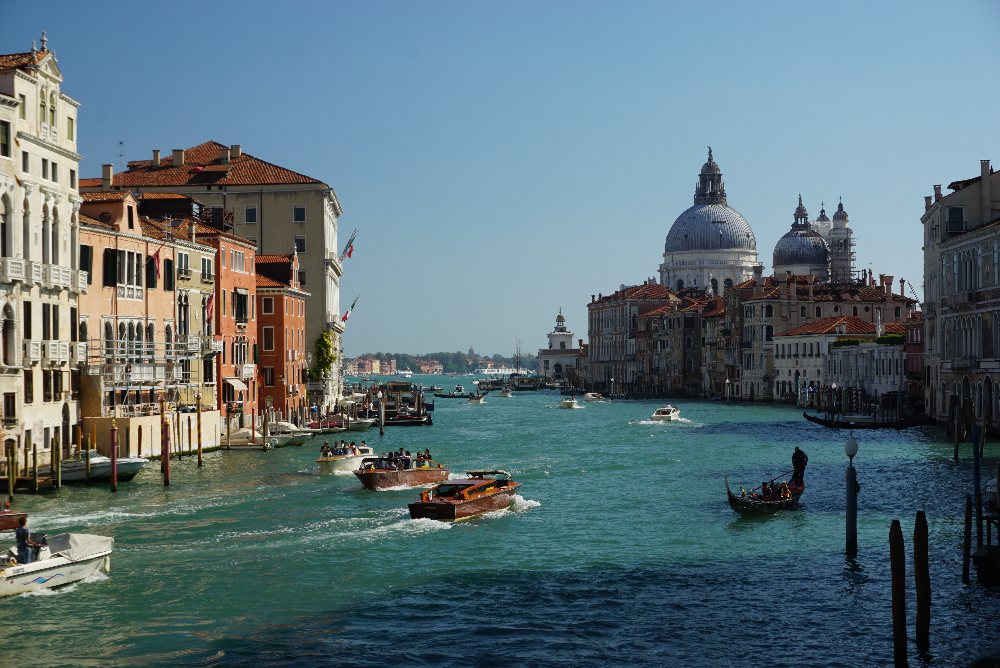
We awoke in Venice, Italy this morning. After breakfast we loaded on a large taxi boat at the nearby train station. We sailed around the south side of the island past San Marco Plaza and the Doge’s Palace. The Venice lagoon was settled by local mainland fishermen fleeing invading barbarians after the fall of the Roman Empire. They were self-governed by elected councils. A figurehead Duke (Doge in Venetian) was elected as leader for life.

At the eastern end, we passed the sea entrance to the Arsenale. Forced to make a living at sea, the Venetians became the foremost trading power of the Middle Ages. They started with fishing and salt, expanding into lucrative luxury goods from the Orient (spices, silk, coffee). In a dangerous world, the Venetians needed a navy to defend their transports and trading ports. The Arsenale (manufacturing shop) was where they built their great rowing vessels. They could produce a new ship every day. And every trading vessel could be converted into a fighting ship when required.

Adjacent to the entrance is an out-of-place, but cool-looking, white plaster sculpture of twelve giant arms spanning a canal. Named Building Bridges, it was erected in 2019 as part of the annual Venice Biennale cultural exhibition. The artist is Lorenzo Quinn, son of actor Anthony Quinn.

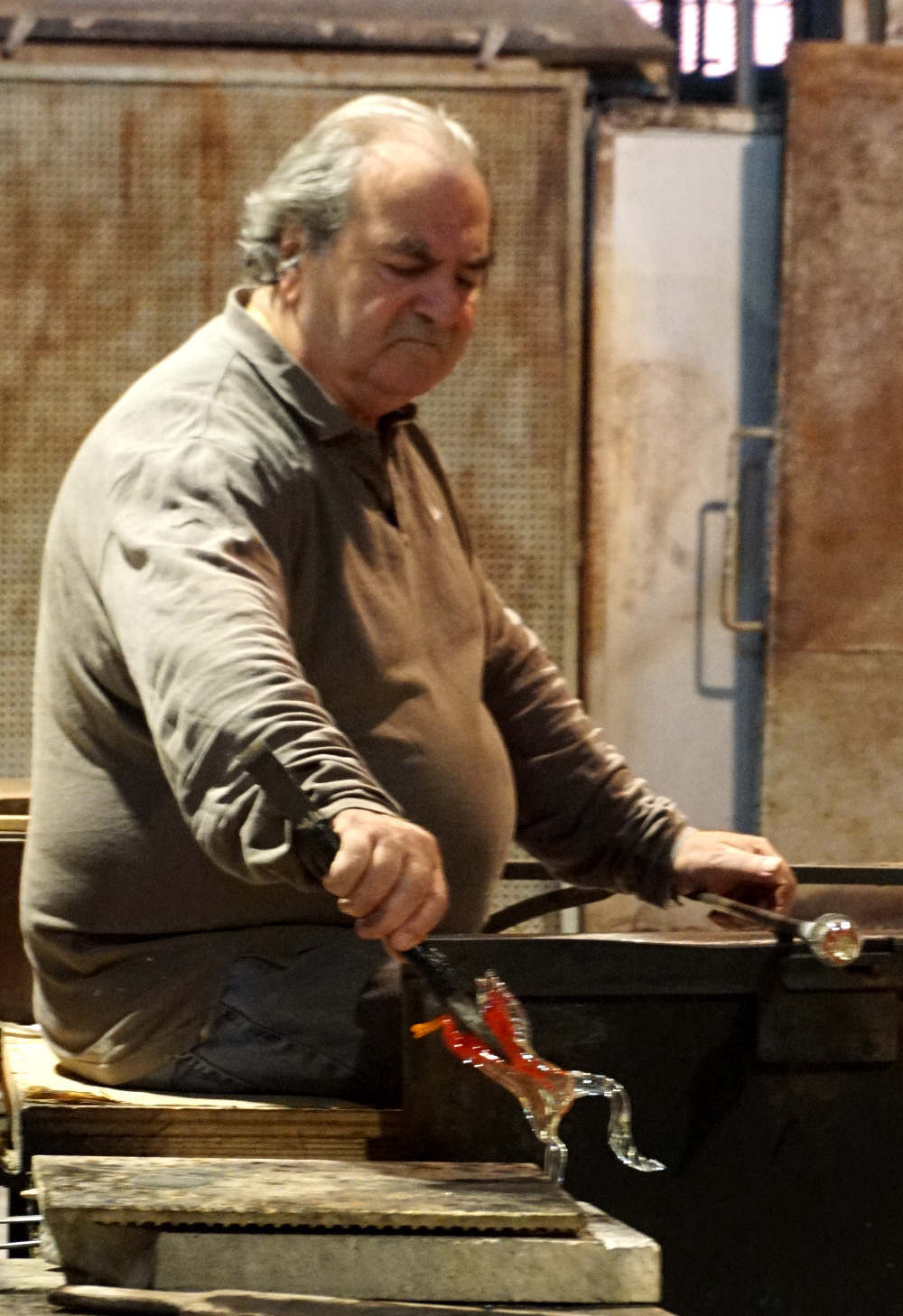
Our boat transfer finishes on the island of Murano, famous for production of fine glass. Venice moved their glassmaking to Murano because of the fire hazard to the wooden structures. Glassmaking was a state secret. Glassmakers who revealed the technology were hunted down and killed. We saw a short demonstration of glass blowing. The craftsman finished by making a glass horse in less than a minute.

We then went through the showroom to look at drinking glass sets and decorative art pieces. It is all very stunning, and we almost succumb to buying something. Fortunately we awoke in time to pass on the expensive opportunity.

We returned to the main island for a walking tour. Our local guide gave us a look at ordinary Venetian life. Amazingly with her direction, we went from madhouse to local in a matter of steps. We even ran into a group of kids playing soccer in a campo (city square). They were oblivious to our presence. She told us Venetians are becoming a dying breed. Venice is a hard city to have a modern lifestyle. Plus locals are getting priced out of the market by well-heeled tourists and strict renovation regulations. Most Venetians have moved to the mainland and commute in.

The tour ended in Piazza San Marco where we get our first glimpse of Basilica San Marco. I didn’t recognize it. When I saw it 38 years ago it was covered in a layer of dark grime. Today it is gleaming white marble! Unfortunately it is also partially blocked by scaffolding.

I was hoping to have a refreshment break at one of the famous cafes around St Mark’s but they are all packed and exorbitantly overpriced. Instead Aimee and I wander west of San Marco. On the way we ran into some ornately decorated churches. The first was San Moise. I am stunned at the amazing 17th century Baroque facade full of intricately carved statuary.

We next stumbled upon Santa Maria del Giglio. Known familiarly as Zobenigo, it has a similar intricate Baroque facade. Interestingly the statuary has no Christian theme, but rather shows the benefactor’s family and maps of cities where he served, including Split. Venetians got very wealthy in the business of trading and these many richly decorated church facades show it. It is a little hard to appreciate because the facade is facing another building directly across a small street.

We pass a cafe with lots of well-dressed locals. When we turn around we notice a bride and groom arriving. Another wedding party. Aimee is now happy. We finally find a cafe down a back street with outdoor seating in a tiny, secluded square. We shared a carafe of white wine and Bruschetta (which is pronounced with a hard K in Italian). We also had bread dipped into Olive Oil and Balsamic Vinegar from Modena. I like the Balsamic so much we make plans to find some when we get closer to that city.

On the way to our next photo stop, I noticed some ladies having difficulty deciding where to turn. I mentioned ‘scala’ (stairs) and they smiled. Finding things in Venice can be difficult because the city is a maze of tightly packed islands, canals and infrequent small bridges. Amusingly I successfully led Aimee and this group of Italians to the Scala of Palazzo Contarini del Bovolo. The wealthy long-gone former owner decided to build himself a very elaborate exterior staircase for his home.

We then worked our way northeast back to the Grand Canal at the Rialto Bridge. This is one of the few bridges across this main water highway. The frugal merchants running Venice picked this bridge design because it incorporated rent-paying stores along the walkway.

We then stopped at Santa Maria Miracoli church for a photo stop but the lighting is poor. Our last stop was at Campo Santi Giovanni e Paolo. On one side is Scuola Grande di San Marco. This is a former fraternal society that is now a public hospital. It has an ornate marble facade. The huge open upper floor has a medical exhibition, so I only take a quick photo of the exquisite ceiling.

We go next door to the very plain but huge brick Basilica dei Santi Giovanni e Paolo (Saints John & Paul). Inside is entirely different. This is where many of the Doges are buried, and they clearly had enormous wealth. Every inch of the inside is covered in the most elaborate of tombs. Each one seemed to top the next. I never took so many photos of the inside of a church before. Venice is surely the place to visit if you like sculpture.

Aimee and I then strolled back to our accommodations. After resting and cleaning up, we had our group farewell dinner and said our goodbyes to our Gate1 traveling companions.

Sunday, October 02, 2022

October 1, 2022

October 1, 2022

It is not raining this morning in Bled, Slovenia, so right after breakfast we step out of the hotel and admire our last look at the lake and the castle high overhead.

After checking out, we left early heading back to the Adriatic coast. Our first stop was just across the border in Italy at the city of Trieste. This town’s name comes from the Croatian word Trg meaning ‘market’ or ‘square’. This is an apt name as Trieste sits on the west side of the Istrian Peninsula at the top of the Adriatic Sea at the crossroads of trade going not only east and west but north and south.

We started our tour of Trieste with its history as part of the Roman Empire. We saw a small theater at the base of San Giusto Hill. At its top was the original settlement. There we see the remnants of a Roman temple. Later two Byzantine churches were built on the site. During a renovation in the 14th century the wall between was removed and the churches combined to form Trieste Cathedral. It was a cost-conscious reconstruction. The facade has a mish-mash of elements. Surprisingly even reused Roman artifacts. The dim interior has Roman columns and two rare Byzantine gold mosaics in the apses. The floor even has patches of the original tile mosaics here and there.

For five hundred years Trieste was part of the Austrian Hapsburg Empire. This can be seen in the main square, Piazza Unita d’Italia. This part of Trieste used to be a salt making operation. It was land-filled to make this zone. This square facing the sea is encircled with ornately decorated buildings that would fit in Vienna.

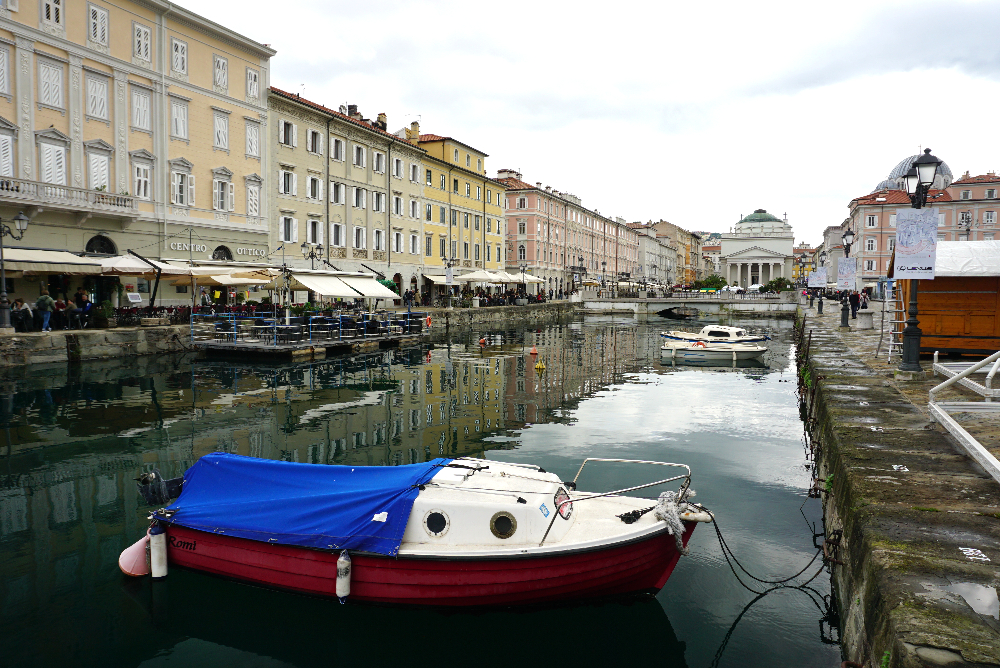
Trieste became an important seaport of the mostly landlocked Austrian Empire. We walked a few blocks to the Grand Canal that used to be the harbor. It is no longer deep enough for modern vessels so this port is now lined with cafes and restaurants. We are hungry so we ate at a pizzeria on the canal.

After lunch we tried to do a little shopping but most of the stores were closed for lunch far longer than their signs stated. This is Italy! Instead we wandered the Old City. What I like is that there is sculpture everywhere. It decorates monuments and many building facades.

Trieste was only given to Italy after WWI as a reward for joining the Allies. It was liberated in WWII by the Yugoslavs. Trieste is still a bilingual city of Italians and Slovenes.

We left Trieste heading deeper into Italy. We passed over the Socha River where some of the fiercest fighting in WWI occurred. Ernest Hemingway was a volunteer ambulance driver here. We also passed the staircased Redipuglia War Memorial containing the remains of over 100,000 soldiers.

In two hours we reached the causeway that leads out to the islands of Venice in the lagoon. We parked and took the new Monorail people mover to Piazzale Roma. We found our hotel on the far side of the train station.

We have some time before dark so we visited the nearby Jewish Ghetto. This island was where Jews were segregated. The site originally held an ironworks. Ghetto is the Italian word meaning foundry. Every square in Venice has a cistern for collection of rainwater. This was the source of Venetian drinking water for a millennium. The Austrians made a disastrous decision when they took control. They dug water wells removing groundwater. As a result the city started sinking into the sea.

Aimee and I are quickly disliking the crowds of Venice. So we retreat to our hotel and have a glass of wine on the patio overlooking the Grand Canal. It is very busy with boats of all sizes.

Saturday, October 01, 2022

September 30, 2022

September 30, 2022

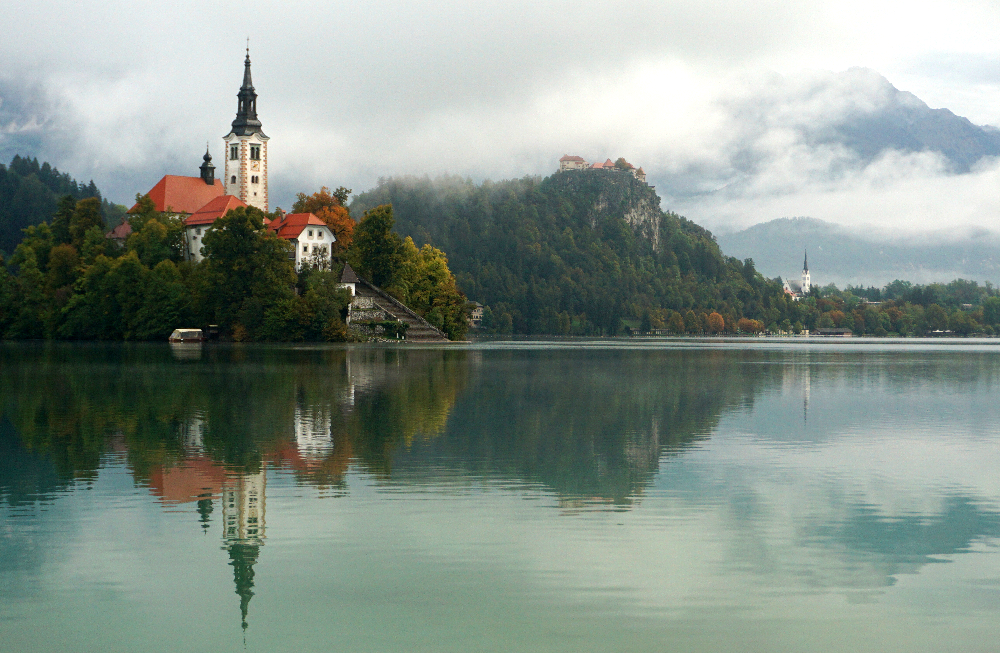
The weather forecast for Lake Bled, Slovenia is heavy rain. Aimee and I awoke early hoping the weatherman was wrong again. He was. So we had a quick breakfast and walked swiftly along the lakefront. Everything is wet and the trees are dripping and the clouds are low and thick. But the lake is calm letting me get some nice reflection photos with the castle high on the cliff.

We continued further, past Vila Bled, a summer home of Marshal Tito, getting closer to the island that sits on one end of the lake. On it is a pilgrimage church dedicated to the Assumption of Mary. After taking a photo with both the island and clifftop castle in it, we hightail it back to our hotel. We are dripping with sweat by the time we return.

The next stop on our tour is Bled Castle on the clifftop. From this perch we get a great overview of glacial Lake Bled and its little church island.

This medieval castle is in great shape and has a museum and lots of little shops to explore including a winery and bee-house. Our favorite is the printer. It has an original press that was used to make the first bible in the Slovenian language. We liked learning that Upper Case and Lower Case letters started out referring to which box the movable type letters were stored in. The little chapel in the castle has beautiful frescoes on the wall and ceiling.

From Bled, we drove the thirty miles back to Ljubljana, capital of Slovenia. We started our walking tour at the landmark Triple Bridge over the Sava River. It sits on the main city square with a Franciscan Church and a statue to Slovenia’s favorite poet. The bridge was designed by Joze Plecnik. He was part of the Secessionist style and was responsible for many of the iconic structures of Ljubljana. It is a highly stylized form of Art Nouveau. His works here are now a World Heritage Site.

We walked through Congress Square named after the Congress of Ljubljana of 1821 that was held here to decide the fate of European powers after the Napoleonic Era. It had been renamed Revolution Square during Yugoslav times. It is also where Independence from Austria (and later Yugoslavia) was declared. It is flanked by several buildings with highly decorated facades. Our last stop was the Cathedral of St Nicholas just as the massive bells rang the noon hour.

Aimee and I walked along the Sava River to the Dragon Bridge which has four large statues guarding it. The dragon is the symbol of Ljubljana.

We are getting hungry so we walk to the Skyscraper Building and take the elevator to the terrace restaurant on the thirteenth floor. It was the tallest building of the Balkans when built in 1933. It is a nice place to have lunch as it overlooks the heart of the city. In particular, we get a nice view of Ljubljana Castle. The castle got its present structure to defend against repeated invasions by the Ottoman Empire.

We spent the next hour strolling through the old town district. It is mostly a pedestrian zone. One interesting stop was the Parliament building of Slovenia. It has a Socialist-era facade of dozens of working people around the entrance. But oddly they are all nude. We also spent some time back in the main square perusing some temporary science exhibits for students. Being a big kid at heart, I have to test the experiments myself.
Mid-afternoon we head back to Lake Bled. We want to walk the perimeter of the lake for more photos and have dinner at an overlook restaurant. Unfortunately we are rained out. The first bad luck of the trip. We try waiting it out but finally run across the street to the restaurant next door. We sit by the window and eat dinner while eyeing Bled Castle through the raindrops. I ordered what I thought was a Slovenian beer. It turned out to be some grapefruit flavored beer from the UK. Not what I wanted but it actually wasn't bad. For dessert we had the Slovenian classic of Kremsnita, or Bled Cream Cake. Delicious!
Newer Posts Older Posts