Friday, September 13, 2024

September 11, 2024

September 11, 2024

In Dresden, we had train noise when we opened our hotel window. Last night in Leipzig we had to listen to an annoying protest march. I think it was about Palestine.

This morning we are going to explore Leipzig’s Cold War history. Just behind our hotel is St. Nicholas Church. In 1989 it was the site of weekly mass gatherings to pray for peace and basic rights. This Peaceful Revolution contributed to the fall of the Iron Curtain, earning Leipzig the moniker City of Heroes. In reality, the new Russian president Gorbachev decided change was needed and Russia was no longer going to intervene in the Eastern Bloc. Sadly after decades of repression East Germans didn’t believe him.

Our next stop was the Contemporary History Forum. This museum covers the history of Leipzig and East Germany after 1945. The Soviets took over after WWII. They systematically moved East German factories to Russia, and put in place a socialist government-run economy. A 1953 Revolt was brutally crushed and children were indoctrinated into the new system. While everyone had a job, progress came to a halt and the East fell further behind their Western counterparts every year. With the gap widening, a wall had to be built to keep people from leaving. No amount of propaganda and censorship could hide the truth.

The museum continues with the fall of the Iron Curtain and reunification with West Germany. With privatization, older obsolete state factories shut down and unemployment skyrocketed. It was a very tough transition for East Germans. (N)Ostalgia for the old system became rampant. It almost seems to me this free museum was set up to remind East Germans what it was like before capitalism and freedom were re-established.

Outside the museum is a modern art sculpture that combines both Nazi and Soviet symbolism. To me it summarizes the museum perfectly. All forms of Socialism run headlong into human nature. In every instance, governments have no choice but to react with coercion. Only capitalism preserves personal freedom.

After this sad review of local history, we needed a mental break. We had a lunch of Soljanka washed down with some local beer. We then went to an historic cafe for coffee and dessert.

In the afternoon we checked out some brighter moments of local history. Leipzig was a music capital. We stopped at St Thomas Church where Johann Sebastian Bach was the music director. He is buried in the choir floor. Outside is a memorial to composer Felix Mendelsohn who introduced the world to this musical genius. Not far away we pass a memorial to opera composer Richard Wagner who was born in the city.

Our next stop was Leipzig University to peruse their small Egyptian Museum. I am always surprised at how many different cities and museums have significant collections. It is a testament to the millennia length of ancient Egyptian history.

Aimee needs some retail therapy after these museum sessions so we check out the mall underneath the main train station. For dinner we have Indian cuisine. We finish with drinks in the hotel bar.

Thursday, September 12, 2024

September 10, 2024

September 10, 2024

This morning we checked out of our Dresden hotel and walked over to the train station. While waiting for our train, a chocolate croissant was beckoning Aimee so we indulged. We then boarded our train west. In ninety minutes we reached Leipzig and checked into our next hotel across the street.

We walked through the Old Town and found a restaurant to have a pizza lunch. It is cool and breezy so we eat indoors. We really like the Radler beer/lemonade combo so I tried the Diesel beer/coke combo. It is not as good.

Afterwards we took a tram southeast to visit the Battle of the Nations Monument. This huge memorial was built on the 100th anniversary of the 1813 Battle of Leipzig, the largest and deadliest prior to WWI. At 300-foot tall, it is the largest monument in Europe.

We bought entry tickets and an audio guide for our visit. Touring the interior was a little tricky as it has a couple elevators and two narrow one-way stairs. The interior is adorned on two levels with over-size grim hulking Teutonic knights. We eventually make it to the very top where we get nice views of the region.

We then continue in the ground floor museum. This portion of the audio guide starts off very interesting talking about how Napoleon saved the revolution in France and gave hope to other Europeans hoping to also gain personal freedom. In particular Napoleon developed a uniform civil law code that overthrew feudal laws favoring the Royals. Unfortunately after that the narrator got long-winded. Apparently people got tired of the constant warfare, and Napoleon over-extended himself by invading Russia. This allowed the Royals of Russia, Austria, Prussia, and Sweden to gang up and defeat him here, restoring the old feudal order.

After stopping back at the hotel, we set off to explore the city. Leipzig has a number of covered shopping arcades in its central core. Aimee was in heaven window shopping. We finished in Madler Passage which has a statue of Faust making a bargain with the devil Mephisto. One scene of this famous Johann Goethe play occurs at the historic Auerbach Cellar restaurant below this shopping arcade. Aimee and I decided to have dinner there.

We have soup and then share a meal of pork strips with gravy and vegetables and potato pancakes. It was very good. Leipzig is famous for Gose Beer. It is supposed to be very sour. I try a version that is sweetened with raspberry liqueur. It is tasty but it looks a little girly especially since it came with a straw. Thinking I can handle the real stuff, I order the straight Gose. To me it is more tasteless than sour.

Wednesday, September 11, 2024

September 9, 2024

September 9, 2024

We woke up to rain and cool weather in Dresden, Germany. Fall is overdue, but I was hoping for a gradual change.

Last night we made a timed reservation for the Historic Green Vault. It is the premier attraction in the Royal Palace Museum. This set of highly decorated rooms contains the treasury of the Saxon Kings. The timed entry through air-locks is partly to control crowds and partly for security. The treasury has had thefts over the years, most recently in 2019. This museum is a two-fer as the room settings are also of interest.

The Green Vault treasury objects are a little overwhelming. The Saxon rulers clearly had too much money and too much time on their hands. They commissioned drinking glasses and decorations out of every conceivable material you could imagine. There is an entire room of amber, another of ivory, and other rooms with objects crafted from rock crystal, ostrich eggs, coconuts, and seashells. They are all ornamented with diamonds, gems, silver and gold. I can possibly see getting one of each, but these Saxons bought dozens and dozens. Who wants a set of utensils with coral handles, except to say you can. They are not useful, only something to fill your museum.

We next visited the New Green Vault. This seems to be the overflow of objects that wouldn’t fit in the Historic Rooms. I had to laugh when I saw sets of protective coverings, but I guess these precious objects all came in their own custom box. What is also shocking about this collection is that it even exists. It not only survived the bombing of Dresden, but also pilfering by rampaging Soviet troops. I cannot believe the Soviet Union even returned these items intact and mostly undamaged. The quantity and quality rivals that of any royal collection.

We are needing a break so we have an early lunch in the Palace Courtyard restaurant. We then continue our visit in the upper museum floors. Next is the Armory with its vast collection. Most of it seems more suited for parading instead of actual battle. It is interesting the other items a general needed when going to battle, such as portable cabinets containing toiletries, surgical tools, and even a vise to pry open castle doors.

The next section was the Turkish Room, which had lots of acquired Ottoman arms and weapons. We saw similar on our visit to Istanbul. The most interesting item was a full-size battle tent you only see in movies.

The next section contained clothing. They were mostly fancy garments when on parade. Fortunately for most kings, real war was probably rare.

The palace state rooms were closed. Only the ballroom was open. It is nice but looks clearly reconstructed. It is too new looking.

There is another section on coins and paper money. Apparently the Saxons were rich because they owned a silver mine. Interestingly one of the currency units was a Groschen. 32 of them were worth one Thaler, from whence came our word Dollar.

Both of us were happy when we finished. The collection was a little too over the top. From the Old Town, we took one of the many trams southeast. Or at least we thought we did. We have a German National Pass that lets us take any transport and I have the phone apps to find the right connection. Unfortunately we find that our route unknowingly changed because of some construction. We punted, took a different tram, and walked the last half mile.

We did all this to visit the Saxon State Library. The central campus has a Book Museum containing the Dresden Codex. This is one of the few surviving books from pre-Columbus America. This accordion-style book is written in Mayan Hieroglyphs. Because it contains lots of numbers and references to astronomy, it was instrumental in deciphering this language. It is amazing that this 800-year-old text survived destruction by Spanish missionaries, but even more that it is thousands of miles away in Dresden. The avid Saxon collectors didn’t know what they bought.

From the library, we took a bus all the way to the Blue Wonder or Loschwitz Bridge. It is an old bridge that somehow survived WWII. It is flanked by two affluent residential areas. Aimee and I had dinner at the Schiller Biergarten facing the river and bridge. My roast pork sandwich was delicious. After getting ice cream, we found a tram that took us all the way back to our hotel.

Tuesday, September 10, 2024

September 8, 2024

September 8, 2024

We like the hotel we chose in Dresden, Germany. Unfortunately we didn't expect their summer heat to last into September. Vintage means no A/C and our convenient location next to the train station means lots of noise if we open the window. Despite this I slept very well.

This morning we took the local commuter train east following the Elbe River. Just short of the Czech border we got off and took a little reaction ferry across to the town of Rathen. There we found a trail that climbs the steep bluffs into Saxon Switzerland National Park.

The sandstone cliffs are deeply gouged into scenic pinnacles. They have been a Saxon playground for centuries. Over 170 years ago a bridge was constructed linking several of the rock spires. This Bastei Bridge is now an icon of the National Park. Today there is an extensive hiking trail around it with many lookout points. This nature hike is a nice change of pace from pounding the city pavement yesterday.

Back at the bottom we have lunch al fresco on the Elbe shoreline. Aimee has a Sweet Potato Soup, while I try a Russian/East German specialty stew called Soljanka. This sour soup is quite tasty. Of course I wash it down with a Radler beer.

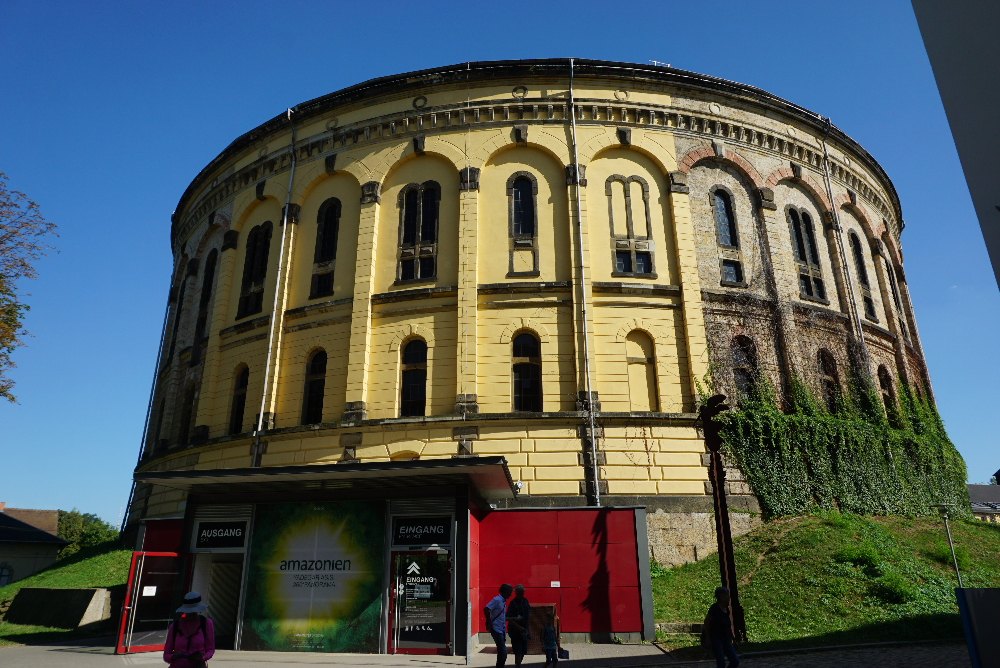
On the train back, we disembarked early and walked to the Dresden Panometer. This is a panoramic art installation inside an old Gasometer, or coal gas storage tank. This area was part of the Dresden gas works and this site had several of these building-size circular brick structures.

I expected to see a display on the bombing of Dresden, but instead it has been replaced with a temporary exhibit on the Amazon rainforest. Aimee and I find it only mildly interesting. Neither one of us likes jungles.

Afterwards we hopped back on the train and took it a few more stops to Dresden main station. There we caught a tram to the Old Town. We wanted to visit the Frauenkirche but it was closed for a concert. Instead we walked by the Parade of Princes Mural. This 300-foot-long scene was created to celebrate the 800th anniversary of the Wettin Dynasty. All the Kings of Saxony are represented chronologically in Meissen Porcelain tiles.

We are thirsty and out of water so we walk west to visit the former Yenidze Cigarette Factory. The building was built in 1909 in an imaginative Turkish style to advertise the imported tobacco. Now it is an office building with a rooftop beer garden and dome restaurant. We rehydrate with a couple Radlers while enjoying the city view.

For dinner we return to New Town by tram and eat at a Vietnamese Restaurant named after the Cuchi tunnels we visited outside Saigon. The meal and mango dessert were quite tasty.

Monday, September 09, 2024

September 7, 2024

September 7, 2024

Months ago I bought train tickets for the journey from the Berlin airport to Dresden. Unfortunately the German train system is not as reliable as it once was and I received notice our train no longer starts here nor ends where we wanted. After checking out of our hotel, we walked to the conveniently located airport train station and took a commuter train to the nearby Schonefeld station. Schonefeld was the old airport of East Berlin. There we caught our original train. I am happy to find that the train is nice and has free Wifi onboard. As we approach Dresden the conductor announces (in German only) that the train is changing its final destination again. Fortunately it is back to the original one we booked. We exit at Dresden-Neustadt or New Town. We find our vintage 1855 hotel conveniently located just down the street.

We were too early to check in, so we dropped our bags with the front desk and set out to find lunch. We eat at a nice restaurant not far away. We both have a Radler beer and a cup of Goulash Soup. It was delicious and rivals my German neighbor’s version. She won’t be happy to hear that. We top it off with ice cream. We were surprised how inexpensive it was. I think we are going to like Dresden.

Needing some exercise, we did some exploration of the New Town. Because it had little industry, this section of Dresden was spared destruction during WWII. It seems to have an artsy vibe. That is emphasized when we walked by one courtyard that had converted its exterior gutters to musical instruments. Another had animal decorations.

We also visited the small Pfund’s dairy shop decorated with hand-painted tiles. It is the most beautiful as certified by the Guinness Book of Records.

Afterwards we walked along the Elbe River. The shore is lined with palaces and government buildings. Historic paddleboats carry tourists down it. The Elbe Valley used to be a World Heritage Site, but was delisted in 2009 after the locals built a new bridge across it. That seems like an over-reaction.

We crossed the bridge into the Old Town and walked along Bruhl’s Terrace, an old castle rampart that has the nickname Balcony of Europe. It is lined with highly decorated palaces. Dresden is surprisingly beautiful for a city that was fire-bombed. It must have undergone significant reconstruction.

We next visit the Zwinger Museum Complex. It is a major two-fer. The buildings have highly decorated Baroque exteriors and are a must-see destination. Unfortunately the central garden courtyard is under construction and full of equipment.

The Zwinger interior contains the collections of the local king Augustus the Strong and his powerful Wettin Dynasty. They ruled the Kingdom of Saxony for centuries. The Zwinger Museum is divided into three main sections. We start with Porcelain. Europeans went gaga over this expensive Chinese art once explorer Vasco Da Gama brought the first pieces home in 1499. Everybody tried to copy it. They were all unsuccessful until two Dresden alchemists discovered the winning recipe in 1708. It went into production in nearby Meissen. This museum section has an incredible collection of porcelain products, both utilitarian and decorative.

The next museum section is called Mathematics and Physics and starts with a historical collection of clocks, then moves into globes and finishes with scientific instruments. It is interesting that since only the rich could afford these objects, they were both functional and works of art in themselves. I kind of laughed when I saw these large burning glasses. The royals probably had great fun focusing beams of sunlight to burn things. Archimedes of Greek Sicily is thought to have invented it as a way to destroy an invading Roman Navy.

The last Zwinger section is the Old Masters and what a collection it is. Despite having been to many art museums, I thought it very impressive. The Wettins of Saxony were big collectors. It is not the largest but I think some of the pieces are of great quality.

We start with the ancients. There are some nice Egyptian Ptolemaic Era painted funereal heads and a very nice Etruscan sarcophagus that still retains its colors. There are lots of Roman sculptures. I especially liked a bust of Emperor Caracalla and some Herculaneum female statues that kicked off the discovery of Pompeii.

We then went upstairs to see the incredible variety and quality of Renaissance art. No wonder Dresden was known as Florence on the Elbe. During the bombing of WWII the art was protected by storage in underground mines and cellars. Much of it was stolen by the Russians as retribution for the war. Thankfully they gave back most, but not all, of it after Stalin died.

We are reaching art-overload, so we exit and decide to walk back to the hotel. Aimee wants to stop at a neighborhood craft show under a golden statue of Augustus the Strong. Surprisingly or maybe not considering Saxon heritage, it is entirely locals selling pottery that is likely hand-made.

We are thinking we pounded the hard pavement too much today. So we eat dinner nearby on Konigstrasse, which is full of restaurants. We dine al fresco with the locals. The weather is hot and sunny, just how we like it.

Sunday, September 08, 2024

September 6, 2024

September 6, 2024

Yesterday on our drive to Lindau, Germany we saw a blimp flying overhead. That is a reminder that the rigid airship was perfected by Count (Graf) Ferdinand Zeppelin in nearby Friedrichshafen. After checking out of our hotel, we drove thirty minutes west along the Lake Constance shoreline to visit that city's Zeppelin Museum. We were delayed a little because of difficulty finding parking in this downtown waterfront location. That is unfortunate because it turned out to be a gem of a museum with tons of models and historical artifacts. I wished we didn’t have to speed through it.

Man has always wanted to fly and lighter-than-air devices were experimented with for more than a century. Zeppelin’s long history of development here culminated with the Graf Zeppelin and the Hindenburg. They were constructed of a rigid metal framework covered with fabric. Inside were passenger compartments and gas bags for lift. The museum has a full-scale mock-up of one section of the Hindenburg with examples of the viewing platforms and the interior cabin spaces. It was luxurious service, very much unlike today’s air flights. These dirigibles were designed to compete with steamships for transatlantic passenger service. The Hindenburg was as long as the Titanic but more than twice as fast. The Yankee Clipper Flying Boat that we visited last month in Ireland was a new competitor close on its heel.

Sadly after two years and 63 transatlantic trips, the Hindenburg burned up on May 6, 1937. It was spectacularly caught on film making it instantly infamous. Zeppelin hoped to use non-flammable Helium for lift, but America had a monopoly on this precious, rare, and expensive gas in its Amarillo, TX gas wells. In 1927 the US banned the export and Zeppelin was forced to use explosive Hydrogen. Plus there were other contributing factors. Either way, dirigibles were not the air transportation mode of the future. Interestingly this museum has many burned artifacts from the disaster.

Running late, we drove another forty minutes west to the Pfahlbauten, or Pile Dwelling Museum. A thousand prehistoric Stilt Houses have been found around the Alps. A hundred of them have been designated a World Heritage Site. Here a large Stone Age village has been recreated based on archeological discoveries at this site.

For us it turns out to be mostly a disappointment. We are short on time and most of the signage is in German with no English. We should have spent more time at Zeppelin. Still it is fascinating that Stone Age man would have made these stilt houses over marshy areas. I would like to know why. These residents would have been contemporaries of Otzi the Ice Man we visited in Italy. Perhaps he was a trader for the Stilt People.

We intended to take the nearby ferry across Lake Constance back to Switzerland. Oddly we couldn't get either of our GPS apps to take us that way. So we punted and drove west around the lake. Surprisingly we passed dozens of apple orchards. We also crossed the Rhine again on the way. Lake Constance is just a wide spot in the Rhine River gouged out by a glacier during the Ice Age.

At the Zurich Airport, we dropped off the car, and had a Caesar salad lunch in the terminal. In the late afternoon, we boarded a flight to Berlin. Our flight path took us over Lake Zurich and Lake Constance. We spent the night at a hotel in the center of the airport. For dinner I had a Curry Wurst. It wasn’t quite what I expected.

Saturday, September 07, 2024

September 5, 2024

September 5, 2024

We checked out of our Val Gardena Dolomites guesthouse right after breakfast. After three days of practicing my German on the landlady, I found out she is a Ladino speaker too. This obscure Romance language is spoken only in a couple isolated mountain valleys, all within a few miles of here. I guess this is a testament to how the many geographical obstacles in Europe hindered easy travel and helped foster the many different languages spoken in Europe.

The weather is cloudy this morning making our departure from this stunning locale easier to accept. We have also concluded the reason the mountains are not crystal sharp especially in the morning is because of fireplace smoke. Perhaps coming here in the Summer before Fall is better for photography.

We retraced our path north over the Brenner Pass to Innsbruck and then west toward Switzerland. The scenery is almost as nice as the Dolomites and easier to appreciate now that I am not tired and jet-lagged. Aimee counted 28 tunnels. To break up the long journey we stopped halfway at a "Raststation" for a mediocre over-priced Cappuccino.

After another two hours we made a short detour to Lichtenstein, one of the smallest countries in the world. It only exists because of its isolated obscure location. The first food after crossing the border according to Google Maps was a Casino. The doorman wanted lots of information and the interior was a little creepy so we left immediately. Humorously right down the street we found a cute American Diner that had a great burger and fries. It was the perfect Liechtenstein stop for us.

Back on the road we quickly crossed into Germany and found our next hotel just outside Lindau on Lake Constance (or Bodensee). After resting for an hour we drove to the island town of Lindau and found a spot in the parking garage. This medieval city is small and very touristy. Aimee is in heaven shopping. She bought a few things, but is limited by the size of her carry-on bag.

In between the shopping we check out the decorated old City Hall building and the little port guarded by a large lion statue and the only lighthouse in Bavaria. A Lake Constance tour boat leaves just as we arrive. We have dinner at a Thai Restaurant.

Friday, September 06, 2024

September 4, 2024

September 4, 2024

After three days of long hikes, we slept in and caught up with admin. Since this is our last day in the Dolomites we can’t waste it. Mid-morning we drove into Selva and parked at the cable car base. We took it up into the Puez Geisler Naturpark. From there we hiked uphill. All the way we enjoyed great views of the entire region. We are flanked by the steep cliffs of Piz Boe. In the distance is Sassolungo mountain that we circled yesterday. It is cooler than the last few days because of cloud cover.

As we climbed higher to the ridge top, we entered a rock wonderland. Another climb puts us at Cir Pass where we get views of the next valley Val Chedul. We had visions of descending down this valley back to our car, but we got started too late and it looks like rain is on its way.

Instead we hiked back down the way we came and stopped at Rifugio Jimmi for lunch. We share a delicious Ravioli Pasta while enjoying the great view. You can’t beat hiking in the Dolomites. The scenery is wonderful, yet good food and drink is just waiting around the corner. The only downside is that this is not undiscovered territory. We have to share it with thousands of Europeans.

We took the cable car back down and had to pay for the return ride at the bottom. In retrospect we wish we had bought a roundtrip ticket. It is also raining now, right on the afternoon schedule we were warned about. We stayed dry inside our hotel room. We later have a delicious pasta dinner in Selva.

Newer Posts Older Posts