Thursday, November 08, 2018

November 5, 2018

November 5, 2018

This morning we left Marrakech and drove north to Casablanca, the largest city in Morocco. The journey takes three hours. Casablanca historically was a small town, which grew in importance when the French made it their commercial center. It remains the business center of Morocco despite the exodus of most Europeans.

After checking-in at our hotel we take a brief city tour. One stop was a Catholic church built in 1956 honoring Lourdes. Another was the Corniche, the stretch of beach cafes along the Atlantic coast. The last stop was the best at Hassan II Mosque, the largest in Morocco and clearly one of the biggest in the world. Built in 1993 on a promontory over the water, it is immense, with a minaret that reaches almost 700 feet high.

One reason many come to Morocco is the movie 'Casablanca'. Unfortunately that Casablanca is long gone. Today Casablanca is just a gritty big city. To cater to American interests, a Rick's Café-themed restaurant was opened in 2004. Since we watched the movie just two weeks ago, a photo stop here is a fitting end to our Morocco adventure.

Back at the hotel we take a spin through the small Medina before joining our tour group for a farewell dinner at a restaurant on the Corniche.

Wednesday, November 07, 2018

November 4, 2018

November 4, 2018

Today we took an all day tour to the city of Essaouira. It is almost a three hour drive straight west. The terrain looks flat but it is hard to tell as fog covers our route most of the way. Eventually the fog burns off and we see dry rolling hills with scattered trees. At one point we pull off the road because a couple of the trees have goats in them. Looking around the dry environment there is precious little grass to eat and the goats improvise by climbing Argan trees to reach the fleshy fruit.

Nearby we stop at an Argan oil artisanal factory to learn more about this tree the goats climb. The Argan tree resembles an olive tree, but with slightly bigger fruit. In this factory women strip the pulp away, then crack the seed on a rock to reveal the kernel. These kernels are roasted and ground to release the Argan oil. This rare oil can be eaten but it is mostly used for cosmetics. We sample some. While tasty it is not worth the hefty price caused by the labor-intensive production process.

In Essaouira, we take an hour guided walk of this World Heritage city. While the inland cities are older and molded by their connection to the Sahara caravan routes, the coastal cities were strongly influenced by Europeans sailing around the coastline. Essaouira, originally called Mogador, was first used as a trading post by the Phoenicians and Romans who collected a tidal shellfish found in the local area. The colorant extracted gave name to the word ‘Purple’ and was used to dye the stripe of Roman Senator togas.

In 1506, the Portuguese built a fortress at the harbor to supply their voyages down the African coast. Essaouira, today is a fishing village with hundreds of small fisherman chasing sardines. All the small boats are painted blue so as not to scare the fish away. The defensive works have been used as a film location for another Game of Thrones city.

After the tour, Aimee and I explored the ‘old’ Medina. Some of the souk shops are tucked in niches in the fortress and between walls, but most are in the encircled village. It is not a maze like the ancient Medinas of Fez and Marrakech, but rather a well-planned street grid. The vendors are also nowhere near as persistent as their inland brethren. Aimee finds some fabric she can’t do without. We then have a late lunch on a terrace restaurant overlooking the city.

On the drive back we get lucky and stumble upon a Fantasia Exhibition. This is a Moroccan Festival that travels around the country. It features dozens of horsemen in traditional costume who roar across an arena en-masse firing very loud black-powder muskets at the end. This is what I envision an Arabic cavalry charge would have been like in the days of Lawrence of Arabia. We stop long enough to watch four 'skirmishes'.

Monday, November 05, 2018

November 3, 2018

November 3, 2018

We took a walking tour of the World Heritage old Medina of Marrakech. From the Koutoubia Mosque we passed through the gates of this walled old city and stopped at the Saadian Tombs. This was the necropolis of the royal dynasty that ruled in the 16th and 17th centuries. The next dynasty destroyed everything the Saadis had built except for these tombs. Since they were sacred they merely walled them off from the adjoining mosque and forgotten. The complex was accidentally rediscovered just a hundred years ago. The Sultan's tomb is the most elaborate with pillars of Carrara marble.

Our next stop is the Bahia Palace. It was built by the ruling Grand Vizier in the late 19th century. He was a black slave who rose to power advising the Sultan. We toured this very crowded sprawling compound. Most of the decorations are in good shape but resemble the other palaces we have seen. The ceiling is decorated cedar wood, while the walls are plastered wood carved in intricate shapes and the floors are mosaic tile. Since figures are not allowed in Islam, the decorations are either Arabic Koran script or geometric shapes. The one refreshing space in the Palace is the huge fountain courtyard in the middle.

After leaving the tour group, Aimee and I explored the Souks of the old Medina. You can follow passages lined with shops seemingly indefinitely. It probably hasn't changed much in a thousand years. Marrakesh being on one end of the caravan route was a market town trading in goods. My favorite are the spice vendors with their conical mounds of colored spices that resemble a box of crayons. We had pizza at another restaurant overlooking the Main Square of Jemaa el Fna. We then returned to the hotel to relax for the afternoon. We need some down time once in a while on our power-tour.

Sunday, November 04, 2018

November 2, 2018

November 2, 2018

Ouarzazate is the Hollywood of Morocco. This area stands in for any desert around the world from Lawrence of Arabia to Gladiator to The Jewel of the Nile. The locals work as extras in movies. Yesterday we met a guy who played Osama Bin Laden.

A half hour north of the city we arrive at the Ksar of Ait Ben Haddou, a World Heritage Site. This fortified hilltop village provided paid protection for caravans passing through this territory on the way to Marrakesh. Its use as a film backdrop provides the money needed to maintain its adobe structures. We walked up through a labyrinth of village alleyways to the fort at the hilltop. Afterwards I walked down to the river and the main gate to get the view that recently starred as the Slave City in the Game of Thrones. That is not a stretch as the camel caravans also did a brisk trade in black slaves along with gold.

After backtracking to the highway we drove northwest across the Atlas Mountains back to the Atlantic Ocean side. The road twisted and turned wildly as we climbed over this very rugged stretch of the High Atlas Mountains. We topped out at Tichka Pass, elevation 7415 feet. The view was very scenic along the whole stretch. It was again National Park worthy. Unfortunately there are small villages clinging to the cliff sides everywhere. The residents have little pieces of terraced land that they are trying to eke out a living through farming. No wonder the indigenous Berbers who lived such isolated existence were very tribal and usually no match to invaders.

Camel caravans making their way to Marrakesh from the desert followed this same route. Marrakesh at times was the Capital of Morocco. Today it is a large urban city on the plains in the shadow of the lofty snow-peaked Atlas Mountains. After checking in the hotel we walk past the Koutoubia Mosque with its landmark 250 foot minaret to the old Medina. Inside, we talk our way into Hotel La Mamounia. Our guide said this 5-star hotel was recently voted the most beautiful. While it did have a massive indoor garden, neither Aimee nor I was that impressed. We have a Chicken Couscous dinner on a terrace overlooking Place Jemaa el Fna. This main square of Marrakesh is crowded with food stalls and entertainers. Popular are handlers with animals tourists want their picture taken with. This includes snakes, cobras, monkeys and even chameleons.

Saturday, November 03, 2018

November 1, 2018

November 1, 2018

From Erfoud, Morocco we made our way back to the highway and drove southwest following the flank of the Atlas Mountains. It is dry the whole route except where rivers flow out of the mountains. Our first detour is up the Todgha River where we encounter a wide date palm oasis and then further along a steep narrow gorge. It would be a national park in the western US, but humans have lived here for several hundred thousand years; the canyon floor is lined with date palms and houses.

Back on the highway we follow terrain that could easily be in Arizona with mesas and canyons. Another hour along we discover the Dades River flowing down from the Atlas Mountains and then paralleling our course. We stop for lunch and have Berber Pea Soup; it is identical to what Aimee makes for me, minus the Ham. Muslims and Jews alike eschew pork.

We continue following the Dades River to the city of Ouarzazate. Before stopping for the evening, we take a tour of the Taourirt Kasbah. This used to be the home of a powerful Pasha in the first half of the 20th century right before Morocco gained its independence in 1956. This Pasha was a brutal and controversial feudal lord and one of the richest men. His support of the French caused his assets to be seized after his death. The Kasbah decorations have faded in the interim and are unexciting.

October 31, 2018

October 31, 2018

This morning we made a brief stop at a local elementary school in Erfoud. The students are out for holiday so only a few were present.

Erfoud is the fossil factory of Morocco. The annual Gem and Mineral Show brings loads of Moroccan fossil dealers to Tucson. Hundreds of million years ago this area was a shallow sea teaming with Trilobites and Ammonite-like Nautiloids. When Africa rammed into Europe the Atlas Mountains were pushed up along with this ocean sediment. We stopped at a Fossil Factory and Showroom to learn about the trade. Unfortunately this stop is a short diversion for us. The selection at this store is very limited and pricey compared to what is available in Tucson.

We drive southeast following the Ziz River toward the Sahara Desert encountering the ruins of the medieval city of Sijilmasa. This city was the northern terminus of the lucrative Trans-Saharan trade. Huge caravans of dromedary camels would travel to Timbuktu to trade salt for West African gold. This trade made Timbuktu into an unlikely center of wealth and culture. This route died when the Portuguese circumvented it by sailing around the west coast of Africa. The sprawling city of Sijilmasa, made from mud adobe, has ‘melted’ over the centuries leaving just remnants. Timbuktu is the epitome of “nowhere” and “the end of the road”. This World Heritage Site is on my bucket list. I am thinking we should try going.

If we are going to join a camel caravan, we need supplies. We stop in the local market of the modern town of Sijilmasa (renamed Rissani by the French). Aimee and I buy scarves to wrap around our faces to keep out the dust. The vendor showed us how to tie them into Berber headdresses. The market is also filled with spices, nuts, raisins, and dates. The dates grow on all the local Palm trees. We tried one. They are sweet and tasty. I am surprised they are not more popular in the US as they are a staple in Africa and the Middle East.

Before leaving we walk through a typical Berber fortified village called a Ksar. It is basically an adobe apartment building that now is wired with electricity. Next door is a mosque that contains the tomb of Muhammad as-Sharif, the founder of the current royal dynasty. One of the pillars of Islam is Haj or Pilgrimage to Mecca. For the poor, a visit to a shrine containing a descendant of Mohammed can be a substitute.

We hire a driver and four-wheel drive jeep to get us into the desert. The terrain is mostly a flat rocky plain. It seems like a salt pan or dry lake bed. We stop at a Berber nomad camp in Oasis Tisserdmine for lunch. Afterwards we are driven to the edge of the Sahara with its intense burnt orange sand. The dunes are the size of mountains and extend thousands of miles across Africa to Egypt.

The jeep isn’t made for deep sand. We locate a camel caravan and join up. The camel driver gets the animals to kneel on the sand so we can mount them. Back on their feet we take off up the sand dunes. It takes 52 days to travel to Timbuktu by caravan. We only make it to the dune peak by late evening. There we dismount and watch the sunset.

As we are resting I watch a shiny blue scarab beetle at my feet make its way across the desert leaving a distinctive trail. My butt hurts already and I don't know which end of the camel smells worse. I turn to Aimee and say lets go home. She is relieved. We turn around and head back to the same hotel as last night.

Thursday, November 01, 2018

October 30, 2018

October 30, 2018

Morocco is a sliver of fertile ground on the northwest coast of Africa separated from the rest of the continent by the Atlas Mountains. Today we are going to explore the eastern side of Morocco that abuts the Sahara Desert. Unfortunately the cold rainy weather here brought early snow to the mountains. Yesterday the passes were closed. The roads are now clear so we head southeast from Fez quickly climbing the Middle Atlas range. We soon arrive in the ski town of Ifrane. Its ski chalets and peaked roofs look European, not Moroccan. We stop for the restroom and a chance to play in the snow.

Continuing across the Middle Atlas we passed through the cedar forest of Ifrane National Park stopping once to watch a colony of Barbary Macaque monkeys. They seem much larger than the Japanese version. We then traversed a barren cold treeless snowy tundra. Or at least I think I did. My arm felt like a windshield wiper constantly clearing the fogging window.

We eventually descended into the snow-less desert valley separating the Middle and High Atlas Mountain ranges. We see a few nomads trying to eke out a living. There is barely any grass for their sheep in this plain. We stop for lunch and have a delicious vegetarian pizza.

We start our ascent of the snow-capped High Atlas Mountains. This range is cut by deep ravines and canyons reminiscent of Arizona. The eastern side is in the rain shadow of the Atlas Range and is dry as a bone. The descent follows the Ziz Gorge. Passing a dam and reservoir, the road descends into a shallow Canyon filled with date palms. This Ziz River Canyon is a thin ribbon of oasis in the desert. Being on the eastern edge of the Atlas the Ziz River peters out in the Sahara.
We stop for the night in a resort in the desert town of Erfoud. Our hotel is like a fortified Kasbah with walls, camels, and Berber Nomad staff. Our room looks like it was made for the Flintstones with reed roof, fossil rock sink and crystal lights. We have a delicious buffet for dinner. After an all day bus ride, we need it.

Wednesday, October 31, 2018

October 29, 2018

October 29, 2018

Last night we had dinner at the home of a Fez Moroccan family who lives in the old Medina. We started with dessert, then moved to an Anise-flavored soup, then bread with several tasty purees. One was lentil bean, another tomatoes and peppers, and the last a sweet pumpkin. The main course was Tajine, a dry stew named after the conical Tajine crock-ware it is steam-cooked in. We finished with lemon tea and fruit.

Fez is the second largest and one of the oldest cities in Morocco. Like Rabat, it has several walled Medinas of various ages. The oldest, established 1200 years ago, is a World Heritage Site. I would love to walk it myself, but its winding narrow alleys are a maze where getting lost several times is expected. So we went on a guided tour of this world’s largest pedestrian zone.

After starting with another overlook of Fez, we entered the old Medina through the Bab Rcif Gate and traversed some of the narrowest alleys barely wide enough for one person. We then walked past craft shops practicing various trades. It all seemed to be done the traditional way. The copper and silver smiths were loudly banging peen hammers and the cloth dyers were hand-dipping fabric. Even the garbage men hauled trash using donkeys.

Fez, with the oldest university and many Madrasa schools was the intellectual center of Morocco. We visited the abandoned 17th century Madrasa Acharatine. It is a peaceful oasis. Instruction took place in the cavernous central courtyard. It is highly decorated with mosaic tiles and intricate wood carvings. Students lodged in the surrounding upper floor dormitories.

Our next stop was the required Rug store. It is housed in a similarly decorated building. The carpets are nice but very expensive. Before leaving we went to the roof for a bird's-eye view of the Medina. I laughed at the sea of dish antennas. Evidently a lot of people still live within this old section.

We stopped at a Carpentry Museum housed in the old Nejjarine Fondouk or traditional Moroccan Inn.  I looked around quickly before accompanying the guide to a clothing store to buy a Djellaba. This is a monk-like hooded cloak that is popular among the locals here. I think it might serve me well on cold Tucson winter mornings.

Afterwards we had lunch in another elaborately decorated building. Fez really drives home the point that you can't judge a book (or home) by its cover (exterior). We had similar starters as last night before our entrée of Lamb with Couscous. It was quite tasty.

Our last stop in the old Medina was the Chouara Tannery. Here leather is made the same way it has for a thousand years using traditional techniques and natural dyes. We view the operation from the terrace of a leather store. The factory consists of almost two hundred open vats. One third are limestone pits where the leather is prepared using a mix of salt, urine and pigeon droppings. The rest of the vats are devoted to dying the leather. The process is all manual with guys knee deep in the vats working the leather hides. It is a stinky, dirty process. We have to hold a mint sprig next to our nose to avoid nausea.

On the way out of the Medina, we stopped at a bakery. It is BYOD, Bring your own Dough. Residents bring their prepared loaves for baking in this communal wood-fired oven

On the way back to the hotel we stopped in the Mellah or walled Jewish Quarter of Fez. For centuries the city had a large Hebrew community who mostly all left when Israel was established. We walked the extensive cemetery and its sea of white plaster monuments. We also visited the old Ibn Danan Synagogue that has been turned into a museum. Next door is the Fez Royal Palace. We are only allowed to view the opulent gate. It is modern having been built in 1968.

Muslims are teetotalers so I have only had one beer since arrival. Aimee and I went to the supermarket near the hotel and found the special Foreigner's section where I bought a six-pack of beer to drink in the room.

Monday, October 29, 2018

October 28, 2018

October 28, 2018

We got up later than planned today because of confusion on the actual time. Early this morning, Daylight Savings Time was supposed to expire and clocks turned back an hour. The King decided two days ago to keep Morocco permanently on DST. Apparently the telephone companies didn’t get the word; most cellphones made the switch anyway which is why our phone alarm didn’t wake us earlier. Personally I think DST is a stupid idea. I always disliked having to change all the clocks in the house twice a year. It causes too much confusion. If there are true benefits just change when school or businesses start and leave the clocks alone. Our guide said it is common for tourists to miss airline flights on the day clocks Spring ahead.

With the confusion our bus left a little late on our journey east. Two hours later we passed the old walled Medina of Meknes, a World Heritage Site and another of Morocco’s Four Royal Cities. Meknes was the capital for a half century around 1700.

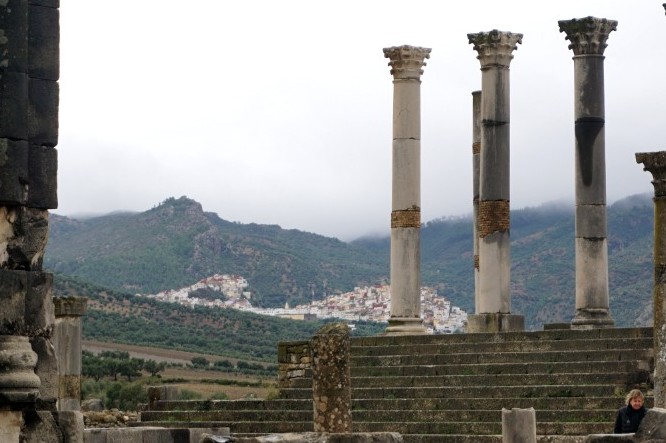
Twenty miles north of Meknes up a winding road we arrived at the Roman City of Volubilis, another World Heritage Site. Volubilis was the capital of the Roman Province of Mauretania. It thrived on the rich local soil producing grains and olive oil for the Empire. The area continues to provide Morocco with valuable export commodities. As we climb the hillside toward the extensive city we pass dozens of ruins admiring several homes with intricate floor mosaics. We top out at the Basilica, or governmental center.  The Catholic cathedral got its name and design from it. All around are pedestals with Roman inscriptions. Each held a statue. Volubilis must have been highly decorated in its prime.

A few minutes later the rain began to pour again, and we rushed wet and cold back to the entrance. There we perused the small museum loaded with artifacts found during excavation. No wonder the new Archeology Museum in Rabat had so many fine Roman specimens.

On a hillside in the distance we see the pilgrimage town of Moulay Idriss, looking like a two-humped camel. The town is named after the descendent of Mohammed buried there. In 789AD Idriss took refuge in Volubilis and went on to establish the first Kingdom of Morocco.

Our tour guide pointed out some of the local flora. One is the Oleander flower for which Volubilis is named. More interesting was the Carob Tree whose beans are so uniform they were used to weigh gold. A pure gold coin common in the Late Roman era weighed 24 Carob (or now Carat) seeds.

We drove back south stopping in Meknes for lunch. Aimee and I had Shish Kebab skewers of chicken with a dipping sauce.

After lunch we took the highway an hour east to the city of Fez. Fez is another of the four Royal Cities. Our first stop was at an overlook giving us a view of the oldest Medina of Fez. Fez hugs the river valley below.

October 27, 2018

October 27, 2018

We woke to a rainy day in the Moroccan capital city of Rabat. I guess it is justice we get rain on the edge of the Sahara Desert as we were blessed with rain-free holidays in usually damp Scotland and South America this year.

On our guided tour of this Unesco World Heritage city, we start at Dar-al-Makhzen, the Royal Palace of the king of Morocco. We are not allowed to get too close to this large residence. The Moroccan king’s dynasty can supposedly trace their lineage back to the Prophet Mohammed’s daughter Fatima.

Our next stop is Chellah, an old medieval fortified necropolis. Inside are some Roman and Phoenician ruins. There is also the ruins of a medieval 14th century mosque; its crumbling minaret is home to several giant stork nests.

Our next stop is at the Mausoleum of King Mohammed V. It contains the remains of the current king’s father and grandfather. It is a gleaming white edifice. Each of the four entrances is protected by a ceremonial guard in elaborate uniform. The street entrance is guarded by two horsemen.

Inside the same complex is Hassan Tower. This is an unfinished mosque begun in 1195. It was intended to be the largest in the world. Unfortunately the Caliph died shortly after construction began and the minaret remains half built. Its location on a hill makes it an icon of Rabat.

Dodging raindrops, we then head to the oldest section in Rabat known as the Kasbah of the Udayas. Kasbah is the Arabic term for castle or keep. It is located right where the local river enters the ocean. It was built in the 12th century by the Almohad Caliphate. Of particular interest are the narrow winding alleys white washed in blue. We take a break in a Moorish Cafe facing the sea. We order Coffee and Mint Tea with some almond and honey snacks.

It starts to rain again on the walk back to the bus. Seeking an indoor venue we have the bus drop us at the uninteresting Rabat Modern Art Museum. We breeze through it and head down the street to the Archaeological Museum. Morocco has a long history of invaders. The coast was colonized first by the Phoenicians who were then swept up by the Romans and subsequently the Vandals and Visigoths. In the 8th century came the Muslims of Arabia. The museum while small has some exquisite pieces from the Roman period.

The sun is beginning to shine, so we decide to walk back to the hotel taking the long way. Inside the 14th century Medina walls we discover a souk or Arabic market that seems to go on indefinitely. A Medina is the old section of an Arabic town. This souk is for locals so it is mostly filled with shoes, clothing, and household goods. There are quite a few vendors selling from open piles of spices. This is apropos as the Portuguese explored this coast on their way around Africa in search of a water route to India and the Spice Islands (Indonesia).

After a short break at the hotel, we took the tram across the river to the sister city of Salé and had dinner on the marina. Salé was infamous in the 17th and 18th century as one of the ports of the Barbary Pirates who raided European ships and terrorized coastal cities in search of loot, ransom, and slaves. Even Ireland was at risk. Kidnapped men were chained to oars while women were sent to harems as concubines. After finishing our first course, the sky opened up and poured on the first row of tables. I am thankful we were too late to get those premium dockside seats!

Saturday, October 27, 2018

October 25-26, 2018

October 25-26, 2018

We are embarking on a set of long overseas flights. This is the fourth big travel trip we are taking this year. That is unusual even for us. Earlier in the year, I passed a major milestone birthday. That event has given me pause making me think that if we are going to successfully see the world, we need to kick it up a notch. It is Autumn so that means we need to focus south. Aimee wants to add her sixth and most likely last continent (Antarctica is too cold for us), so we are headed to Africa.

After flying in the opposite direction for ninety minutes we change planes in LAX and board a non-stop to Paris. We have some clear skies at the beginning and I see the Queen Mary ocean liner at the Long Beach dock, Valley of Fire outside Vegas, and Coral Pink Sand Dunes in Utah. We are welcomed with a nice sunrise entering Paris. Almost like a miracle the clouds part and I spot the Eiffel Tower.

In Paris, we catch a three hour flight to Casablanca, the commercial center of Morocco. There we find our tour group and make our way ninety minutes up the coast to Rabat, the current capital of the independent Kingdom of Morocco. Along the way our tour manager talks of the various ways Morocco is successfully becoming one of the most western and tolerant of Muslim countries. This includes funding the religion with public money and tightly controlling the education and placement of peaceful Imams in Mosques. The government is undergoing massive housing infrastructure projects aimed at improving living conditions to side step discontent with the public. We see row after row of new apartment buildings.
Newer Posts Older Posts